
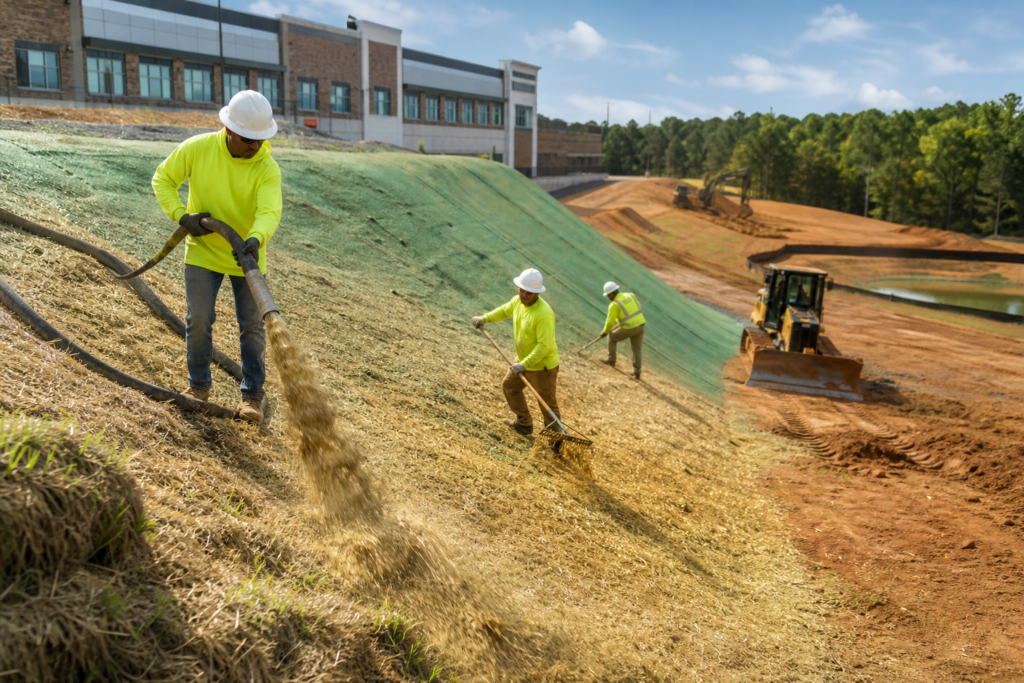
Seeding and mulching can help stabilize suitable disturbed soil on a Bethlehem construction project, but they are not a universal substitute for erosion and sediment control. The right approach depends on grades, drainage paths, slopes, soil and surface conditions, construction timing, final land use, and approved project requirements.
For developers, general contractors, public agencies, property managers, and engineering teams, the practical question is not simply whether to seed and mulch. It is how to coordinate vegetative stabilization with grading, stormwater drainage, roadway work, inspections, and other temporary or permanent controls.
What seeding and mulching does on a construction site
Seeding establishes vegetation on disturbed soil, while mulch helps protect the surface during establishment. Together, they can support longer-term ground cover on areas intended to remain vegetated, such as selected slopes, open areas, shoulders, or finished portions of a development.
The method is most suitable when the final grade is ready, the surface can support vegetation, runoff is managed, and the area will not immediately be re-disturbed by utilities, paving, building work, or additional earthwork. The final choice may also depend on approved plans, project specifications, weather, access, and required documentation.
Georgia guidance treats grassing, seeding, and mulching as part of a broader construction process. Georgia DOT specifications address grassing and mulching, while construction guidance calls for clearing, excavation, embankment work, finish grading, seeding, mulching, and other erosion-control measures to be coordinated with the contractor’s ability to keep stabilization current. See the Georgia DOT grassing specifications and related construction erosion-control guidance for official context.
Temporary erosion control versus final stabilization

Temporary erosion and sediment controls protect a site while construction is still changing the ground. Final stabilization addresses surfaces intended to remain after grading and construction are complete. These are related stages, but they are not interchangeable.
A project may need silt fence or inlet protection while earthwork continues, then use seeding and mulching or another permanent surface treatment after final grades are established. Erosion matting may be added where a slope needs more surface protection, while check dams may be appropriate for selected concentrated drainage paths.
Seeding and mulching alone may not control runoff from an active construction area, protect a downstream inlet, or manage concentrated flow. Effective erosion control combines source control, surface stabilization, sediment control, drainage protection, inspection, maintenance, and closeout documentation according to site conditions and approved requirements.
Compare seeding and mulching with other erosion-control measures
| Measure | Primary role | When it may fit | Important limitation |
|---|---|---|---|
| Seeding and mulching | Establishes vegetation while protecting soil during establishment | Finished or temporarily inactive areas intended to remain vegetated | Needs suitable conditions, time, protection, and follow-up |
| Hydroseeding | Applies seed and related materials as a slurry | Areas where the plan and access make spray application suitable | Still depends on preparation, protection, and follow-up |
| Erosion matting | Provides added surface protection | Exposed slopes or vulnerable surfaces | Must suit the slope, drainage, surface, and installation method |
| Silt fence | Intercepts sediment along selected perimeter or downslope areas | Locations where flow patterns support perimeter control | Does not control source erosion or concentrated flow alone |
| Inlet protection | Helps reduce sediment entering a stormwater inlet | Active construction near drainage inlets | Requires inspection, maintenance, access, and upstream controls |
| Check dams | Helps manage runoff energy in selected channels | Appropriate concentrated-flow locations | Requires site-specific selection and is not drainage design |
The appropriate combination depends on the approved plan, site conditions, sequence of work, and final surface. A useful decision is often not which measure is best, but which risks remain after the primary stabilization method is selected.
Five factors that should guide the choice
1. How long will soil remain exposed?
Short exposure, phased grading, and prompt stabilization can reduce the amount of soil available for runoff to move. If an area will remain open while other trades work nearby, temporary controls may be needed before final seeding and mulching.
2. Are slopes or concentrated flows involved?
Broad surfaces intended to remain vegetated may be evaluated differently from steep slopes, channels, roadway embankments, or areas receiving concentrated runoff. Vulnerable surfaces may require erosion matting, flow controls, drainage improvements, or other measures in addition to vegetative cover.
3. Where will stormwater travel?
Review swales, ditches, inlets, culverts, pipe systems, property edges, pavement limits, and downstream discharge points before choosing a stabilization method. Drainage decisions should account for grades, available space, utilities, access, and maintenance responsibilities. See this guide to stormwater drainage risks in Bethlehem.
4. What will the land become?
A surface intended to remain grassed has different stabilization needs from a future parking lot, roadway, building pad, utility corridor, or hardscape area. Seeding and mulching may suit one portion while another requires paving, structural drainage, temporary protection, or later restoration.
5. What does the construction sequence allow?
Stabilization should be scheduled around grading, utility installation, drainage work, paving, access, and inspections. Applying a final treatment too early can create rework, while delaying all protection can leave exposed soil unmanaged.
Coordinate stabilization with grading and stormwater drainage
Seeding and mulching decisions should follow a review of current survey information, proposed grades, drainage paths, utilities, pavement limits, building areas, and adjacent conditions. If the grade changes after stabilization, water may flow differently, finished surfaces may be disturbed, and previously protected soil may become exposed again.
A practical sequence is to confirm controlling plans and current conditions, establish the grading and drainage approach, identify areas that will remain vegetated, install required temporary controls, complete relevant earthwork and drainage work, prepare the surface, apply the selected stabilization, and assign inspection and maintenance responsibilities.
Before mobilization, review benchmarks, existing elevations, proposed contours, slopes, drainage structures, access points, and utility conflicts. The earthwork and grading checks for Bethlehem projects can help organize that review.
Georgia requirements to verify before work begins
Do not assume that seeding and mulching alone satisfies every requirement for a Bethlehem project. Verify the approved erosion and sediment control plan, applicable permits, required best management practices, inspection obligations, stabilization provisions, Georgia DOT specifications where relevant, and local Bethlehem or Barrow County requirements with the responsible professionals and agencies.
The Georgia Soil and Water Conservation Commission explains that erosion and sediment control requirements for land-disturbing activities are tied to state standards and best management practices. Georgia EPD also provides plan checklists and guidance for infrastructure and common development projects. Requirements can vary by project type, jurisdiction, disturbed area, discharge conditions, and agency review.
A contractor can help execute a defined scope, but the owner and responsible design or compliance professionals must confirm which plans, permits, approvals, and inspections apply. Keep approved documents and current revisions aligned with field work throughout construction.
Bethlehem project-readiness checklist
- Current site, grading, drainage, utility, and erosion-control plans, including revision dates.
- Project limits and disturbed areas, including slopes, channels, shoulders, or other surfaces requiring treatment.
- Existing and proposed grades, flow paths, drainage structures, inlets, outlets, and downstream connections.
- Areas intended to remain vegetated versus areas planned for pavement, buildings, utilities, hardscape, or future phases.
- Construction sequence, expected soil-exposure periods, access limitations, and planned earthwork or roadway operations.
- Required temporary controls, final stabilization measures, inspection frequency, maintenance responsibilities, and weather-response procedures.
- Applicable permits, approved plans, agency specifications, local requirements, testing expectations, and closeout documentation.
This information helps separate a straightforward stabilization scope from work that also requires grading corrections, drainage coordination, field verification, maintenance, or documentation support.
What to provide when requesting a quote
A useful quote request should identify the project location, owner or contracting party, work limits, current plans, disturbed-area quantities, intended final surfaces, access conditions, target sequence, and required deliverables. State whether the request concerns temporary stabilization, final stabilization, or both.
Also identify controls already installed and those still needed. If the project includes roadway work, stormwater systems, utilities, slopes, or multiple phases, explain how the requested scope connects to those activities. Pricing, quantities, materials, schedule assumptions, and maintenance needs should be confirmed for the specific site rather than estimated from a generic rate.
How DCBC LLC can support the broader civil site-work scope
DCBC LLC is a Georgia-based civil site work and roadway construction contractor. Its listed erosion-control capabilities include silt fence, seeding, mulching, inlet protection, check dams, and erosion matting, along with earthwork and grading and stormwater systems.
The company also lists support for commercial developments, residential subdivisions, roads and highways, and public infrastructure projects in Georgia. That broader scope can be relevant when stabilization must be coordinated with grading, roadway work, drainage, project documentation, or related civil site work. Any proposed scope, requirements, and pricing remain project-dependent.
Frequently asked questions
Is seeding and mulching enough for erosion control on a Bethlehem construction site?
Not necessarily. It may stabilize suitable disturbed soil, but an active site may also need source-control measures, silt fence, inlet protection, erosion matting, check dams, drainage work, inspections, and maintenance.
When should a project use hydroseeding instead of conventional seeding and mulching?
Hydroseeding may be considered where the project plan, surface preparation, access, and application conditions support slurry application. It is not automatically better and still requires appropriate grading, protection, and follow-up.
Do slopes or concentrated drainage flows require more than seeding and mulching?
They may. Steep or vulnerable slopes and concentrated-flow paths can require additional surface protection, drainage measures, or sediment controls. Review grades, flow paths, approved plans, and construction sequence before selecting treatment.
What information should I send a contractor for a seeding and mulching quote?
Send current plans, site limits, disturbed-area details, grades, drainage information, intended final surfaces, construction sequence, access constraints, required controls, inspection expectations, and documentation requirements.
Which Georgia requirements should be checked before disturbing soil in Bethlehem?
Confirm the applicable erosion and sediment control plan, permits, BMP requirements, inspection and stabilization provisions, Georgia DOT specifications where relevant, and local Bethlehem or Barrow County requirements.
How to choose the next step for your Bethlehem project
Seeding and mulching can be practical when the area is suitable for vegetation, grades are established, runoff is addressed, and the construction sequence allows the surface to remain protected. It should be evaluated as one part of a coordinated erosion and sediment control system.
Start by reviewing current plans, exposed areas, slopes, drainage paths, final land use, temporary controls, approval requirements, and maintenance responsibilities. Then request a scope review that separates seeding and mulching from grading, stormwater, roadway, erosion-control, inspection, or closeout work that must occur alongside it.
For a Bethlehem-area project, DCBC LLC invites developers, contractors, public agencies, property managers, and engineering teams to discuss seeding and mulching, erosion control, grading, stormwater, or related civil site work needs in Georgia.