
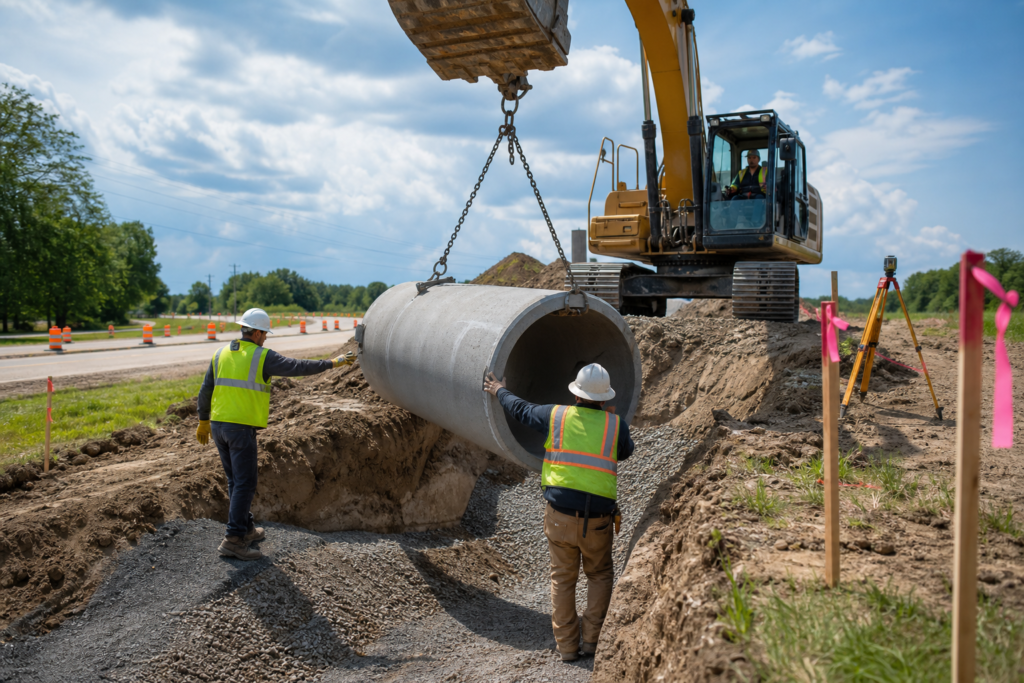
Reinforced concrete pipe installation should follow the approved plans, project specifications, and engineer direction, not a generic field recipe. The essential controls are confirming responsibilities before mobilization, preparing stable bedding, maintaining line and grade, inspecting joints and connections, and documenting the work before it is covered.
Pipe class, bedding details, joint systems, cover, slope, backfill, compaction, testing, and acceptance criteria must come from the contract documents. Georgia DOT Section 550 likewise directs storm drain pipe and related structures to be installed according to the specifications, plans, or Engineer’s direction.
Key Takeaways
- Confirm approved drawings, specifications, submittals, inspection authority, and change responsibilities before excavation.
- Verify layout, utilities, trench conditions, water control, and bedding readiness before setting the first pipe.
- Control every section for bearing, line, grade, invert continuity, joint condition, and connection details.
- Stop for inspection before backfill conceals the pipe, joints, structures, or defects.
- Assemble delivery records, inspection notes, testing records, photographs, approved changes, and as-built information.
1. Review the plans, specifications, and responsibilities
Begin by identifying pipe runs, structure locations, outlets, crossings, tie-ins, profiles, details, and limits of work. Confirm requirements for pipe type, jointing, bedding, foundation treatment, backfill, testing, erosion control, and restoration. A detail used on another project should not be treated as automatically applicable.
Assign responsibility for layout, utility coordination, material approvals, inspection requests, dewatering, traffic control, changes, testing, and closeout. On Georgia roadway or public infrastructure work, identify the applicable agency requirements and the person authorized to interpret the plans or approve a change. Georgia DOT certification is relevant when evaluating a contractor for transportation work, but it does not by itself confirm that every RCP scope, inspection, or documentation obligation is covered.
Before mobilizing, use the RCP installation checklist to organize contract requirements, joint details, delivery checks, bedding preparation, and inspection checkpoints.
2. Verify layout, utilities, and site conditions

Confirm the pipe centerline, structure locations, invert elevations, slopes, connection points, roadway crossings, and work limits in the field. Compare the layout with existing utilities, access routes, traffic-control limits, adjacent structures, and the planned sequence of grading and drainage work.
Establish a stop point for conditions that do not match the drawings. Examples include an unexpected utility, unavailable outlet, elevation conflict, unstable foundation, or structure location that cannot be built as shown. Record the discrepancy and obtain direction from the responsible design or inspection authority before changing slope, depth, pipe location, or connection details.
Field layout support can be useful when pipe installation must align with broader site grading and roadway work. DCBC LLC lists construction stakeout plans, grade calculations, and three-point level verification among its related consulting and virtual services.
3. Prepare the trench and bedding before pipe placement
The trench must provide a stable working area and enough room to place, joint, inspect, and support the pipe as required by the project documents. Address trench stability, groundwater, surface-water entry, unsuitable foundation material, access, and safe work procedures before placement begins.
Bedding is a structural control, not simply a leveling layer. TxDOT installation guidance states that bedding should use selected, compacted material conforming to the outside curvature of the conduit. For rigid reinforced concrete pipe, bedding irregularities cannot be accommodated like those of a flexible conduit, and bedding affects the required pipe strength.
Check that the foundation and bedding match the approved detail, are free of point-loading conditions, and are ready for inspection. This is a major hold point. If bedding is uneven, contaminated, excessively saturated, or inconsistent with the approved section, correct it before setting pipe.
4. Place and align each pipe section
Handle pipe with equipment and procedures that avoid cracking, chipping, joint damage, or uncontrolled movement. Confirm that each section is the correct type and length, then place it so the barrel has continuous support and the invert follows the approved line and grade.
After each section is positioned, verify alignment, elevation, bearing, orientation, and joint readiness. Watch for rocking pipe, concentrated bearing, displaced bedding, open joints, damaged bells or spigots, and invert discontinuity. A pipe that appears close to the intended position may still cause problems at a structure, outlet, roadway crossing, or downstream connection.
Stop when the pipe cannot be placed to the approved alignment, a joint will not close as specified, or the trench foundation changes. Reworking bedding or requesting direction is preferable to forcing a section into position and concealing the problem.
5. Control joints, connections, and related structures
Joint systems must match the approved submittal and project requirements. Depending on the design, the work may involve gaskets, mastic, mortar, sealants, tied joints, or other specified controls. Verify that contact surfaces are clean and that curing, wrapping, overlap, or restraint requirements are satisfied before covering the connection.
RCP rarely functions as an isolated component. The installation may connect with drop inlets, catch basins, manholes, flumes, spillways, slope drains, roadway crossings, or outlets. These components are not automatically interchangeable. Confirm structure elevations, opening sizes, pipe connections, flow direction, access requirements, and protection details against the plans.
DCBC LLC lists RCP installation services alongside HDPE, DIP, drop inlets, catch basins, flumes, spillways, manholes, slope drains, roadway crossings, and related civil site work. The listed scope can help with coordination, but the approved design remains the authority for selection and installation requirements.
6. Inspect before backfill and compaction
The inspection before concealment is one of the most valuable control points in the sequence. Before backfill, verify pipe line and grade, bedding contact, joint condition, connections, structure interfaces, visible damage, and required measurements or photographs.
Post-installation evaluation guidance for reinforced concrete pipe addresses concerns such as cracks, spalling, slabbing, and joint integrity. If any appear, record their location and characteristics and refer them to the qualified engineer, inspector, or authority identified in the contract. Do not patch, accept, or bury a potentially significant defect without the required review.
Inspection records should identify the pipe run or station, date, relevant site conditions, personnel present, observed issues, corrective action, and approval to proceed. Do not advance until required inspection points are released.
7. Place backfill and coordinate erosion control
Backfill protects the pipe and transfers surrounding loads, so its material, sequence, moisture condition, lift control, and compaction must follow project requirements. Place it without displacing the pipe, opening joints, damaging structures, or creating uneven loading. Protect completed work from construction traffic and uncontrolled water until required cover and stabilization are in place.
Coordinate trench backfill with the wider erosion and stormwater plan. Depending on the project, this may involve silt fence, inlet protection, check dams, seeding, mulching, erosion matting, slope drains, or other stabilization measures. Install, maintain, and adjust those measures as clearing, grading, pipe installation, and roadway work change flow paths and exposed areas.
Do not treat erosion control as a final cleanup item. An open trench, stockpile, disturbed slope, or newly connected inlet can change how water moves through the site before permanent stabilization is complete.
8. Choose the right delivery model
The best delivery model depends on complexity, inspection structure, equipment needs, public-agency requirements, and documentation demands.
| Model | When it may fit | Control to establish |
|---|---|---|
| Contractor-led | Coordinated excavation, pipe placement, structures, erosion control, and field supervision. | Define scope, approved submittals, inspection releases, testing, and change authority. |
| Owner-led | An experienced organization has qualified staff, equipment, inspection access, and records responsibility. | Assign competent supervision and cover technical review and acceptance. |
| Hybrid | Field construction is combined with layout, estimating, grade verification, or as-built support. | Document handoffs so measurements, changes, approvals, and final records remain consistent. |
DCBC LLC identifies itself as a Georgia-based civil site work and roadway construction contractor with Georgia DOT certification. Its listed support includes RCP and related drainage work, construction stakeout plans, grade calculations, estimation and takeoff, and GDOT as-built GIS submittals. These services may suit projects needing field execution and supporting documentation, subject to the agreed scope.
9. Assemble the acceptance and closeout package
Closeout requirements are controlled by the contract and reviewing authority, but teams should generally organize approved submittals, delivery records, layout and elevation records, inspection reports, joint notes, defect evaluations, testing or compaction records where required, structure information, photographs, approved changes, and as-built data.
Compare the final installation with the approved drawings before declaring the work complete. Confirm that changes were authorized, outlets and structures are documented, disturbed areas are stabilized, and inspection comments are resolved. For public or GDOT-related work, verify the required format and submission path for as-built information.
RCP installation field checklist
- Documents: Plans, specifications, submittals, permits, inspection responsibilities, and change procedures are available.
- Materials: Pipe, joints, bedding, backfill, structures, and accessories match approved requirements.
- Site readiness: Utilities, access, trench limits, water control, foundation conditions, and safety procedures are addressed.
- Layout: Centerline, inverts, slopes, structures, outlets, crossings, and tie-ins are verified.
- Bedding: The foundation and bedding are stable, clean, correctly shaped, and inspected.
- Placement: Each section has the required bearing, line, grade, orientation, and joint preparation.
- Connections: Joints, structures, outlets, and related drainage components match the plans.
- Pre-backfill inspection: Defects, joint conditions, alignment, bedding contact, and interfaces are recorded and released.
- Backfill and stabilization: Placement, compaction, traffic protection, erosion control, and restoration follow requirements.
- Closeout: Inspection records, testing, photographs, changes, approvals, and as-built information are assembled.
Frequently asked questions
When should RCP bedding be inspected?
Inspect bedding after trench preparation and immediately before the first pipe section is placed. Confirm that it matches the approved detail, provides continuous support, and is not affected by unsuitable material or uncontrolled water.
What RCP defects should trigger review?
Cracks, spalling, slabbing, damaged joint surfaces, separated joints, unexpected movement, poor bearing, and alignment problems should be recorded and referred for qualified review. The response depends on the contract, defect severity, pipe location, and engineer direction.
Is geotextile wrap required for every RCP installation?
No universal answer applies. Use geotextile wrap only when the plans, specifications, approved submittal, or site-specific conditions require it. The project documents govern.
What should be checked before RCP is covered?
Check line and grade, bedding contact, pipe condition, joints, connections, structure interfaces, visible defects, required measurements, and inspection documentation. Release the work only after the responsible authority completes the required review.
How should RCP installation coordinate with drop inlets and catch basins?
Coordinate structure locations, rim and invert elevations, pipe connections, flow direction, access, excavation sequence, and backfill requirements. Confirm every connection against the approved plans.
Conclusion
Good RCP installation is a controlled sequence from document review through acceptance. Confirm requirements, verify layout, prepare and inspect bedding, control placement and joints, coordinate connected drainage work, and stop before backfill whenever a condition needs review.
For Georgia commercial, residential subdivision, roadway, and public infrastructure work, DCBC LLC provides civil site work, RCP-related drainage construction, and supporting services such as stakeout plans, grade calculations, estimation and takeoff, and GDOT as-built GIS submittals. Request a project-specific scope before mobilization.