
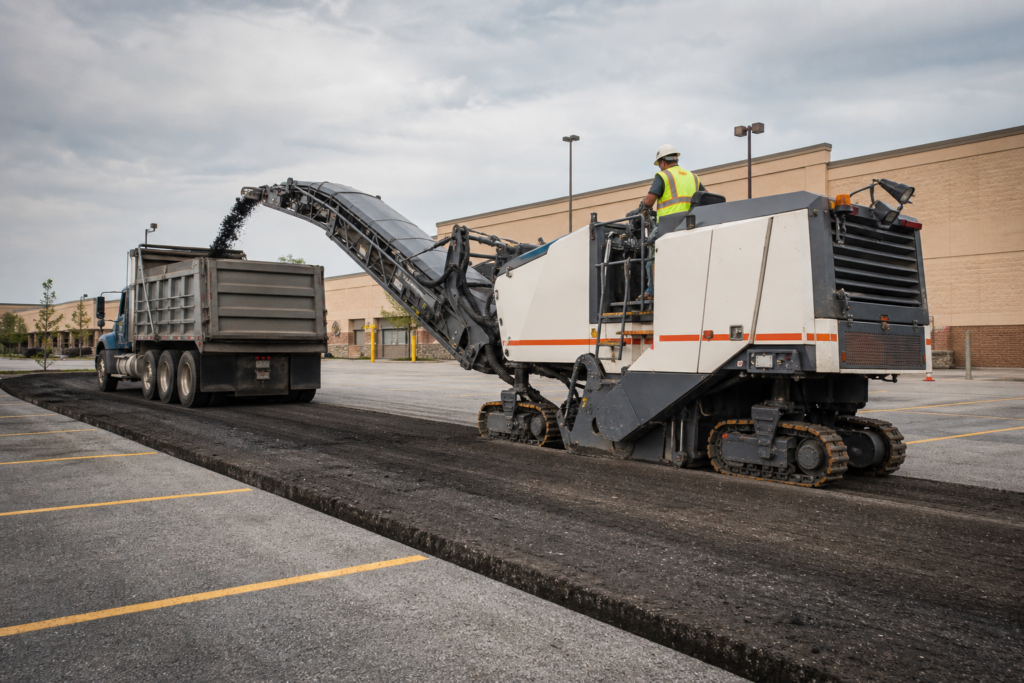
Asphalt milling techniques are methods for removing or profiling existing asphalt to a planned depth and shape before resurfacing, pavement repair, or related roadway work. The right method depends on the condition of the pavement, required grades, drainage features, tie-ins, traffic requirements, and project specifications.
Milling is not simply the act of removing asphalt. It is a controlled operation that can adjust elevations, correct selected surface defects, prepare a textured bonding surface, and help a new overlay meet curbs, drives, structures, or adjoining pavement. The technique must match the problem being solved.
Key Takeaways
- Asphalt milling techniques include conventional milling, micro-milling, and controlled-depth milling, each serving distinct purposes.
- Conventional milling is ideal for surface distress and elevation adjustments, while micro-milling offers a more controlled surface texture.
- Proper milling techniques can enhance the longevity of asphalt surfaces and improve drainage features.
- Understanding the specific project requirements is crucial for selecting the appropriate milling method.
- DCBC LLC offers comprehensive asphalt milling and civil site work services across Georgia.
Quick summary

- Conventional milling removes a planned portion of asphalt to address surface distress, irregularities, elevations, or overlay preparation.
- Micro-milling creates a more closely controlled surface texture when the project specifications call for it. It is not automatically appropriate for every parking lot or roadway.
- Selective or controlled-depth milling uses different limits or depths in specific areas such as transitions, curb lines, inlets, manholes, and pavement tie-ins.
- Milling can address some surface and profile problems, but failed base materials, major drainage problems, or extensive structural damage may require broader repairs or reconstruction.
- A good proposal should define milling limits, depth, grade controls, material handling, traffic control, surface inspection, and closeout documentation.
What Is Asphalt Milling?
Asphalt milling, also called cold planing or pavement profiling, uses a milling machine to remove a specified portion of an existing asphalt pavement. The machine can control the removal depth, longitudinal profile, and cross slope, leaving a textured surface that may be cleaned and prepared for an asphalt overlay. The Federal Highway Administration’s pavement guidance describes this relationship between controlled removal, surface profile, cleaning, tack coating, and overlay preparation.
Georgia transportation specifications also illustrate why equipment and controls matter. For applicable work, the Georgia Department of Transportation specifies power-driven, self-propelled milling equipment with grade and slope controls, conveyors, and the ability to remove asphalt to a specified depth with stated accuracy. Those requirements should not automatically be treated as universal rules for every private pavement project, but they show the level of control that transportation work may require.
For a step-by-step explanation of preparation, cutting, material handling, sweeping, and field checks, review the asphalt milling process. In practical terms, the goal is to remove the right material while preserving or establishing the profile needed for the next stage of construction.
Asphalt Milling Techniques Compared

The terms below describe useful distinctions, but they are not interchangeable project specifications. Actual milling limits, depths, texture requirements, and tolerances should come from the plans, engineer, owner, or agency requirements.
| Technique | Primary purpose | Surface or profile emphasis | Questions to confirm |
|---|---|---|---|
| Conventional milling | Remove a planned portion of pavement before repair or resurfacing | Correct surface irregularities, selected distress, elevations, or tie-ins | What depth, width, profile, and overlay preparation are required? |
| Micro-milling | Create a more closely controlled texture or profile where specified | Uniform texture and closely managed surface characteristics | Is a test section, approval, or special texture requirement included? |
| Selective or controlled-depth milling | Address specific areas or transitions without treating the entire pavement identically | Targeted adjustments at curbs, structures, edges, drives, or distressed areas | How will limits, grades, transitions, and field changes be verified? |
Conventional Milling for Surface Removal and Reprofiling
Conventional milling may fit a project that needs to remove distressed or irregular surface material, adjust finished elevations, improve a pavement transition, or prepare an existing surface for an overlay. The process can also help address selected rutting, corrugations, shoving, bleeding, raveling, shoulder drop-offs, cross-slope concerns, and curb-reveal issues when the underlying pavement structure remains suitable.
The machine removes asphalt in a planned pass or series of passes. A conveyor transfers the milled material into haul trucks, while the exposed pavement is swept and inspected. The material may be hauled away, stockpiled, or considered for approved reuse depending on the contract and project requirements.
Conventional milling does not eliminate the need to inspect what is exposed. If milling reveals unsuitable material, deeper cracking, weak subgrade, or a failed base, the project team may need to revise the repair scope before paving continues.
Micro-Milling for a More Closely Controlled Surface Texture
Micro-milling is a specialized milling approach used when the project calls for a particular texture, profile, or surface condition. It is generally associated with more closely controlled surface characteristics than a typical removal pass, so the equipment setup, cutting pattern, test section, and acceptance criteria can be important.
Georgia DOT special provisions for micro-milling demonstrate this point. They describe a test section, a uniformly textured surface and cross section, and specific texture measurements that must be approved or achieved for the applicable work. These provisions belong to the relevant project requirements, not to every private parking lot or roadway.
Before selecting micro-milling, confirm why the specified texture is needed, what approval process applies, and how the finished surface will be measured. A contractor should be able to explain the relationship between the requested texture, the planned overlay or final surface, and the project’s acceptance criteria.
Selective and Controlled-Depth Milling at Transitions and Problem Areas
Not every part of a pavement needs the same milling treatment. Selective or controlled-depth milling may use different limits or depths to manage transitions at curbs, driveways, ramps, manholes, catch basins, inlets, pavement edges, roadway crossings, and adjoining surfaces.
This approach is especially relevant when finished elevations must be preserved. Removing too little material may leave an uneven transition or create problems with the proposed overlay. Removing too much may affect drainage, reveal structures, or expose layers that were not intended to be disturbed.
The limits should be based on plans, field measurements, existing pavement thickness, grade information, and inspection. A contractor should not assume that a standard depth works uniformly across a commercial lot, subdivision street, or public roadway.
When Is Milling the Right Choice?
Milling is generally most useful when the problem is concentrated in the asphalt surface or when existing elevations need to be adjusted before new paving. FHWA identifies cold planing as a method that can address surface defects such as raveling, bleeding, rutting, corrugations, shoving, shoulder drop-offs, cross-slope concerns, and curb-reveal adjustments.
It may be appropriate when:
- The wearing surface is distressed but the supporting pavement remains suitable for rehabilitation.
- An overlay would otherwise raise elevations too close to curbs, structures, drives, or drainage features.
- Existing pavement irregularities must be removed before resurfacing.
- A transition or tie-in needs a planned profile rather than a simple overlay edge.
- Contamination, raveling, or surface deterioration would prevent a uniform treatment.
Milling is not a substitute for correcting a failed base, unstable subgrade, major drainage deficiency, or extensive structural cracking. Before a surface treatment is applied, the team should identify areas requiring full-depth repair, stabilization, grading, or drainage work. Surface preparation guidance also highlights the need to address contamination, cracks, potholes, and failed areas before applying a treatment.
Milling, Overlay, or Reconstruction?
Choosing among these options requires more than comparing the names of treatments. The decision should account for pavement condition, supporting layers, finished elevations, drainage, traffic access, tie-ins, and the intended service of the pavement.
| Possible scope | When it may fit | What still needs review |
|---|---|---|
| Overlay after preparation | The existing pavement and supporting conditions are suitable for a new surface. | Surface repairs, grades, drainage, edges, access, and overlay thickness. |
| Milling followed by overlay | Existing asphalt must be removed or adjusted before resurfacing. | Milling depth, profile, transitions, exposed conditions, and paving sequence. |
| Selective milling with broader paving work | Only certain areas need removal or elevation adjustment while other areas can receive related treatment. | Limits, tie-ins, drainage structures, traffic phases, and quantity changes. |
| Deeper repair or reconstruction | The base, subgrade, drainage system, or structural pavement has failed or requires substantial correction. | Excavation limits, replacement materials, grading, drainage, stabilization, and testing. |
Choosing between asphalt milling versus overlay depends on what the project must correct. In some cases, milling and overlay are complementary rather than competing options. In others, neither surface treatment addresses the underlying cause.
What the Asphalt Milling Process Looks Like on Site
- Review existing conditions. Document pavement distress, thickness information where available, grades, drainage features, access requirements, and adjoining surfaces.
- Define limits and controls. Establish the milling areas, proposed depths, profile, cross slope, transitions, and grade-control method.
- Set traffic control. Plan vehicle movement, pedestrian protection, deliveries, temporary closures, signage, and work phasing.
- Mill the pavement. The machine removes the specified asphalt while conveyors transfer material to trucks or another approved handling area.
- Sweep and inspect. Remove loose material and inspect the exposed surface for defects, unsuitable material, drainage concerns, and unexpected conditions.
- Verify the result. Check grades, slopes, transitions, milling limits, and surface condition against the project requirements.
- Prepare for the next treatment. Complete repairs, tack coating, paving, or another approved treatment according to the construction sequence.
Noise, vibration, dust, truck movements, and temporary access interruptions are normal operational considerations. The project schedule and traffic plan should explain how those impacts will be managed for a commercial property, roadway, subdivision, or public facility.
Site Factors That Can Change the Milling Scope
Drainage features deserve particular attention. Milling changes pavement elevations, so the team should review how the proposed surface relates to catch basins, drop inlets, manholes, pipes, slope drains, curb lines, and discharge paths. Milling alone cannot solve a drainage system that is undersized, blocked, poorly graded, or otherwise defective.
Other scope-changing factors include driveway and ramp transitions, pavement edges, adjacent concrete, traffic phases, utility structures, access to occupied buildings, and the thickness of the existing asphalt. A parking lot may require coordination with striping, signs, wheel stops, and accessible routes. A roadway may require turn lanes, acceleration or deceleration lanes, agency controls, and more detailed documentation.
What to Request Before Hiring an Asphalt Milling Contractor
Use this checklist when reviewing a proposal or preparing a scope of work:
- Defined milling limits, proposed depth, width, profile, and transition details.
- The method for controlling grade and slope, including survey, stakes, machine controls, or field verification.
- Applicable tolerances, testing requirements, inspection responsibilities, and acceptance criteria.
- A traffic-control plan covering vehicles, pedestrians, deliveries, closures, and temporary access.
- Material-handling details explaining whether reclaimed asphalt will be hauled away, stockpiled, or considered for approved reuse.
- Sweeping and cleaning requirements before inspection, tack coating, or paving.
- A process for handling unsuitable soil, weak base, deeper cracking, or other conditions exposed during milling.
- The paving sequence and how the contractor will protect the milled surface if paving does not immediately follow.
- Closeout records such as quantity documentation, grade verification, photographs, test results, and required agency or owner submittals.
- Evidence of relevant qualifications, including Georgia DOT certification where the project requires or benefits from applicable transportation experience.
Coordinating Milling With Broader Civil Site Work
Milling is often one part of a larger pavement or site-development scope. It may need to be coordinated with asphalt paving, earthwork and grading, stormwater systems, erosion control, striping, signage, takeoff, and project documentation.
DCBC LLC provides asphalt paving and milling for parking lots and roadway-related work, along with civil site work, earthwork and grading, stormwater systems, erosion control, paint striping and signs, and estimation and takeoff. Its supplied project information also describes scopes that combine milling with unsuitable-soil removal, subgrade preparation, asphalt paving, striping, and related site improvements. You can review examples of how these elements may fit together in broader asphalt milling and overlay project scopes.
Frequently Asked Questions About Asphalt Milling Techniques
Is asphalt milling the same as cold planing?
They are commonly used for the same basic operation: removing a portion of existing asphalt to a planned depth. The exact terminology may vary by agency, specification, contractor, or project document, so the defined scope and acceptance requirements matter more than the label.
Can asphalt milling fix drainage problems?
Milling can adjust pavement elevations or improve a transition that affects surface flow, but it cannot replace a defective drainage system. Inlets, pipes, catch basins, slopes, and discharge paths should be evaluated before deciding that surface milling will solve ponding or runoff concerns.
When should a project use milling and overlay together?
That combination may fit when existing asphalt must be removed or adjusted to establish suitable elevations, transitions, or surface conditions before new asphalt is placed. The decision depends on pavement and base condition, grades, drainage, tie-ins, and the proposed paving section.
What should a contractor verify after milling?
The contractor should verify the milled limits, depth, profile, cross slope, transitions, exposed surface condition, drainage interfaces, and cleanliness required for the next treatment. The specific measurements and documentation should follow the project plans or applicable specifications.
Does micro-milling apply to every parking lot or roadway project?
No. Micro-milling is a specialized option that may be required for a particular texture or profile. If the project includes special provisions, confirm whether a test section, engineer approval, texture measurement, or other acceptance step applies.
Conclusion: Match the Milling Technique to the Pavement Problem
The best asphalt milling technique is the one that matches the material being removed, the required profile and elevation, the condition of the supporting pavement, and the project’s drainage, access, tie-in, and documentation requirements. Conventional milling, micro-milling, and controlled-depth milling serve different purposes, while overlay or deeper reconstruction may be more appropriate when the underlying problem extends beyond the surface.
For a project-specific discussion of asphalt paving and milling, grading, stormwater, erosion control, striping, or related civil site work in Georgia, request a quote from DCBC LLC.