
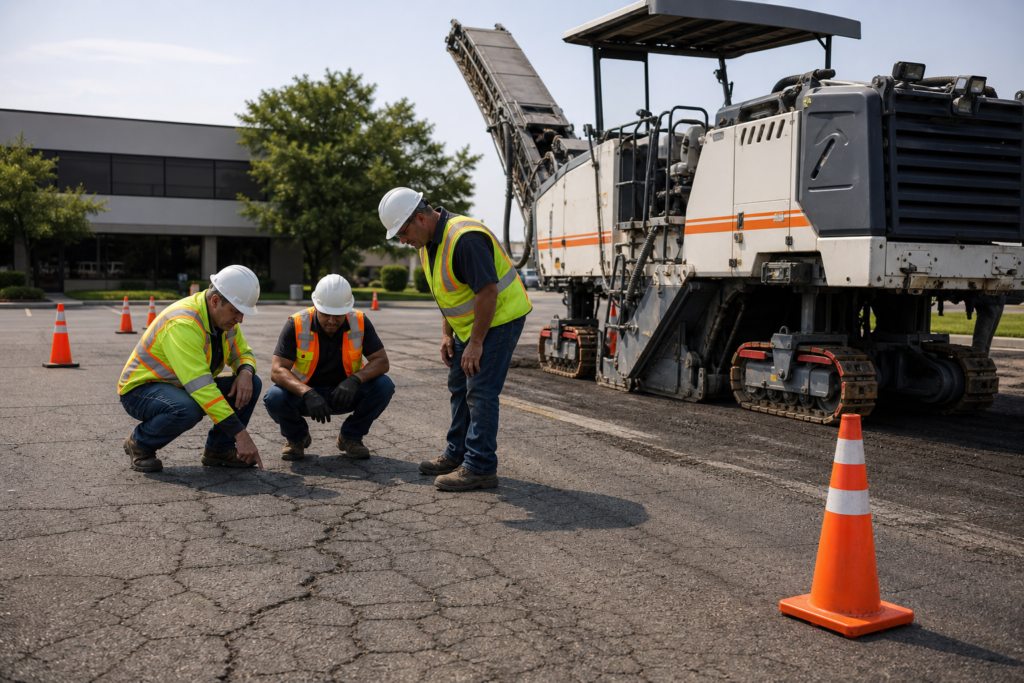
Choosing between asphalt repair, sealcoating, milling, resurfacing, and reconstruction should begin with pavement condition, not the treatment name. Cracks, potholes, standing water, settlement, weak subgrade, and worn markings can point to different scopes of work.
Asphalt paving maintenance is more than improving the visible surface. Georgia DOT describes pavement preservation as planned work intended to maintain serviceability and slow deterioration without increasing structural capacity. That distinction helps property owners, developers, contractors, and public agencies decide whether they need routine maintenance or a deeper correction. Georgia DOT’s pavement evaluation guidance provides useful context.
Key Takeaways
- Inspect pavement conditions thoroughly before selecting a treatment to ensure the right approach.
- Sealcoating is not a substitute for repairs; it is meant for sound surfaces needing maintenance.
- Understand the differences between milling and resurfacing versus other maintenance options.
- Request detailed quotes that outline the scope of work, including preparation and traffic control measures.
- Gather comprehensive site information to facilitate accurate assessments and proposals.
What Asphalt Paving Maintenance Can Include
Maintenance can range from preservation treatments to work that renews or rebuilds pavement. Georgia DOT maintenance materials distinguish crack sealing, patching, base repair, overlays, and mill-and-inlay as separate treatments. Each addresses a different condition, so a proposal should explain why the recommended scope fits the site. Georgia DOT’s maintenance treatment definitions are a useful reference, but they are not a project-specific specification.
For routine maintenance, first determine whether the pavement remains suitable for a surface treatment. A property owner may be considering parking lot sealcoating for surface upkeep, but failed sections, drainage concerns, or extensive cracking may require a different scope first.
More substantial work may include localized patching, replacement of unsuitable soil, subgrade preparation, asphalt paving, milling and overlay, or broader reconstruction. DCBC LLC’s verified project information includes these types of asphalt and preparation scopes, along with pavement striping and wheel stop installation.
Compare the Main Asphalt Maintenance Options

The table below is a decision framework, not a construction specification. Actual treatment selection depends on pavement condition, support, drainage, grades, traffic, design requirements, and field verification.
| Treatment | May be appropriate when | It does not solve | Confirm before selecting |
|---|---|---|---|
| Sealcoating | The surface is generally sound and needs a maintenance treatment. | Structural failure, severe settlement, failed base, or significant drainage problems. | Surface condition, repairs, preparation, access, and whether markings must be restored. |
| Crack sealing | Cracks are suitable for sealing as part of a planned maintenance scope. | Broad pavement failure, unstable areas, or problems caused by unresolved movement or water. | Crack type, repair limits, preparation, material, and follow-up pavement work. |
| Patching or base repair | Damage is localized and the affected pavement or support can be corrected. | Widespread deterioration or site-wide grade and drainage deficiencies. | Removal limits, replacement depth, subgrade condition, compaction, and tie-ins. |
| Milling and resurfacing | The surface needs renewal and the underlying pavement can support an overlay after preparation. | Unresolved subgrade failure, major settlement, or drainage problems below the milled surface. | Milling depth, profile, transitions, grades, overlay thickness, material handling, and acceptance checks. |
| Reconstruction | Surface, base, subgrade, grades, or drainage require broader correction. | Nothing automatically. The scope still needs site investigation and design coordination. | Removal, earthwork, drainage, subgrade preparation, pavement section, phasing, and documentation. |
When surface deterioration is too extensive for routine maintenance, the asphalt milling process may prepare pavement for a new overlay. Milling limits, grade checks, tie-ins, and the handling or reuse of milled material should be defined in the proposal rather than assumed.
Inspect Pavement Condition Before Choosing a Treatment
A useful inspection records patterns, not just isolated defects. Walk or drive the entire paved area and note where damage occurs, whether it is spreading, and whether it corresponds with drainage paths, heavy traffic, utility cuts, entrances, or transitions.
- Cracking: Record location, extent, width, and pattern. Repeated or interconnected cracking may require more investigation than isolated cracks.
- Potholes and failed areas: Mark locations where pavement has broken apart, raveled, or lost support. Ask whether repairs include the underlying base.
- Rutting and settlement: Note wheel-path depressions, uneven transitions, low areas, and settlement near structures or utility work.
- Surface wear: Identify oxidation, raveling, polished areas, loose aggregate, and inconsistent surface treatment.
- Standing water: Photograph ponding after rain if possible and identify whether it relates to blocked inlets, low grades, or pavement depressions.
- History: Gather information about previous paving, milling, repairs, sealcoating, utility work, flooding, and changes in traffic use.
Annual inspection is specifically required in some engineered-control contexts, where checks may include settlement, asphalt condition, and cracks. That does not create a universal maintenance interval for every property, but it reinforces the value of documenting changing conditions. Georgia EPD inspection guidance provides an example of this type of condition review.
Review Drainage, Grading, and Subgrade Conditions
Water and pavement performance are closely connected. Runoff that reaches failed edges, collects in low areas, or travels through cracks can make a surface-only treatment incomplete. A grade change can also affect pavement quantities, tie-ins, entrances, and the way water reaches stormwater structures.
Review catch basins, drop inlets, manholes, flumes, spillways, slope drains, roadway crossings, and other drainage interfaces near the paved area. Also look for erosion, exposed soil, washouts, clogged inlets, and slopes that direct water toward pavement or adjacent property.
If settlement or recurring water problems are present, ask whether earthwork and grading, stormwater systems, erosion control, or subgrade preparation should be evaluated alongside asphalt work. Treating a visible depression without addressing its cause can leave the owner comparing incomplete proposals.
Coordinate Striping, Signs, Access, and Site Features
Maintenance planning should account for what must be removed, protected, temporarily relocated, or replaced. Parking stalls, crosswalks, accessible markings, traffic signs, wheel stops, speed-control features, and highway signs can affect scope and reopening.
For an occupied commercial property, document operating hours, delivery routes, emergency access, pedestrian paths, tenant needs, and preferred work phases. Ask how milling, paving, curing, striping, and temporary traffic control will affect access. A lower-priced proposal may not be comparable if it assumes unrestricted access or excludes traffic-control measures.
Turn lanes and acceleration or deceleration lanes require attention to transitions, grades, markings, and traffic management. DCBC LLC lists asphalt paving and milling, striping and signage, wheel stops, grading, stormwater, and erosion control among its capabilities, allowing related scopes to be discussed together when broader coordination is needed.
How to Compare Asphalt Maintenance Quotes
Request itemized proposals that make the treatment and its limits clear. Each quote should identify what the contractor observed, what work is included, and what conditions would require a change order or separate scope.
- Condition and preparation: Ask whether cleaning, crack preparation, patching, vegetation removal, failed-area excavation, or subgrade work is included.
- Quantities and limits: Confirm pavement area, repair quantities, milling depth and width, overlay assumptions, edges, tie-ins, and transitions.
- Drainage interfaces: Identify whether inlets, manholes, slopes, ponding areas, erosion, or stormwater connections are included or excluded.
- Materials and handling: Ask how removed or milled asphalt will be stockpiled, recycled, hauled, or disposed of.
- Traffic and access: Review phasing, closures, signage, pedestrian protection, delivery coordination, and temporary access.
- Final site features: Confirm striping, accessible markings, crosswalks, signs, wheel stops, and other items to be restored.
- Verification: Ask how grades, profiles, quantities, surface preparation, and completed work will be checked and recorded.
- Exclusions and closeout: Require a written list of exclusions and identify photographs, reports, as-builts, or acceptance documents needed at completion.
For public or Georgia DOT-related work, confirm documentation and acceptance requirements before mobilization. A contractor’s general maintenance description is not a substitute for project documents, agency requirements, or direction from the responsible design professional.
Information to Gather Before Requesting a Quote
A contractor can evaluate a project more efficiently when the initial request includes practical site information. Send the following where available:
- Property address, approximate paved area, site plan, and photographs.
- Pavement age, previous paving or milling records, repair history, and known utility work.
- A marked-up plan showing cracks, potholes, settlement, ponding, failed sections, and erosion.
- Drainage concerns, flooding history, blocked inlets, or runoff crossing pavement.
- Operating hours, traffic patterns, delivery needs, and access restrictions.
- Required parking stalls, accessible markings, crosswalks, signs, wheel stops, or roadway features.
- Whether you want standalone maintenance or a coordinated proposal involving grading, stormwater, erosion control, or other civil work.
- Required schedule, phasing, public-agency documentation, or closeout records.
When to Request a Broader Civil Site Work Review
Ask for broader review when pavement defects occur with drainage failures, settlement, erosion, unsuitable soil, major grade changes, utility conflicts, or extensive reconstruction. The same applies when a parking lot or roadway project is part of a larger development, subdivision, public-infrastructure, or site-completion package.
DCBC LLC provides civil site work that includes asphalt paving and milling, earthwork and grading, stormwater systems, erosion control, striping, signage, and wheel stops. The company also lists estimation and takeoff services for asphalt, earthwork, storm, sewer, water, landscape, hardscape, and related trades. These capabilities may be relevant when maintenance must be coordinated with other site work, but the appropriate treatment still depends on project-specific conditions.
Frequently Asked Questions
Is sealcoating enough for damaged asphalt?
Not necessarily. Sealcoating may suit a generally sound surface that needs maintenance, but it should not be treated as a repair for failed pavement, major settlement, weak subgrade, or unresolved drainage problems. Define repairs before comparing coating proposals.
When should a parking lot be milled and resurfaced instead of repaired?
Milling and resurfacing may be considered when the surface is deteriorated but the pavement structure, grades, drainage, and tie-ins can support an overlay after preparation. Localized failures may need patching, while widespread structural or subgrade problems may require reconstruction.
Should drainage problems be fixed before asphalt resurfacing?
Drainage concerns should be evaluated before resurfacing because a new surface may not correct ponding, settlement, blocked structures, or runoff-related erosion. The proposal should state whether drainage and grading work is included, coordinated separately, or excluded.
What should an asphalt maintenance quote include?
It should identify treatment type, preparation, repair limits, quantities, milling depth if applicable, overlay assumptions, traffic control, material handling, drainage interfaces, striping, exclusions, verification, schedule, and closeout documentation.
Does asphalt maintenance include parking lot striping and wheel stops?
It can, but these items are not automatically included in every pavement proposal. List parking stalls, crosswalks, accessible markings, traffic signs, wheel stops, and related features in the request and confirm whether removal, replacement, and layout are included.
Conclusion: Match the Treatment to the Pavement Condition
The right asphalt paving maintenance decision starts with evidence from the site. Inspect the pavement, document cracking and failed areas, review drainage and grades, consider subgrade conditions, and identify access and marking requirements before choosing sealcoating, crack sealing, patching, milling and resurfacing, or reconstruction.
Then compare complete proposals rather than treatment names or price alone. A useful quote explains preparation, limits, quantities, exclusions, traffic control, related civil work, verification, and closeout records. Gather pavement history, approximate area, visible defects, drainage concerns, access constraints, and desired scope before requesting an evaluation.
DCBC LLC provides quote-based civil site work and related asphalt paving, milling, grading, stormwater, erosion-control, striping, signage, and estimation services for projects in Georgia.