
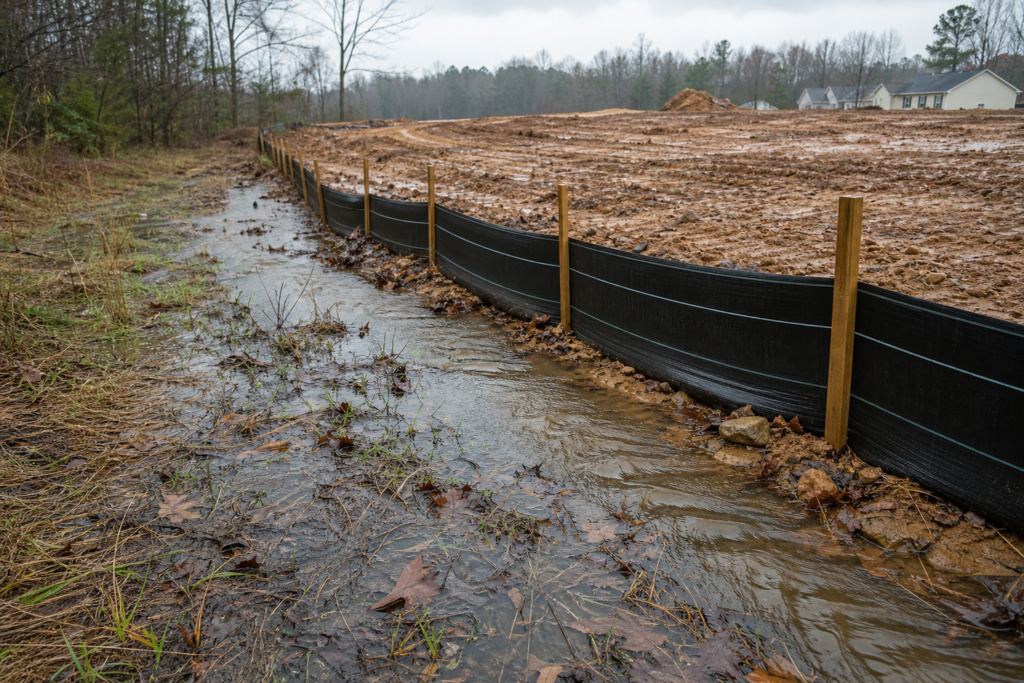
Silt fence can perform well on a Bethlehem construction site when it is used for its intended purpose: slowing sediment-laden sheet flow from disturbed ground. It is not a standalone drainage system, flood-control measure, or solution for water concentrated in a ditch or channel. Performance depends on the approved project plan, flow path, placement, installation condition, inspection, maintenance, and coordination with other controls.
Georgia’s erosion and sediment-control requirements and the site-specific plan control the final decision. The guidance below is a practical way to identify performance risks before mobilization and organize better questions for the project team.
What Silt Fence Is Designed to Do
Silt fence is a temporary sediment barrier. Its basic job is to intercept sediment carried by sheet flow from disturbed soil, allowing sediment to settle before runoff leaves the work area. Georgia guidance describes this intended use and identifies approved silt fence fabrics through GDOT’s Qualified Products List 36. Georgia’s erosion and sediment-control guidance should be read alongside current project requirements, approved plans, and applicable permits.
Sheet flow is relatively shallow runoff moving across a broad surface rather than through a defined channel. For example, rainfall may move downslope from a recently graded area toward the edge of a site. A properly planned barrier can slow that movement and retain sediment, but it does not eliminate runoff or make an unstable slope safe.
That distinction matters on commercial developments, residential subdivisions, roadway work, and public infrastructure projects. Erosion and sediment control must be coordinated with grading, drainage, construction entrances, utilities, access routes, stabilization, and the sequence of earthwork.
Where Silt Fence Performance Breaks Down

The most important question is not simply whether a site has silt fence. It is whether the fence is receiving the kind of flow it was selected to manage. Georgia field guidance states that silt fences should not be used in concentrated channel flow situations and should not replace check dams in ditches.
Performance commonly declines when water runs around the end of a fence, passes beneath it, overtops it, or cuts a channel through or behind it. These problems can result from changing grades, a new drainage path, an overloaded control area, disturbed soil extending beyond the planned boundary, or a storm that changes how runoff reaches the barrier.
Concentrated flow creates a different hydraulic condition. Water moving through a ditch, swale, pipe outlet, roadway channel, or defined drainage path may require another control or a coordinated system of controls. Silt fence alone may be damaged, overtopped, or bypassed in these locations.
Temporary controls also do not replace permanent drainage planning. Silt fence should be evaluated as one of several temporary erosion controls, not as a substitute for permanent drainage planning.
Placement and Installation Checks That Affect Performance
Before judging whether a fence is working, confirm that it was placed where the plan expects sediment-laden sheet flow to be intercepted. Review current drawings, revisions, disturbed-area limits, existing and proposed grades, drainage paths, access points, outlets, and adjacent properties. A fence at the wrong edge of a work area cannot perform as intended, even if the fabric appears intact.
Review the flow path
- Does runoff approach the fence as sheet flow, or has it become concentrated?
- Are the ends addressed by the approved plan?
- Could a new cut, fill, stockpile, or excavation redirect water around the barrier?
- Are nearby inlets, channels, ditches, outlets, and slopes protected with suitable controls?
Review the installation condition
- Is the barrier continuous where the plan requires it?
- Is the lower edge in effective contact with the ground?
- Are there tears, displaced posts, exposed edges, or undercutting?
- Has grading or equipment traffic damaged the barrier?
- Does the installation remain appropriate for the current phase of work?
Do not infer project-specific dimensions, fabric selection, anchoring details, or spacing from a general article. Those details should come from the approved plan, applicable Georgia standards, and qualified project professionals.
Inspection, Maintenance, and Repair Checks
Inspection is ongoing because a construction site changes after grading, storms, stockpile moves, utility installation, and stabilization. Georgia field guidance calls for inspection after rain events, prompt repair or cleaning, and sediment removal when deposits behind the fence reach one-half of the fence height.
After rainfall, walk the full control line rather than inspecting only the most visible section. Record the date, weather, location, condition, corrective action, and responsible person. Photos can help show whether a recurring problem comes from a failed section, a changing drainage path, or an unsuitable control type.
Look for these warning signs
- Water or sediment bypassing the ends.
- Flow passing underneath, through a tear, or over the top.
- Scouring, undercutting, exposed edges, or soil loss behind the barrier.
- Leaning posts, detached fabric, collapsed sections, or equipment damage.
- Sediment deposits approaching one-half of the fence height.
- Blocked or redirected flow near inlets, outlets, channels, and crossings.
- New disturbed ground, slopes, or stockpiles not addressed by the existing layout.
Repairs should address the cause as well as the visible defect. Replacing a torn section will not solve a problem if concentrated flow is reaching the fence or grading has created a bypass route.
Silt Fence Compared With Other Erosion and Drainage Controls
No single control is appropriate for every site condition. The comparison below identifies useful coordination questions, but it does not replace the approved plan, professional design where required, or agency direction.
| Site condition | Control category | Question to resolve |
|---|---|---|
| Broad, shallow runoff from disturbed soil | Silt fence or another sediment barrier | Does it intercept sheet flow without bypass? |
| Runoff approaching a storm drain inlet | Inlet protection | How will sediment stay out while drainage and access remain safe? |
| Water moving through a ditch or channel | Check dams or channel-specific controls | What approved control is designed for concentrated flow? |
| Exposed slopes or channels | Erosion matting or slope stabilization | What protects the soil while vegetation establishes? |
| Completed or inactive disturbed areas | Seeding and mulching or other stabilization | When will the area be stabilized and monitored? |
| Runoff requiring collection, storage, or discharge | Permanent drainage planning | Where does water go, and who maintains the system? |
These controls often work together. Silt fence may protect the perimeter while inlet protection addresses drainage structures and erosion matting protects a slope. Permanent drainage must be planned around grades, pavement, utilities, downstream conditions, and long-term maintenance.
What Bethlehem Project Teams Should Verify in Georgia
Bethlehem projects are governed by statewide Georgia erosion and sediment-control requirements, applicable construction permits, approved plans, and site-specific conditions. The Georgia Soil and Water Conservation Commission explains that its urban program addresses erosion from development sites and supports standards for land-disturbing activities. The current Georgia urban erosion and sediment-control program is a useful starting point for confirming the governing framework.
The current framework includes the 2016 Edition of the Manual for Erosion and Sediment Control in Georgia and NPDES construction permits effective August 1, 2023. Requirements can depend on the project, permit coverage, local responsibilities, plan approvals, and construction phase, so a generic Bethlehem checklist should not be treated as authorization to proceed.
Before work begins, confirm which drawings control, who owns inspections, what happens after rain, how repairs are documented, and when sediment must be removed. Also verify how temporary measures transition as grading, drainage, paving, and final stabilization progress.
Contractor-Ready Silt Fence Performance Checklist
- Current approved erosion and sediment-control drawings, revisions, permits, and agency requirements.
- Survey, benchmark, existing-grade, proposed-grade, drainage, access, and disturbed-area information.
- Mapped sheet-flow and concentrated-flow paths, channels, ditches, inlets, outlets, and receiving areas.
- Control locations for silt fence, inlet protection, check dams, erosion matting, seeding, mulching, and stabilization.
- Responsibility for installation, inspection, repair, cleaning, sediment removal, relocation, and final removal.
- A post-rain process recording conditions, photographs, corrective actions, and completion dates.
- An escalation trigger when water bypasses the control, flow becomes concentrated, or the site phase changes.
- Coordination with grading, stormwater work, utilities, access, paving, and final stabilization.
- Closeout records showing repairs, sediment removal, stabilized areas, and remaining control conditions.
When to Request Civil Site Work or Erosion-Control Support
A contractor discussion is useful when a project involves substantial grading, changing drainage paths, multiple phases, roadway work, difficult access, recurring fence failures, or several controls that must be coordinated. It is also helpful when an owner or general contractor needs a defined scope for installation, maintenance, stabilization, and field documentation.
DCBC LLC identifies silt fence, inlet protection, check dams, erosion matting, seeding, and mulching among its erosion-control capabilities. Its broader civil site work offering supports commercial developments, residential subdivisions, roads and highways, and public infrastructure projects in Georgia. Scope and pricing depend on project information and requested work.
Frequently Asked Questions
Is silt fence appropriate for every drainage path on a Bethlehem construction site?
No. It is primarily intended for sediment-laden sheet flow from disturbed areas. Concentrated flow in a ditch, channel, pipe outlet, or defined drainage path may require another approved control.
How often should silt fence be checked after rain?
Georgia field guidance calls for inspection after rain events. Project plans and permit conditions may require additional inspections. Walk the entire control line and document bypassing water, undercutting, damage, displacement, and sediment buildup.
When should sediment be removed from behind a silt fence?
The supplied Georgia field guidance states that sediment should be removed when it reaches one-half the fence height. Removal should be prompt and should not damage the control or create new sediment.
What should be used when runoff is moving through a ditch or channel?
Do not assume silt fence is suitable. The approved plan should identify a control for concentrated flow, which may include check dams or another channel-specific measure.
Can silt fence replace permanent stormwater drainage planning?
No. Silt fence is temporary sediment control. It does not replace planning for permanent grades, inlets, pipes, channels, basins, outlets, receiving areas, or long-term maintenance.
Conclusion
To evaluate silt fence performance in Bethlehem, start with the flow condition. If runoff is sheet flow across disturbed ground, the barrier may be appropriate when placed and installed according to the approved plan. If water is concentrated, bypassing, undercutting, or changing the site, investigate the cause and coordinate a more suitable control.
Performance also depends on what happens after installation. Assign inspections, check after rain, repair or clean promptly, remove sediment at the one-half-height threshold identified in Georgia guidance, and update controls as grading and stabilization progress. For a tailored civil site work or erosion-control scope, contact DCBC LLC with the project plans, site conditions, control needs, and requested deliverables.