
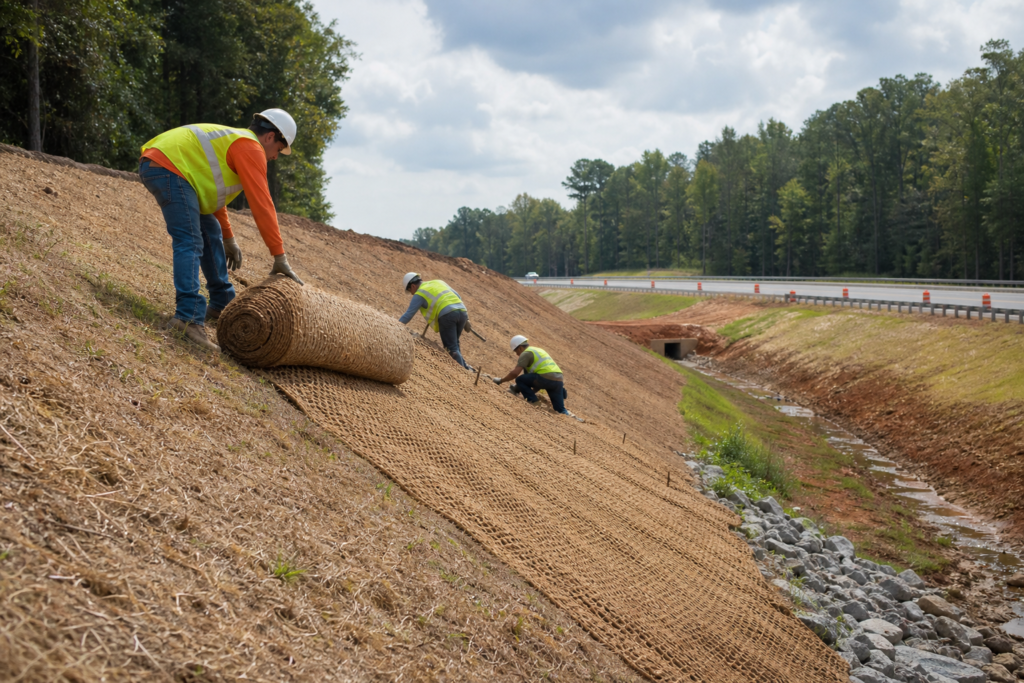
The right erosion matting depends on how water moves across the site, how long soil will remain exposed, and whether the goal is temporary protection, vegetation establishment, or permanent reinforcement. A product name alone is not enough. A blanket suited to sheet flow may be inappropriate where runoff concentrates in a swale or channel.
For Georgia construction and roadway projects, compare site conditions with approved plans, applicable requirements, and the specified technical category before ordering materials. The decision should also account for grading, drainage, seeding, anchoring, inspections, and maintenance.
What erosion matting does, and what it does not do
Erosion matting is surface protection placed over exposed soil. Depending on the product, it can reduce raindrop impact, limit surface soil movement, support vegetation establishment, or reinforce a vegetated surface against greater hydraulic stress. Georgia DOT describes slope stabilization as using rolled erosion-control products or hydraulic erosion-control products to help prevent erosion and establish temporary or permanent vegetation. Georgia DOT’s slope stabilization detail provides technical context for these categories.
Matting is not automatically a drainage system, sediment basin, or perimeter control. It does not replace stable grading, directed runoff, inlet protection, silt fence, check dams, inspection, or maintenance. A slope can remain vulnerable if water is concentrated above the mat, flows beneath an improperly trenched edge, or leaves the protected area through an uncontrolled outlet.
A broader set of erosion control strategies may be needed around active grading, roadway cuts, drainage installations, stockpiles, or downstream inlets.
Erosion matting options compared

This table is a planning framework, not a substitute for approved design or product requirements. Everyday terminology overlaps, while Georgia specifications distinguish several categories.
| Option | Typical role | Best-fit considerations | Important limitations |
|---|---|---|---|
| Straw or other organic blanket | Temporary cover and vegetation support | Suitable exposure period, seed plan, and manageable sheet flow | May be unsuitable where hydraulic forces or durability demands are greater |
| Coir mat | Natural-fiber surface protection and vegetation support | Specified natural-fiber product and compatible slope and flow | Still requires suitable anchoring and project approval |
| Synthetic erosion blanket | Surface stabilization and vegetation support | Exposed slopes requiring a defined synthetic product category | Performance varies. Follow approved specifications, not the label alone |
| Permanent soil-reinforcing mat | Longer-term reinforcement of a stabilized or vegetated surface | Finished surfaces needing more support than a temporary blanket provides | Requires final-grade preparation and specified installation |
| Turf-reinforcement matting | Reinforcement of vegetation under higher hydraulic stress | Specified slopes, channels, or locations where shear stress is a design concern | Not interchangeable with every blanket and not a drainage substitute |
Georgia guidance treats erosion-control mats and blankets, permanent soil-reinforcing mats, and turf-reinforcement matting as separate categories. Georgia DOT’s erosion-control categories should be checked before treating products as equivalent.
Start with slope, runoff, and soil conditions
Slope angle matters, but it is only one part of the decision. Identify whether water will move as dispersed sheet flow or collect into rills, swales, outlets, or channels. Matting is easier to evaluate on a stable slope with sheet flow than where concentrated water can lift, undercut, or bypass the product.
Review soil, grade stability, drainage paths, exposure area, and construction sequence. Clay soils, loose fill, disturbed embankments, and newly cut slopes may require more than surface cover. If water comes from upslope, address the runoff path as well as the receiving surface.
Where flow is concentrated, the design may need a channel treatment, check dams, lined outlet, riprap, drainage structure, or another engineered control. Do not select a blanket solely because a slope is steep or a product is marketed for channels. Teams can also review temporary versus permanent measures when weighing slope, soil, drainage concentration, exposure, maintenance, and regulatory fit.
Temporary versus permanent matting
Temporary protection suits a defined construction phase when the surface will later be stabilized, paved, landscaped, or changed. It must still remain functional for the expected exposure period and construction sequence.
Permanent or reinforced systems may be appropriate when the finished surface remains vulnerable, vegetation needs additional support, or project documents specify greater resistance. Final land use matters. A vegetated slope, drainage channel, roadway embankment, and future paved area may require different stabilization strategies.
Vegetation is not an afterthought. Seed selection, soil preparation, application timing, and establishment expectations affect performance. Where vegetation is part of final stabilization, erosion control revegetation explains how ground cover works alongside seeding, mulching, matting, and other controls.
Georgia and GDOT terminology and specification checks
Buyer language may use “erosion mat,” “erosion blanket,” “slope protection blanket,” or “turf mat” broadly. Project documents may be more specific, using terms such as rolled erosion-control product, erosion-control mat or blanket, permanent soil-reinforcing mat, or turf-reinforcement matting.
Georgia DOT turf-reinforcement matting is categorized by type and allowable hydraulic shear stress. The Georgia DOT turf-reinforcement requirements also address concurrent permanent grass establishment. A team should not substitute one category for another without design and specification review.
Check drawings, erosion and sediment control plans, special provisions, product submittals, seed requirements, and agency comments. GDOT contractor specifications and reference materials can help locate requirements, but project-specific plans and approvals control. A Georgia DOT-certified contractor may bring relevant experience, but certification does not make every product automatically approved.
A practical erosion matting selection sequence
- Confirm final use. Determine whether the area will be vegetated, paved, landscaped, used as a channel, or temporarily exposed.
- Map water movement. Identify sheet flow, concentrated flow, outlets, upstream contributing areas, and downstream inlets.
- Review slope and soil. Check stability, surface preparation, cut and fill areas, rilling, and sloughing.
- Define exposure. Establish how long soil will remain exposed and how construction phases affect installation.
- Set the vegetation objective. Confirm seed, mulch, soil amendments, and whether vegetation is temporary or permanent.
- Select the category. Compare organic blankets, synthetic blankets, permanent soil-reinforcing mats, and turf-reinforcement matting.
- Verify requirements. Match the product to plans, specifications, agency requirements, hydraulic criteria, and submittals.
- Plan maintenance. Assign preparation, anchoring, inspections, storm response, repairs, and closeout records.
Installation, inspection, and maintenance checks
Prepare the surface to the grade and condition required by the plans and product instructions. Coordinate seed placement with the matting system, then install edges, joints, transitions, and anchors according to the specified method. Trenching, overlaps, fastening, and outlet transitions are installation details, not informal preferences.
Inspect after rainfall and during active construction. Look for lifted edges, failed anchors, undercutting, exposed soil, washouts, damaged vegetation, and water bypass. Repair deficiencies promptly and record the location, cause, corrective action, and date.
Inspection should include connected controls. A functioning mat does not prevent sediment from reaching an inlet if runoff bypasses the slope, and a silt fence cannot correct erosion at its source. Follow approved plans, manufacturer instructions, and Georgia requirements rather than universal spacing assumptions.
Coordinate matting with the erosion-control system
Matting works best as part of a coordinated system. Grading establishes surfaces and flow paths. Stormwater structures carry or release runoff. Silt fence and inlet protection manage sediment movement, while check dams may reduce energy in suitable drainage paths. Seeding, mulching, and revegetation support final stabilization.
A quote should identify whether it includes surface preparation, seed, mulch, matting, anchors, drainage interfaces, repairs, inspections, removal, and closeout documentation. It should also show where erosion control connects with earthwork, roadway construction, utilities, and final grades.
Erosion matting preselection and field checklist
- Current drawings, revisions, erosion-control plan, and applicable specifications
- Slope limits, finished grades, soil information, and disturbed areas
- Sheet-flow paths, concentrated-flow locations, channels, outlets, and downstream inlets
- Final land use and expected soil-exposure period
- Product category, hydraulic criteria, seed mix, and submittal documentation
- Surface preparation, trenching, overlaps, anchors, transitions, and drainage interfaces
- Quantities for matting, seed, mulch, anchors, repairs, and related controls
- Inspection responsibilities, storm-response procedures, maintenance triggers, and closeout records
Coordinating erosion matting with civil site work
DCBC LLC lists erosion matting alongside silt fence, seeding and mulching, inlet protection, check dams, earthwork and grading, stormwater systems, and estimation and takeoff services. These related scopes can be discussed together when a project requires coordinated quantities, drainage interfaces, surface stabilization, or a specialized erosion-control package.
DCBC LLC is a Georgia-based civil site work and roadway construction contractor that positions itself as Georgia DOT certified. Its listed capabilities cover commercial, residential subdivision, roadway, and public infrastructure work, subject to project scope, plans, and quote requirements.
Frequently asked questions
What is the difference between an erosion control blanket and an erosion control mat?
The terms are often interchangeable in general conversation, but project documents may distinguish products by material, duration, hydraulic performance, and vegetation purpose. Use the specified category rather than assuming products are equivalent.
Which erosion matting is best for a steep construction slope?
There is no universal answer. Review slope stability, soil, runoff concentration, exposure, vegetation objectives, and approved product requirements. A steep slope with sheet flow may need a different system from one receiving concentrated runoff.
When should a project use turf-reinforcement matting?
It may be required where plans call for a reinforced vegetated surface or address higher hydraulic stress. Select it by specified type and design criteria, not simply because a slope appears steep.
Can erosion matting be used in a channel or drainage swale?
It can be used in some applications when the product, anchoring, flow conditions, and design support that use. Concentrated flow may also require lining, check dams, riprap, drainage structures, or other controls.
Does erosion matting replace silt fence or inlet protection?
No. Matting protects a surface, while silt fence and inlet protection address sediment movement at selected perimeter and drainage locations. They may need to operate together.
What should a Georgia project team verify before approving erosion matting?
Verify approved plans, product category, agency and GDOT requirements where applicable, hydraulic criteria, seed requirements, installation details, submittals, inspection duties, maintenance procedures, quantities, and closeout records.
Conclusion: Select the matting category before ordering materials
A sound comparison starts with water movement and final stabilization goals. Then evaluate slope, soil, exposure, vegetation, specification category, anchoring, drainage interfaces, inspection, and maintenance. If runoff is concentrated or the grade is unstable, add controls that address the cause rather than expecting matting alone to solve it.
For Georgia projects needing coordinated erosion control, grading, stormwater, roadway, or quantity support, discuss the plans and scope with DCBC LLC, which lists erosion matting, related erosion-control measures, civil site work, and estimation and takeoff among its services.