
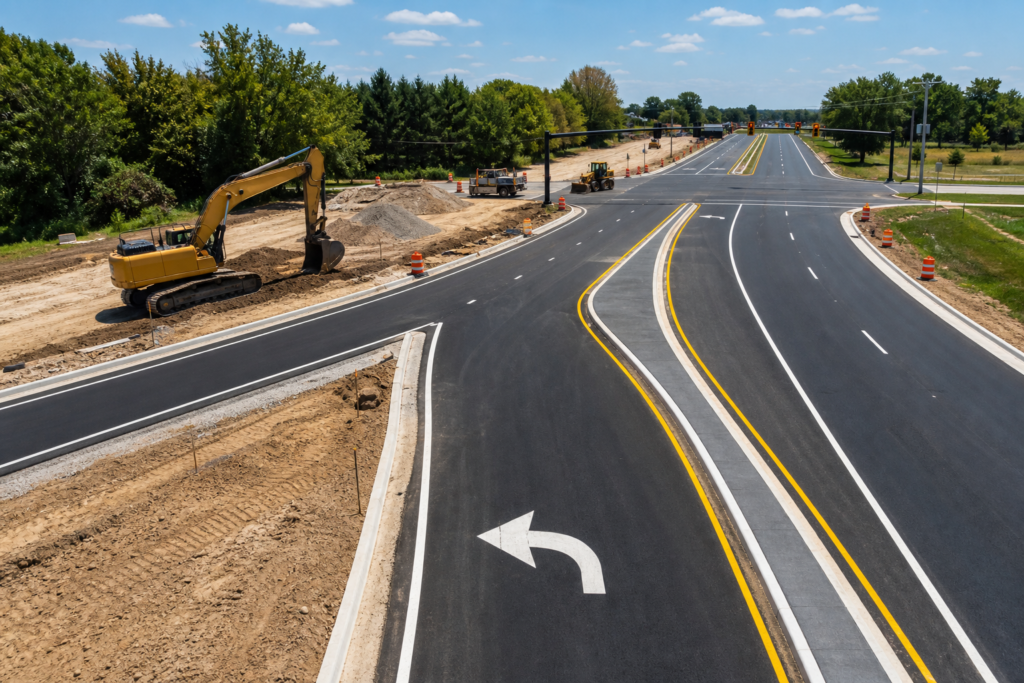

What are turn lane construction standards?
Turn lane construction standards are the set of engineering rules and agency requirements that govern how dedicated left, right, acceleration, and deceleration lanes are justified, designed, constructed, and accepted. Standards cover the full scope of physical and procedural items that affect safety and operations, including geometry and pavement, taper lengths, lane and storage widths, drainage and pavement transitions, signage and striping, right of way and sidewalk impacts, access management, permitting, and as-built documentation. For federal guidance on the safety purpose and typical applications of dedicated turn lanes see the FHWA proven countermeasures on dedicated left and right turn lanes at intersections.
What the standards typically cover
Turn lane construction standards are broad. At a minimum a thorough standard or design manual will address these areas.
- Operational justification, when traffic counts, turning volumes, or crash history require a separate lane to improve safety or reduce delay. The Federal Highway Administration recommends turn lanes where significant turning volumes exist or where turn-related crashes are common, especially on major approaches to an intersection. FHWA proven countermeasures
- Cross-section geometry, lane widths, shoulder transitions, and receiving lane dimensions that ensure vehicles can enter and exit safely. State guidance often states that turn lane widths should match travel lane widths, with documented exceptions for constrained sites; see state greenbook guidance for examples. FDOT greenbook notes
- Taper and transition geometry, how long lane tapers must be where through lanes convert to or from a turn lane. State DOT manuals provide taper length methods and references for pavement taper calculation. TxDOT taper guidance
- Storage and receiving capacity, how many vehicles the turn lane must hold to avoid queuing into the through lane, and the width of the exit lane where double lefts or special movements exist. Local standards sometimes specify minimum receiving widths for single and double left-turn lanes. Example county standard
- Drainage and pavement, how stormwater inlets, slopes, and pavement sections are managed so the new lane does not create ponding or accelerate erosion
- Pedestrian and bike facilities, changes required to sidewalks, crosswalks, and bike lanes and how to reconstruct or preserve pedestrian clearances when adding a lane
- Right of way and access management, whether additional ROW or compensating easements are required, and how driveways and median treatments must be modified to meet access policy. See access management guidance for the rationale behind left-turn lane design and deceleration requirements. Access management discussion
- Permitting and as-built documentation, submittal checklists, inspection records, and GIS or other as-built formats the approving agency requires
Core geometric and operational elements to check
When evaluating turn lane construction standards for a project, engineers and project managers should explicitly confirm these elements before producing plans or soliciting bids.
Justification and data collection
Turn lane standards begin with justification. Typical inputs are peak hour turning counts, overall approach volumes, speed data, existing crash history, and queuing observations. The FHWA recommends turn lanes on major approaches where turning volumes or crash patterns indicate a safety or operational benefit. FHWA proven countermeasures
Lane width, receiving width, and vehicle accommodation
Design guides specify lane widths for turn lanes and the receiving lane widths on the exit leg of the movement. Many state manuals prefer the turn lane width to match the travel lane and include documented reductions where ROW or truck turning volumes are constrained. The FDOT greenbook discussion notes allowable reductions in constrained situations while still addressing truck needs. FDOT greenbook notes
Taper lengths and pavement transitions
Tapers transition traffic from through lanes into a turn lane or from a turn lane back to through lanes. Pavement taper lengths and lateral shift tapers are found in state design chapters and traffic standards. Designers use those methods to calculate the required taper for a given speed and lane change. See the state pavement taper chapter for typical references used in practice. TxDOT taper guidance
Storage length and queuing
Storage length design accounts for expected peak queues so turning vehicles do not block the through lane. Local access management guidance explains how speed and volumes influence storage needs and why storage is an explicit element of turn lane design. Access management discussion
When to add a dedicated turn lane
Three practical triggers commonly appear in standards. First, significant turning volumes during the peak hour that would otherwise impede through traffic. Second, a history of turn-related crashes at the approach. Third, persistent operational delay or queuing that cannot be corrected with signal timing or minor geometric changes. The FHWA summary of dedicated left and right turn lanes explains these typical applications and where agencies should examine adding lanes. FHWA proven countermeasures
Right of way, sidewalk impacts, and permitting

Adding a turn lane often changes the pavement footprint and may require new right of way or reconstruction of sidewalks and bike lanes. County permitting handbooks commonly require compensating ROW when existing county ROW is used, and they specify pedestrian clearances and sidewalk reconstruction requirements. Check the local ROW permitting and inspection handbook for binding requirements in permit review. ROW permitting handbook
Where to find authoritative design criteria
Designers should consult three levels of guidance in order. First, federal summaries and safety countermeasures explain the safety purpose and operational rationale. See the FHWA guidance for when turn lanes reduce crashes and delay. FHWA proven countermeasures
Second, use the applicable state DOT design manuals and traffic standards for geometric details such as taper formulas and pavement cross sections. State chapters provide the methods for taper length calculation and cross-sectional elements. TxDOT taper guidance
Third, review municipal and county standard detail books for the exact construction details that a permitting agency expects. These detail books include typical sections for right and left turn lanes, median noses, and related curb and gutter geometry. Local standard details
How a GDOT-certified contractor supports Georgia projects
For projects in Georgia, designers and owners must align plans with GDOT and local agency requirements. Working with a Georgia DOT certified contractor helps ensure field work meets inspection standards and that the contractor understands GDOT submittal expectations. DCBC LLC is a Georgia-based civil site work and roadway contractor that holds Georgia DOT certification and offers turnkey turn lane construction plus virtual engineering services such as construction stakeout plans and GDOT as-built GIS submittals, which support permit approval and closeout. DCBC LLC
Contractor deliverables that agencies commonly require

Plan reviewers and inspectors frequently expect the following contractor deliverables for a turn lane project.
- Construction stakeout plans and house location or roadway stakeout for accurate grade and alignment
- Roadway grade calculations and three-point level verification to confirm pavement elevations
- Traffic control plans aligned with city or county standards
- Quantity takeoffs and materials lists for asphalt, base, and striping
- Inspection records and GDOT-compliant as-built GIS submittals for acceptance and closeout
DCBC provides many of these virtual and field deliverables to support permit submittal and acceptance. See the DCBC site to learn about combined construction and virtual engineering services and equipment options including truck rentals when required. dump truck
Common constraints and decision criteria
Owners and designers should expect some constraints during planning. Typical issues are limited right of way, buried utilities in the proposed footprint, storm drainage impacts, budget and schedule limits, and conflicts with pedestrian or bicycle facilities. Decision criteria used to accept or defer a turn lane include verified traffic counts, vehicle speed, observed queuing, crash history, and the cost and feasibility of ROW changes. Local permitting handbooks often require that turn lane construction be completed before certain site work proceeds when the lane is on a public collector or arterial. ROW permitting handbook
Practical next steps and a short checklist before design or bidding
Before starting detailed design or soliciting contractors, gather the essentials listed below. This five-item checklist speeds review and reduces surprises during permitting.
- Traffic counts and turning movement data for peak and off-peak hours
- Posted speed or measured 85th percentile speed for taper calculations
- Existing plan set, utility as-builts, and a right of way exhibit
- Sidewalk, bike facility, and drainage condition notes for the project limits
- Agency standards and detail books that will govern the permit and construction
When you request bids, ask each contractor for: method for maintaining traffic during construction, sample traffic control plan, schedule and milestones, as-built deliverables including GIS submittals, and references for similar turn lane projects. If you need stakeout plans, grade calculations, or as-built GIS deliverables, confirm that the contractor offers those virtual services or will accept a separate virtual engineer deliverable.
Frequently asked questions
Who sets turn lane construction standards in Georgia
Standards are set by a combination of authorities. Federal guidance such as FHWA documents informs safety rationale. The controlling geometric and construction criteria come from the state DOT and the local permitting agency. For Georgia projects consult GDOT and the county or city engineering standards, and consider a Georgia DOT certified contractor to ensure field work matches inspection expectations. FHWA and DCBC LLC
When is a dedicated left or right turn lane justified
A lane is typically justified when turning volumes are high, turn-related crashes are frequent, or existing queuing causes operational delays that could be mitigated by a separate lane. The FHWA summary describes these common triggers and when agencies recommend adding dedicated lanes. FHWA proven countermeasures
Where can I find taper length and lane width guidance
Consult the state DOT geometric design chapter for pavement taper formulas and lane width conventions. State manuals provide the methods used by designers to size tapers and transitions. See the TxDOT pavement taper chapter for an example of how taper methods are codified in a DOT manual. TxDOT guidance
What deliverables should a GDOT-certified contractor provide for turn lane acceptance
Agencies usually require construction stakeout plans, grade calculations, 3-point level verification, traffic control documentation, inspection logs, and GDOT-compliant as-built GIS submittals for acceptance. Confirm deliverables in the contract and include electronic as-built formats the agency prefers. DCBC LLC
Can a turn lane be built inside existing right of way without sidewalk reconstruction
Sometimes, but not always. If the lane fits within existing ROW and maintains the required pedestrian clear zone, sidewalk reconstruction may not be needed. Many county permit handbooks require sidewalk reconstruction or compensating ROW if the work reduces pedestrian clearance. Check the local ROW and permitting handbook for definitive requirements before assuming no sidewalk work will be required. ROW permitting handbook
Key takeaway: treat turn lane design as a combined operational, geometric, and permitting exercise. Consult FHWA and the applicable DOT and local manuals, collect the necessary field data, and engage contractors who provide the construction and virtual engineering deliverables your approving agency requires.
Ready to move from concept to bid or to get stakeout and as-built support? Contact DCBC LLC to request a quote for turn lane construction or virtual deliverables including construction stakeout plans and GDOT as-built GIS submittals. DCBC LLC