
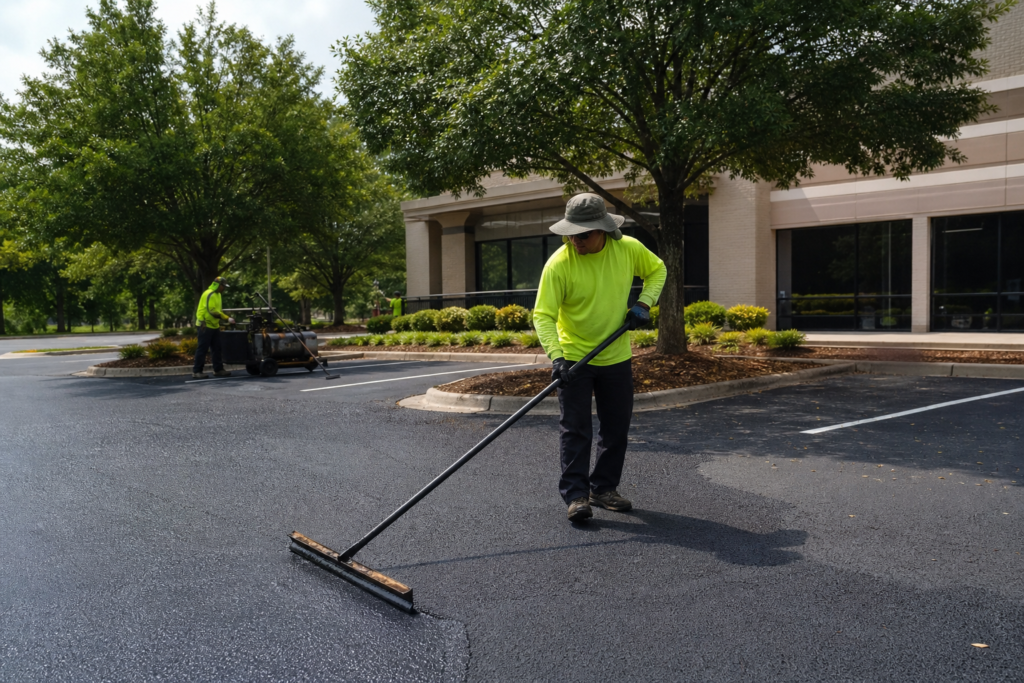
Effective parking lot sealcoating in Bethlehem starts with assessing the pavement and defining the work clearly, not simply choosing a coating. The right scope depends on the lot’s condition, access requirements, related repairs, and whether markings, signs, drainage, or grading must be coordinated.
1. Assess the Pavement Before Planning Sealcoating
Start by documenting what the parking lot needs now. Look for cracking, potholes, failed patches, uneven areas, raveling, standing-water concerns, and sections that appear substantially deteriorated. Note whether damage is concentrated in drive aisles, entrances, loading areas, or other high-use zones.
Sealcoating may be one part of the maintenance plan, but it should not replace an evaluation of underlying pavement problems. If sections need more extensive correction, the scope may need to include asphalt paving and milling before coating work is finalized. A condition review helps separate areas suitable for surface maintenance from areas requiring a different treatment.
2. Define What You Want the Maintenance Project to Accomplish

A property owner may want a cleaner appearance, a defined maintenance scope, improved presentation for tenants and visitors, or coordination with parking-lot improvements. A developer or general contractor may need sealcoating considered alongside paving, site completion, or other construction activities.
State the objective before requesting a quote. Identify the areas to be considered, whether the lot must remain partially accessible, and whether the work is standalone or part of a broader site-work package. DCBC LLC lists parking lot sealcoating among its services, along with sealcoating for driveways, roads, airport runways, tennis courts, and playground surfaces. The appropriate scope still depends on the specific surface and project conditions.
3. Coordinate Repairs Before the Coating Scope Is Finalized
Repairs, asphalt replacement, milling, grading, and sealcoating should be discussed together when a lot has more than routine surface-maintenance needs. A coating-only scope can make it difficult to compare proposals if failed areas and other conditions are not identified in advance.
Ask each contractor to distinguish included and excluded work. That may cover patching, removal of failed material, localized paving, milling, surface preparation, or correction of areas affected by grade and drainage. If the site has elevation or runoff concerns, discuss whether earthwork and grading services should be evaluated separately. The goal is not to add unnecessary work, but to ensure the proposal reflects the pavement that will actually receive the coating.
4. Plan Striping, Signs, and Parking Access Together
Surface work and parking-lot markings should be planned as one coordination exercise. List the elements that matter to the property, such as parking stalls, crosswalks, accessible markings and signs, traffic signs, directional markings, and wheel stops.
Confirm whether preparation, paint striping and signage, and wheel-stop installation are included in the same proposal or priced separately. Also ask how vehicles, pedestrians, deliveries, and emergency access will be handled during the work. A clear access plan helps property managers communicate restrictions and avoid confusion about which areas are included.
5. Check Access, Drainage, and Erosion-Control Needs
Parking lots operate as part of a larger property. Before requesting a final scope, identify entrances, loading areas, stormwater features, low points, adjacent slopes, and areas where access must remain open. Share information about phased occupancy, tenant schedules, public use, or nearby construction that could affect coordination.
Drainage or runoff concerns may require a civil review rather than a sealcoating-only response. DCBC LLC provides stormwater systems and related civil site work, and its listed services include grading and erosion control. Discussing these needs early can help determine whether the project should be quoted as standalone parking-lot maintenance or as part of a wider site-work package.
6. Compare Quotes by Scope, Not Just Price
Two parking lot sealcoating quotes are comparable only when they describe similar work. Review each proposal for the areas covered, preparation, repairs, coating scope, striping, signage, access coordination, exclusions, and recommended related work. Ask how uncertain or visibly damaged areas will be handled if they cannot be fully defined from the initial information.
Distinguish a standalone sealcoating quote from a coordinated proposal that includes paving, grading, drainage, or markings. DCBC LLC describes its construction and consulting work as custom and quote-based, with estimation and takeoff services available for project planning. An itemized scope makes it easier to evaluate value, identify gaps, and obtain internal approval.
7. Record the Finished Scope and Plan the Next Review
At closeout, retain the approved scope and note what was completed. Useful records can include the areas coated, repairs performed, markings and signs installed, access measures used, drainage or erosion-control items addressed, and conditions intentionally excluded.
Use those records to guide future inspections instead of relying on a generic maintenance interval. Review the lot periodically for changes in cracking, potholes, drainage performance, markings, traffic patterns, and areas receiving heavier use. If the property’s needs change, the next scope may involve sealcoating, paving, milling, striping, grading, or stormwater work in different combinations.
What to Include When Requesting a Sealcoating Quote
Provide enough information for a contractor to understand the property and the decision you need to make. A useful request can include:
- Property location and approximate parking-lot size
- Known pavement history, including recent paving, milling, or repairs
- Visible damage, deteriorated sections, or areas needing evaluation
- Drainage, grading, erosion, or standing-water concerns
- Access constraints, operating hours, delivery routes, and occupancy considerations
- Parking stalls, crosswalks, accessible markings, traffic signs, or wheel stops to be addressed
- Whether repairs, striping, signage, or related civil work should be included
- Whether you want a standalone sealcoating scope or a coordinated site-work proposal
These details do not replace a contractor’s assessment, but they make the initial conversation more productive and help prevent important constraints from being overlooked.
Conclusion
The strongest Bethlehem parking lot sealcoating decisions begin with pavement condition and end with a clearly documented scope. Assess the lot, define the objective, identify repairs, coordinate markings and access, check drainage and erosion-control needs, compare complete proposals, and retain records for future reviews.
When the lot involves more than surface maintenance, ask whether asphalt paving and milling, grading, stormwater, erosion control, or striping should be evaluated at the same time. DCBC LLC provides parking lot sealcoating and related civil site work across Georgia. Request a custom quote with your property details and desired scope.