
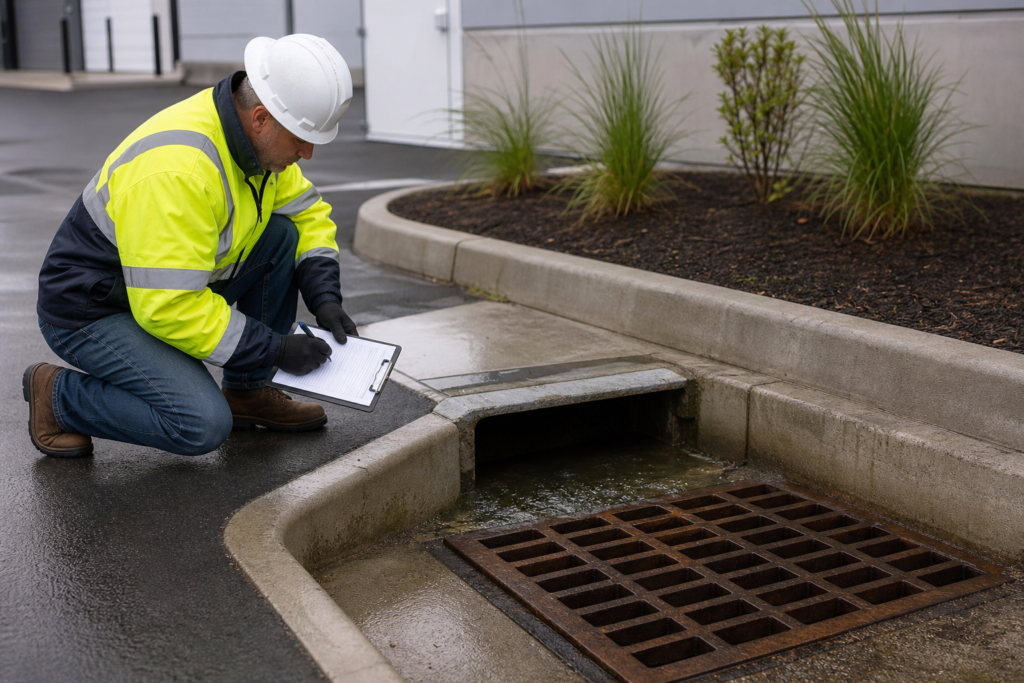
A useful catch basin inspection checks more than whether the grate is visible. Inspect the frame, structure, sediment, connected pipes, surrounding grades, erosion, access, and the wider drainage path. This field checklist helps Georgia developers, contractors, property managers, public works teams, and project personnel decide whether the next step is monitoring, cleaning, repair, or qualified review.
Use this as a visual inspection and decision tool, not as a substitute for project-specific engineering, confined-space procedures, owner requirements, or agency direction. Georgia DOT’s stormwater inspection material uses broader drainage-structure terminology and includes catch basins, inlets, manholes, junction boxes, and outlets.
Key Takeaways
- Conduct thorough inspections by checking the grate, frame, sediment, and connected pipes.
- Document findings meticulously, including photographs and condition notes for accountability.
- Classify inspection results into categories like clean, maintenance, repair, or review for effective follow-up.
- Ensure safety by using proper traffic controls and never entering confined spaces without authorization.
- Utilize Georgia DOT resources to align inspections with state standards and requirements.
Quick summary

- Inspect safely from the surface unless trained, equipped, and authorized for additional access.
- Check the grate, frame, walls, sump, sediment, debris, visible pipes, flow path, pavement, grades, and erosion.
- Record the asset location, date, recent weather, photographs, measurements, condition, priority, and responsible party.
- Classify the result as clean and monitor, routine maintenance, repair candidate, or engineering or agency review.
- Do not approve a catch basin in isolation when flooding, surcharge, failed grades, outlet erosion, or uncertain downstream capacity is present.
Before You Inspect: Scope, Safety, and Site Information
Identify the structure by plan label, facility number, address, station, intersection, or another location reference. Gather available drainage drawings, previous inspection reports, maintenance records, and information about who owns or maintains the asset.
Note recent rainfall and site activity. Standing water, sediment movement, or a blocked grate may look different after a storm than during dry weather. If flooding occurred, record where water came from, where it went, and whether several connected structures were affected.
Use suitable traffic and pedestrian controls. Never enter a catch basin, manhole, or other drainage structure based on a visual checklist alone. These spaces may involve confined-space hazards, unstable conditions, contaminated water, poor air quality, or unexpected flow. Follow the owner’s safety procedures and use qualified personnel for entry, heavy-cover removal, flow testing, or specialized measurements.
For wider site coordination, a civil site work checklist can connect basin checks with grading, trenching, pipe placement, paving, erosion control, and final drainage acceptance.
Catch Basin Inspection Checklist

Use the same sequence each time. Mark each item acceptable, defective, inaccessible, not visible, or requiring follow-up. Avoid writing only “good” or “bad.” Describe what was observed, where it was observed, and what action is needed.
1. Inspect the Grate, Frame, and Surface Around the Basin
- Is the grate present, correctly seated, and secure?
- Are bars, openings, hinges, fasteners, or locking features damaged or missing?
- Is the frame cracked, displaced, loose, corroded, or separated from pavement?
- Is the opening blocked by trash, leaves, vegetation, stored materials, or construction debris?
- Does surrounding pavement, curb, shoulder, or sidewalk show settlement, cracking, rutting, or a trip hazard?
- Is water ponding around the grate instead of reaching the inlet?
- Could the condition endanger vehicles, pedestrians, cyclists, or maintenance crews?
Surface condition matters because a structurally sound basin can still fail to collect water if surrounding grades have changed. Georgia DOT’s standard catch basin detail addresses access, clearances, dimensions, and the relationship between the structure top and adjacent surfaces. Confirm whether that detail applies to the project being inspected.
2. Check the Walls, Bench, Sump, and Visible Interior
From a safe position, inspect visible surfaces with suitable lighting. Look for cracking, displacement, open joints, deterioration, exposed reinforcement, soil entering through joints, undermining, or signs that the structure has shifted. Record whether a defect is isolated or affects the frame, walls, base, or pipe connection.
Check the bench and sump for sediment, standing water, debris, roots, or unusual deposits. Ordinary sediment may indicate routine maintenance, while a collapsed wall, displaced section, continuing soil loss, or exposed connection is a repair or review concern. Do not determine structural capacity from photographs alone.
3. Record Sediment, Debris, Blockage, and Water Conditions
- Estimate sediment depth or the proportion of the sump occupied, if safe and repeatable.
- Describe trash, leaves, gravel, construction material, vegetation, or other blockage.
- Record whether the grate, inlet throat, outlet, or visible pipe opening is obstructed.
- Note standing water, unusual color, sheen, odor, or floating material without making an unsupported environmental determination.
- Document whether the condition followed rainfall, construction, sweeping, or maintenance.
If sediment returns soon after cleaning, investigate upstream erosion, construction runoff, poor stabilization, or inadequate maintenance rather than treating it as a one-time housekeeping issue.
4. Check Connected Pipes, Inlets, Outlets, and Flow Paths
Inspect visible pipe connections for blockage, separation, cracking, displacement, exposed bedding, or leakage. Look for surcharge, bypass, backflow, erosion, or water entering from an unintended path. Where visible, document the outlet and downstream structure too.
A catch basin cannot be approved in isolation when water is not moving through the intended system. Confirm, where project information allows, how it connects to upstream inlets, pipes, channels, outlets, roadway crossings, or other structures. Before finalizing the inspection process, review stormwater drainage risks such as outlet conditions, downstream capacity, access, and maintenance responsibilities.
Repeated surcharge, unexplained standing water, bypass flow, or outlet erosion should be escalated rather than resolved by cleaning alone. Hydraulic performance requires project-specific evaluation of grades, pipe sizes, flow, downstream conditions, and applicable criteria.
5. Inspect Surrounding Grades, Pavement, and Erosion
- Check whether pavement, curb, shoulder, or landscape grades direct water toward the basin.
- Look for settlement, low spots, ponding, rutting, or changed grades.
- Inspect nearby slopes for rills, gullies, washout, exposed soil, or sediment deposits.
- Look for exposed pipe, undermined structures, outlet scour, damaged slope drains, or failed erosion controls.
- Record whether sediment is moving toward the basin from active construction.
These observations may indicate a broader grading or erosion-control problem, particularly on construction sites, roads, parking areas, subdivisions, and properties where drainage changes could affect adjacent land.
6. Document the Finding So Someone Can Act on It
Use one record for each structure. Include:
- Asset identification: plan label, address, station, GPS reference, or nearby landmark.
- Inspection details: date, time, inspector, weather, recent rainfall, and site activity.
- Condition notes: grate and frame, structure, sump, sediment, debris, pipes, flow, grades, pavement, and erosion.
- Evidence: photographs showing the structure, surrounding area, defects, and a location reference, plus relevant measurements.
- Action: monitor, clean, remove debris, repair, investigate, test, survey, or coordinate with an owner or agency.
- Accountability: responsible party, priority, target completion date, and follow-up date.
Photograph the basin from a consistent distance and add close-ups of defects. For construction closeout, retain records with plan revisions, field notes, repair documentation, and required as-built information.
How to Classify Inspection Findings
| Classification | Typical observations | Likely next step |
|---|---|---|
| Clean and monitor | Secure grate and frame, stable structure, open flow path, and no significant erosion or ponding. | Record the condition, retain photographs, and schedule the next inspection. |
| Routine maintenance | Leaves, trash, light sediment, vegetation, or minor blockage without clear structural damage. | Remove the obstruction safely, document the work, and verify access afterward. |
| Repair candidate | Damaged grate, loose frame, pavement settlement, displaced component, recurring blockage, joint failure, or localized erosion. | Protect the area as needed, obtain a repair scope, and reinspect after correction. |
| Engineering or agency review | Recurring surcharge, flooding, uncertain outlet capacity, major displacement, structural deterioration, severe scour, changed grades, or public-infrastructure impacts. | Escalate to the owner, qualified professional, engineer, or applicable agency. |
A clean basin does not prove that the drainage system is hydraulically adequate. A dirty basin does not prove that the structure has failed. Keep observations separate from conclusions and identify what additional information is needed.
Construction-Stage Catch Basin Inspection Hold Points
Inspect at defined hold points rather than waiting until final paving or closeout. Confirm location, accessibility, intended grade, visible pipe connections, alignment, joints, inlet and outlet conditions, and the relationship between the frame, grate, curb, pavement, and adjacent surfaces.
Coordinate observations with trenching, bedding, backfill, compaction, grading, and surface-restoration requirements. Protect the structure from construction debris and verify that temporary erosion controls prevent sediment from entering the system. After surrounding work is complete, inspect for settlement, ponding, damaged frames, blocked openings, and erosion.
At closeout, gather photographs, field measurements, punch-list responses, maintenance information, and required record drawings or as-built deliverables. Exact requirements depend on the plans, owner, jurisdiction, and project type. Use a broader drainage acceptance process to coordinate these checks with related site-work inspections.
Georgia and GDOT Context: Use the Right Checklist
Georgia DOT’s stormwater system inspection and maintenance manual provides context for drainage structures and conveyances associated with GDOT systems. It is useful reference material, but it does not automatically establish requirements for every private, municipal, commercial, or non-DOT project.
Likewise, Georgia DOT’s standard catch basin detail describes a particular transportation construction detail. Confirm which plans, specifications, permits, maintenance agreements, and agency instructions govern the structure being inspected.
When to Involve a Civil Site Work or Drainage Contractor
Consider qualified support when you find recurring flooding, surcharge, damaged structures, failed pipe connections, outlet erosion, uncertain grades, multiple connected assets, active construction impacts, or agency closeout needs. Support may also be appropriate for field measurements, construction stakeout, grade verification, drainage construction, erosion control, or organized documentation.
DCBC LLC provides Georgia civil site work and stormwater services involving catch basins, drop inlets, manholes, slope drains, roadway crossings, and related drainage infrastructure. The company also offers construction stakeout plans, three-point level verification, roadway grade calculations, estimation and takeoff, and GDOT as-built GIS submittals. Request a scope that separates construction, consulting, verification, documentation, and work requiring design or agency approval.
Frequently Asked Questions
How often should a catch basin be inspected?
No single interval applies to every Georgia basin. Base frequency on the owner’s process, site use, construction activity, flooding history, debris loading, erosion, and project or agency requirements. Inspect after significant events when appropriate.
Can a visual inspection determine whether a basin is hydraulically adequate?
No. Visual inspection identifies blockage, ponding, surcharge evidence, erosion, and visible connection problems. It cannot establish pipe capacity, grades, outlet adequacy, or downstream performance without appropriate plans, survey information, calculations, testing, or qualified review.
What should be checked after heavy rain or flooding?
Record water marks, debris lines, sediment movement, ponding, bypass flow, grate blockage, outlet erosion, slope damage, and conditions at connected structures. Photograph the area and determine whether the issue is isolated or part of a wider flow path.
What is the difference between catch basin and stormwater structure inspection?
A catch basin inspection focuses on one inlet and its immediate surroundings. A broader stormwater inspection may include connected inlets, pipes, manholes, junction boxes, outlets, channels, detention features, erosion controls, and maintenance responsibilities.
When should a damaged basin be repaired instead of cleaned?
Cleaning addresses removable sediment, trash, vegetation, or blockage. Repair should be considered for unsafe grates, displaced or deteriorated structures, failing joints, settled pavement, damaged pipes, or undermining erosion. Severe or recurring conditions require appropriate professional review.
What belongs in an inspection report?
Include location, date, inspector, weather, recent rainfall, photographs, visible condition, sediment and debris observations, measurements, connected-drainage notes, recommended action, priority, responsible party, and follow-up date. Construction records may also require plan references, corrective-work records, and as-built documentation.
Conclusion: Turn Observations Into a Follow-Up Plan
The strongest catch basin inspection checklist connects safe observation, clear evidence, condition classification, and assigned follow-up. Check the opening and structure, but also review grades, pavement, erosion, connected pipes, outlets, downstream conditions, and maintenance responsibility. This wider view helps distinguish routine cleaning from a drainage, construction, structural, or agency-review issue.
If your Georgia project needs stormwater construction, grading coordination, drainage field verification, erosion control, stakeout support, or as-built documentation, DCBC LLC provides civil site work and consulting services for commercial, residential subdivision, roadway, public infrastructure, and Georgia DOT-related work.