
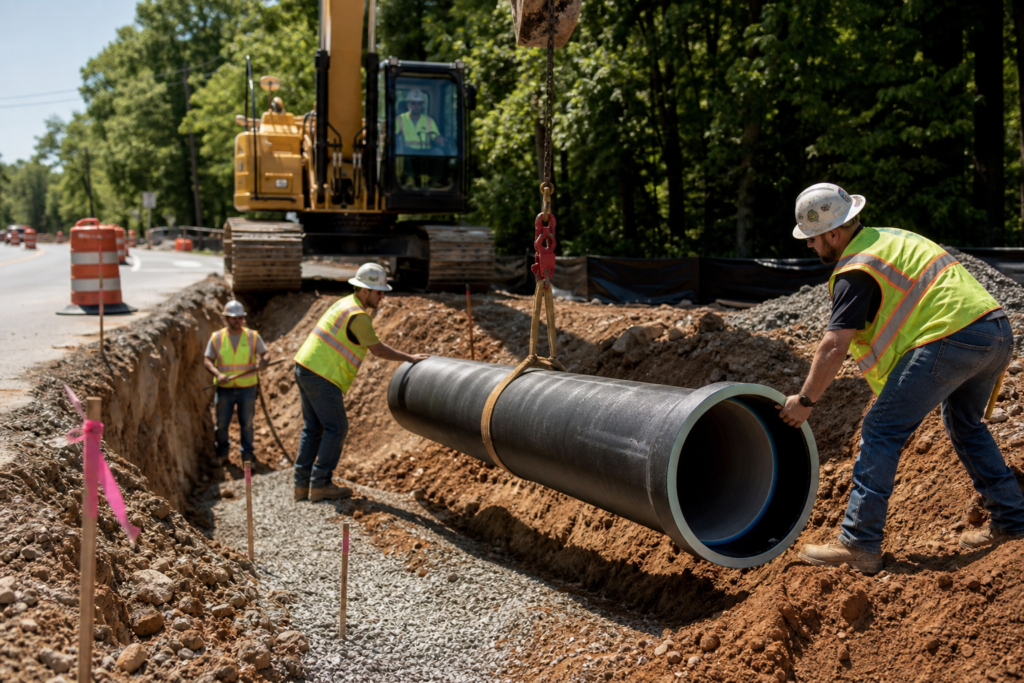
Ductile iron pipe, often shortened to DIP, should be selected from the project requirements rather than from material preference alone. The application, hydraulic and structural design, pressure conditions, soil, joints, corrosion exposure, installation constraints, and governing specifications all affect the right choice.
This DIP pipeline selection guide explains how to organize that decision before procurement. It also compares ductile iron pipe with HDPE and reinforced concrete pipe, identifies approval points, and shows what to include in a bid and closeout package.
Key Takeaways
- Ductile iron pipe selection should be based on project requirements, including application and design specifications.
- Confirm governing specifications from relevant authorities, including GDOT, before finalizing material choices.
- Evaluate installation constraints and material properties to ensure compatibility with the project environment.
- Compare ductile iron pipe with alternatives like HDPE and RCP to determine the best fit for specific project needs.
- Build a comprehensive procurement package that includes all necessary documentation and specifications for clarity.
Quick summary

- Define whether the pipe serves water, stormwater, a roadway crossing, or another infrastructure function.
- Confirm the owner’s, utility’s, municipality’s, or GDOT’s specifications before selecting class, joints, or protection.
- Have the design team establish diameter, pressure requirements, external loads, cover, and corrosion protection.
- Compare DIP with HDPE and RCP using the entire installation and lifecycle context.
- Include bedding, backfill, testing, field verification, inspection, and as-built requirements in the bid package.
Step 1: Define the application and design basis
Begin by documenting what the pipe must do. A pressurized water line has different design questions from a gravity stormwater line, roadway crossing, or drainage connection. The application affects hydraulic calculations, pressure requirements, fittings, joints, protection, testing, and acceptance criteria.
Before requesting prices, assemble the available information:
- Service or drainage function and expected flow conditions.
- Required diameter, alignment, profile, connection points, and invert elevations.
- Operating pressure, surge or transient conditions, and external loading.
- Burial depth, traffic loading, trench geometry, groundwater, and dewatering needs.
- Existing and proposed utilities, access limits, easements, and traffic-control requirements.
- Soil information, groundwater chemistry, corrosion exposure, and other site conditions.
For stormwater work, coordinate pipe selection with the complete drainage system. Conveyance, detention, infiltration, water-quality measures, grading, and erosion control can affect where pipe is needed and how it connects to other features.
Stop point: Do not finalize pipe class or joints while the application, design flow, pressure basis, profile, or loading assumptions remain unclear. Obtain confirmation from the design engineer or owner’s representative first.
Step 2: Confirm the governing specifications

Project specifications can control material standards, pressure class, joint type, testing, installation, inspection, and closeout documentation. The controlling requirements may come from a municipality, utility owner, public agency, roadway authority, engineer of record, or contract special provision.
For example, a supplied Georgia DOT project specification states that buried ductile iron pipe must meet cited ANSI/AWWA C150/A21.50 and C151/A21.51 requirements for the specified class and joint. It identifies mechanical or push-on joints and states that pipe diameters of 12 inches or less are minimum Pressure Class 350 unless otherwise specified. Review the Georgia DOT specification directly for applicable project language.
This example is not a universal rule. A different owner, diameter, service condition, or contract may establish different criteria. Confirm the governing edition and reconcile drawings, technical specifications, standard details, and special provisions.
Georgia project teams should also verify certification, prequalification, and contract eligibility against the applicable solicitation. DCBC LLC identifies itself as a Georgia DOT-certified contractor and provides construction and consulting support for civil infrastructure work.
Stop point: If contract documents conflict or fail to identify the governing standard, request written clarification before ordering pipe.
Step 3: Select diameter, pressure class, and wall requirements
Diameter is primarily a hydraulic and connection decision, while pressure class and wall requirements address internal and external demands. These decisions must be coordinated. A larger diameter does not automatically solve a pressure or structural issue, and choosing a higher class without checking the design basis may create unnecessary cost or incompatibility.
The design review should consider flow capacity, operating pressure, surge conditions, burial depth, traffic loading, trench support, bedding, backfill, groundwater, and surrounding soil. It should also account for fittings, valves, bends, restrained sections, connections to other materials, and areas where thrust or movement may be concentrated.
Keep engineering calculations separate from a contractor’s quantity takeoff. A takeoff can identify lengths, fittings, structures, and estimated quantities, but it does not replace hydraulic, structural, or corrosion analysis. Current survey information, benchmarks, proposed elevations, roadway profiles, and drainage transitions should be coordinated before quantities are approved.
Stop point: The design engineer or approving authority must confirm the final diameter, pressure class, wall or material requirements, and special fittings before procurement. Do not infer them from a similar project.
Step 4: Evaluate joints, linings, coatings, and corrosion protection
Joint selection affects installation, movement, restraint, connections, inspection, and testing. Confirm whether the project requires push-on, mechanical, restrained, or another specified joint arrangement. Review how bends, tees, reducers, valves, transitions, and changes in direction will be restrained or supported.
Internal lining and external coating decisions should reflect the service and surrounding environment. Review soil chemistry, groundwater, moisture, stray-current exposure, industrial conditions, and contact with dissimilar materials. The correct protection system is project-specific and should be identified in the specifications or approved by the engineer.
Clarify field handling requirements as well. Pipe, fittings, gaskets, coatings, and joint materials may require delivery inspection, protection from damage, storage controls, and documented installation procedures. These requirements belong in the procurement package, not only in an informal discussion with the installer.
Step 5: Review installation constraints before ordering pipe
A material that works on paper may be difficult to install in a restricted corridor. Review trench width, equipment access, utility conflicts, traffic control, groundwater, dewatering, soil stability, cover, bedding availability, and surface restoration.
Installation method also influences the comparison. Open-cut construction may be practical where right-of-way is available and surface disruption can be managed. Constrained corridors may require a separate constructability review involving traffic, utilities, rail or roadway crossings, sensitive landscaping, or limited staging areas.
For comparison, review HDPE pipe installation considerations, including open-cut, horizontal directional drilling, pipe bursting, and sliplining. These methods do not automatically apply to DIP, but they demonstrate why material selection and installation planning should be evaluated together.
Stop point: Pause the order if utility locations, grade information, trench conditions, access, or dewatering requirements are unresolved.
Step 6: Compare DIP with HDPE and RCP
No material is the universal winner. Compare each option against pressure, structural, hydraulic, environmental, installation, maintenance, and documentation requirements.
| Material | Potential fit | Questions before selection |
|---|---|---|
| Ductile iron pipe | Projects where the design, pressure requirements, joints, fittings, loading, and owner standards support a rigid pipe system. | What diameter, pressure class, joints, lining, coating, restraint, and corrosion protection are required? |
| HDPE | Projects where flexibility, fusion jointing, trenchless work, or rehabilitation may address access and surface-disruption constraints. | Which installation method, fusion controls, thermal movement measures, backfill requirements, testing, and records apply? |
| RCP | Gravity drainage and stormwater applications where the design and owner specifications support reinforced concrete pipe. | What pipe class, wall thickness, joints, bedding, compaction, inspection, testing, and grade requirements apply? |
For another rigid-pipe benchmark, use the RCP pipe installation checklist to compare bedding, joints, inspection, testing, and acceptance documentation. The goal is not to substitute one material for another, but to review each option with comparable detail.
Step 7: Build the procurement and bid package
A clear package reduces assumptions between the owner, engineer, supplier, and contractor. Include these items where applicable:
- Project function, service conditions, design flow, pressure basis, and required diameter.
- Plan and profile drawings showing alignment, grades, connections, cover, structures, and crossings.
- Applicable standards, pipe class, wall requirements, manufacturing documentation, and substitution rules.
- Joint type, fittings, restraint, valves, transitions, lining, coating, and corrosion-protection requirements.
- Trench, bedding, embedment, backfill, compaction, dewatering, and restoration requirements.
- Delivery inspection, handling, installation inspection, testing, and service-specific acceptance requirements.
- Quantities, measurement and payment terms, exclusions, alternates, permits, and traffic-control responsibilities.
- Required survey, stakeout, grade verification, test reports, inspection signoffs, and as-built records.
When requesting a quote, state whether you need material supply, installation, consulting support, field layout, estimation and takeoff, or a combined scope. This helps bidders price the same work and exposes missing responsibilities early.
Step 8: Plan field verification, testing, and closeout
Design approval, field layout, installation inspection, testing, and as-built documentation are separate stages. The approved design establishes what should be built. Stakeout and grade verification transfer that design to the field. Inspection and testing document whether the installed work meets requirements. Closeout records show what was accepted.
Depending on the contract, the closeout package may include approved submittals, delivery records, material certifications, joint or installation records, bedding and compaction results, test reports, inspection signoffs, grade verification, photographs, field changes, and final as-built information. Public or GDOT-related work may also require GIS-ready documentation identified in the contract.
DCBC LLC lists construction stakeout plans, roadway grade calculations, three-point level verification, estimation and takeoff, stormwater systems, ductile iron pipe installation, and GDOT as-built GIS submittals among its capabilities. These services can support coordination, but the project engineer and approving authority remain responsible for design approval and acceptance criteria.
Final pre-bid checklist for DIP selection
- Application: Is the water, stormwater, roadway, or infrastructure function defined?
- Design basis: Are flow, pressure, surge, alignment, profile, cover, loading, soil, and groundwater documented?
- Specifications: Have owner, utility, municipal, GDOT, and contract requirements been reconciled?
- Pipe requirements: Are diameter, pressure class, wall requirements, standards, fittings, and connections confirmed?
- Protection: Are joints, restraint, lining, coating, and corrosion-control requirements specified?
- Constructability: Are utilities, access, traffic, trench conditions, dewatering, bedding, and restoration addressed?
- Alternatives: Have DIP, HDPE, and RCP been compared using the same project criteria?
- Acceptance: Are testing, inspection, grade verification, as-built, and closeout records listed?
- Approval: Has the qualified design professional or governing authority approved the selection?
Frequently asked questions
Is ductile iron pipe suitable for stormwater projects?
It can be suitable for some stormwater and drainage applications, but suitability depends on hydraulic design, loading, soil and groundwater conditions, connections, corrosion exposure, installation constraints, and governing specifications. Evaluate the pipe as part of the complete drainage system.
Who should approve the pressure class and joint selection for DIP?
The qualified design professional, owner, utility authority, or governing agency should approve those selections according to the contract and applicable standards. A contractor or supplier can identify constructability and pricing concerns, but should not replace project-specific engineering approval.
What records belong in a ductile iron pipe closeout package?
Typical records may include approved material submittals, delivery and inspection documentation, installation and joint records, bedding and compaction results, testing reports, inspection signoffs, field changes, grade verification, and as-built drawings or GIS files when required. The contract should define the final list before construction.
Conclusion: Select the pipe after the criteria are clear
A responsible ductile iron pipe decision starts with the application and design basis, then moves through governing specifications, diameter and pressure requirements, joints, protection, installation constraints, alternatives, procurement documents, and acceptance records. DIP may be the right fit, but that conclusion should follow documented criteria rather than a general preference.
For Georgia commercial, residential subdivision, roadway, and public infrastructure work, DCBC LLC provides civil site work, stormwater and ductile iron pipe installation, construction stakeout, grade verification, estimation and takeoff, and GDOT as-built support. Request a project-specific quote with available plans, survey information, specifications, scope, and documentation requirements.