
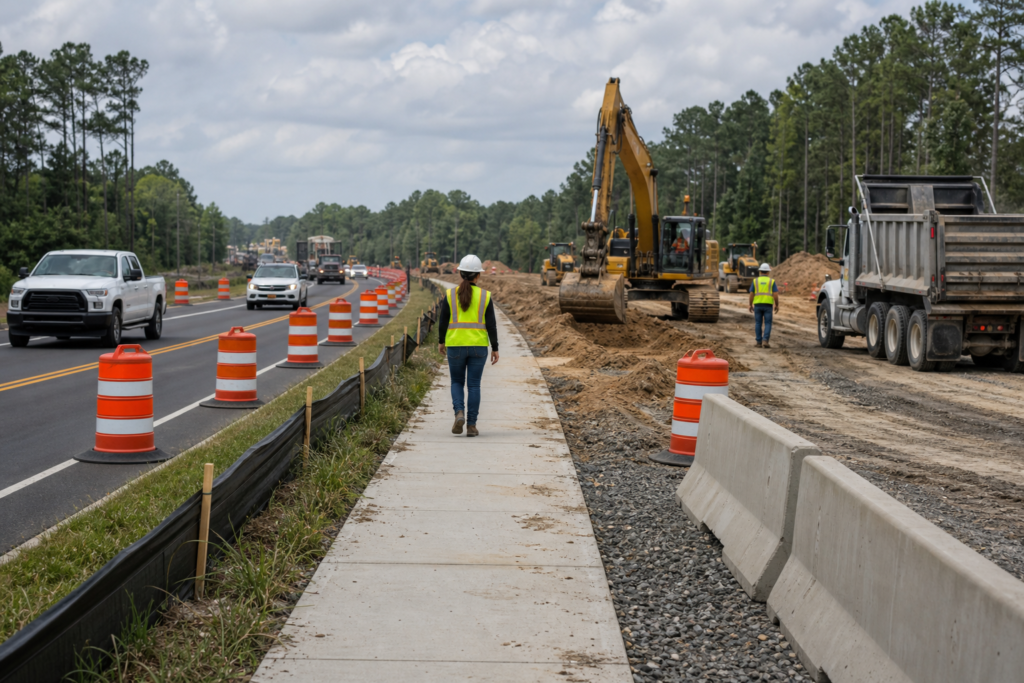
Traffic control planning determines how motorists, pedestrians, bicyclists, workers, equipment, and deliveries move around active construction. For a Georgia civil project, begin with public-road exposure, lane interruptions, construction entrances, work phases, pedestrians, emergency access, and the authority whose requirements apply. A traffic control plan or temporary traffic control plan should then show the controls for each phase, while a Traffic Interruption Request addresses qualifying scheduled lane or road closures on the state highway system. Source: Chapter Seven – Traffic Control.
The goal is not simply to place signs around a work area. A workable plan connects traffic paths with excavation, utilities, grading, drainage, paving, deliveries, access routes, personnel, inspections, and changes in the field.
What Traffic Control Planning Means on a Civil Site
Traffic control in construction is the coordinated management of movement through or around a work zone. It covers public vehicles, workers, construction equipment, delivery vehicles, pedestrians, bicyclists, property access, and emergency routes.
Temporary traffic control also includes the devices and procedures used to make those movements workable. Depending on the project, that can involve signs, pavement markings, channelizing devices, barriers, flaggers, temporary paths, access controls, communication procedures, and staged changes to the work zone. Georgia DOT describes temporary traffic control as a way to provide passage for motorists, bicyclists, and pedestrians, including people with disabilities, through work zones and addresses the installation and maintenance of temporary traffic-control devices on applicable projects.
- Where will each road user travel while work is active?
- Which movements will change during excavation, utility work, grading, paving, or demobilization?
- How will construction vehicles enter, leave, turn, queue, and cross pedestrian routes?
- Who will install, inspect, maintain, and revise the setup?
- How will emergency access and adjacent properties remain usable?
TCP, Temporary Traffic Control Plan, TMP, and TIR: Which One Do You Need?

These terms overlap, but they do not always describe the same deliverable. The project contract, roadway authority, permit conditions, and applicable standards control the final requirement.
| Term | Plain-language meaning | Decision it supports |
|---|---|---|
| Traffic control plan, or TCP | A plan showing how traffic and access will be controlled around a defined work area. | How should vehicles, pedestrians, workers, and equipment move during the planned operation? |
| Temporary traffic control plan | A work-zone-focused plan for temporary conditions, devices, paths, staging, and changes during construction. | What temporary arrangement will protect and direct road users while the permanent facility is incomplete? |
| Traffic management plan, or TMP | A broader project-level strategy for managing transportation impacts across several work zones or phases. | How will the project manage access, traffic impacts, communication, staging, and coordination over its full duration? |
| Traffic Interruption Request, or TIR | A Georgia DOT submission associated with qualifying scheduled road closures involving one or more lanes on the state highway system. | Has the planned interruption been submitted through the applicable Georgia DOT process? |
In construction terminology, TCP usually means “traffic control plan.” It does not automatically mean that the plan has been approved, that a contractor may close a road, or that the plan satisfies every agency requirement.
Georgia DOT states that project managers and contractors must submit a Traffic Interruption Request when a scheduled road closure disrupts one or more lanes on the state highway system. Work in Georgia DOT right-of-way can also involve utility facility encroachment applications through GPAS. Review the applicable requirements before treating a plan as ready for field use. Source: Traffic Interruption Request -TIR Form.
Does Your Project Need a Formal Traffic Control Plan?
A formal plan becomes more important as public exposure, traffic disruption, pedestrian interaction, access constraints, and construction complexity increase.
- Work beside a public road: If workers, equipment, excavation, materials, or staging will occupy or influence a public roadway, shoulder, sidewalk, driveway, or roadside area, define the traffic arrangement before mobilization.
- Lane or road interruption: If traffic will be shifted, stopped, narrowed, alternated, or detoured, identify the required plan and agency submission before scheduling the work.
- Construction entrance: If trucks will cross a sidewalk, enter from an active road, queue near a travel lane, or share an entrance with the public, document the movement and control points.
- Pedestrians or bicyclists: If a path is closed, redirected, crossed by equipment, or placed beside an excavation, the alternative route needs to be planned rather than improvised.
- Changing phases: If utility work, grading, drainage, paving, striping, or structures will move the work zone, expect the traffic arrangement to change too.
- Constrained deliveries: If concrete trucks, dump trucks, asphalt deliveries, cranes, or oversized equipment must use a limited route, coordinate arrival, queueing, turning, and exit movements.
- Public right-of-way: If work affects a state route or Georgia DOT right-of-way, identify the applicable permit, traffic interruption, plan, and review requirements.
- Long-duration work: If conditions will remain in place for an extended period, assign inspection, maintenance, public access, and revision responsibilities.
A simple internal access plan may be suitable for contained work entirely within a private site with no public-road, pedestrian, or neighboring-property effects. It becomes insufficient when the project creates shared movements or a changing public interface.
Before mobilization, coordinate surveys, permits, grading, drainage, utilities, paving, erosion control, sequencing, field responsibilities, and closeout records as one project sequence. That broader traffic control planning context helps prevent a traffic setup from conflicting with the civil work it supports.
Build the Plan From These Project Inputs
A planner cannot select workable controls from a site address alone. Assemble the following information before drawing the plan or requesting a review.
Project limits and authority
Identify the property boundary, roadway limits, sidewalks, driveways, intersections, nearby businesses, adjacent properties, and public right-of-way. Record which agency or owner controls each affected route. Include current drawings, revisions, permit conditions, and specifications.
Existing movement and site constraints
Map lanes, shoulders, pedestrian paths, bicycle movements, sight restrictions, grades, drainage paths, utilities, structures, and narrow areas. Note where vehicles currently turn, queue, park, load, or cross.
Work activities and phases
List clearing, excavation, utility installation, pipe placement, grading, concrete work, asphalt milling, paving, striping, sign installation, and cleanup. For each phase, show work limits, equipment footprint, material storage, haul route, delivery path, and access arrangement.
Construction access and deliveries
Define the construction entrance, truck route, staging area, delivery windows, turning movements, spotter locations, and points where equipment crosses public or pedestrian paths. A clear route should work for both the planned vehicle and surrounding road users.
Traffic plans and clear access routes help coordinate construction access, deliveries, utility work, and neighboring road users. For broader Bethlehem site-planning context, review how clear access routes fit with utilities and active civil work.
People who need access
Identify residents, businesses, employees, visitors, emergency responders, delivery drivers, inspectors, utility crews, and people walking or bicycling near the work. State which access must remain open, which can be restricted, and how changes will be communicated.
Water, erosion, and weather conditions
Show drainage paths, inlets, slopes, exposed soil, temporary erosion controls, and areas where runoff could affect a travel path. A device or route that works in dry conditions may need attention after rainfall, grading changes, or drainage installation.
Traffic Control Plan Checklist: What the Drawing and Notes Should Cover
This structure can brief a planner, support a draft review, or define a project-specific scope. It is not a substitute for current MUTCD requirements, contract documents, agency review, permits, or approved project details.
- Project information: project name, location, owner, contractor, designer, plan date, applicable drawings, permits, standards, revisions, roadway authority, work hours, emergency contacts, and decision authority.
- Limits and phases: work-zone boundaries, vehicle, pedestrian, and bicycle paths, lane shifts, closures, detours, crossings, construction entrances, haul routes, delivery staging, property access, and emergency routes.
- Devices and visibility: signs, markings, channelizing devices, barriers, lighting where required, device locations, orientation, visibility, condition, and phase-change arrangements.
- Personnel and communication: installation and removal duties, traffic-direction roles, superintendent coordination, delivery-driver communication, stop-work authority, and revision approval.
- Pedestrian and accessible routes: retained, closed, crossed, or redirected routes, separation from equipment, route identification, and communication with affected users.
- Inspection and records: inspection triggers, deficiency tracking, damaged or displaced devices, dated revisions, distribution, photographs, approvals, notifications, and closeout records.
How Traffic Control Changes by Construction Phase

One initial setup rarely describes an entire civil project accurately. The work area, equipment, traffic exposure, pedestrian conflict, and access needs change as the project moves from dirt work to finished pavement.
Mobilization and initial access
Establish the construction entrance, staging area, delivery route, parking arrangement, and separation between public movement and site activity. Confirm that trucks can enter and leave without blocking a travel lane or forcing pedestrians into an equipment path.
Excavation and utility installation
Excavation creates changing edges, spoil piles, pipe-handling movements, and conflicts with sidewalks, driveways, and utilities. Show how work limits move, how open excavations are separated from traffic, and how deliveries reach the work area.
Earthwork and grading
Grading changes elevations, sight lines, slopes, drainage paths, and equipment movements. Recheck the construction entrance and haul route as cuts, fills, stockpiles, and temporary drainage controls appear.
Drainage and erosion-control work
Pipe installation, inlets, crossings, slopes, and temporary controls can shift both traffic and water. Coordinate traffic control with drainage sequencing, exposed soil, runoff paths, and stabilization. For related guidance, see roadway project erosion control.
Concrete, structures, and vertical work
Concrete trucks, pump setups, reinforcing steel, formwork, cranes, and structure work can create short-duration, high-conflict movements. Identify delivery timing, equipment setup, spotter duties, pedestrian separation, and the route that remains open.
Asphalt milling and paving
Milling and paving require coordinated truck circulation, material delivery, paving-machine movements, roller paths, changing lane edges, and restricted access. Distinguish active paving movements from areas ready for traffic.
Striping, signs, and final features
Fresh markings, signs, wheel stops, and other final features can temporarily restrict access after paving is complete. Coordinate installation and the transition from temporary controls to the completed layout.
Demobilization and closeout
Remove temporary devices in a controlled sequence, restore the intended route, clear staging areas, and confirm that no temporary restriction remains. Retain the final plan, revisions, inspection records, notifications, and closeout information.
Georgia DOT, Lane Closures, and Right-of-Way Coordination
Work on the state highway system or within Georgia DOT right-of-way can involve more than an internal site traffic plan. Identify the roadway authority and applicable process before scheduling a closure, lane shift, utility crossing, or other interruption.
Georgia DOT requires project managers and contractors to submit a Traffic Interruption Request for a scheduled road closure involving one or more lanes on the state highway system. For utility facility encroachment in Georgia DOT right-of-way, applications are handled through the Georgia Permit Application System, or GPAS. A utility permit and a traffic interruption submission are separate questions.
Georgia DOT permit guidance states that traffic control must follow the applicable diagram or current MUTCD. Work requiring lane closures may also require a detailed traffic control plan submitted for department review. Project documents and agency direction determine what applies, and Georgia DOT certification alone does not authorize a closure or approve a particular plan.
Who Owns Preparation, Setup, Inspection, and Changes?
Traffic control fails operationally when everyone assumes another party owns the next decision. Assign each responsibility in the contract, work plan, or preconstruction meeting.
| Party | Responsibilities to assign |
|---|---|
| Owner or developer | Provide objectives, access priorities, affected properties, restrictions, and stakeholder coordination. |
| Engineer or designer | Identify design constraints, roadway interfaces, drawings, specifications, and technical information. |
| General contractor | Coordinate the plan with schedule, subcontractors, deliveries, equipment, access routes, and phases. |
| Site superintendent | Manage daily conditions, communicate changes, coordinate crews, and escalate conflicts. |
| Traffic-control provider or planner | Prepare or review the agreed deliverable and identify assumptions, limits, and approvals. |
| Subcontractors and utility teams | Follow the current arrangement, provide movement information, and report conflicts before changing access. |
| Roadway authority | Review or impose applicable requirements within its jurisdiction. |
Name the responsible party for preparation, submissions, installation, inspection, maintenance, incident response, public communication, revision approval, and removal. Also state who can pause an activity when the field arrangement no longer matches the plan.
Field Review: How to Keep the Setup Working

Treat the plan as a live project document when work limits, traffic paths, equipment, weather, or access conditions change. Compare the installed arrangement with the current plan, not a superseded drawing.
- Confirm the current revision. Verify that the superintendent, crews, traffic-control personnel, and subcontractors use the same phase information.
- Walk the movement paths. Follow vehicle, pedestrian, bicycle, delivery, and emergency routes from entry to exit.
- Check the devices. Review signs, markings, channelizing devices, barriers, placement, visibility, condition, and consistency with the plan.
- Review the work-zone edge. Confirm that excavation, stockpiles, equipment, materials, drainage work, and erosion controls have not expanded into an open route.
- Check after meaningful changes. Reassess after phase changes, roadway shifts, major deliveries, heavy rainfall, incidents, utility discoveries, altered entrances, or changed work hours.
- Record and correct findings. Document the deficiency, responsible party, correction, date, and required revision.
The exact inspection timing and qualifications depend on the governing standard, contract, permit, and project conditions. Inspect at points that can change the risk or movement pattern, then document what was found and corrected.
When to Use In-House Planning, a Specialist, or Civil-Site-Work Support
In-house planning can fit contained work on private property with stable access, no public-road impact, no pedestrian diversion, and limited phase changes. Document routes, responsibilities, equipment movements, emergency access, and the conditions that require review.
Professional preparation or review is more appropriate when work affects a public road, requires a lane interruption, involves a state route or right-of-way, has complex staging, crosses pedestrian routes, serves occupied properties, or changes traffic arrangements repeatedly.
DCBC LLC lists civil site work and roadway construction among its services. If traffic control must fit a broader civil scope, define the traffic deliverable, project interfaces, responsibilities, and approval requirements alongside the construction work.
Traffic Control Planning Questions Project Teams Still Ask
What does TCP stand for in construction?
TCP usually stands for traffic control plan. It describes how traffic, pedestrians, equipment, and access will be managed around a defined work area. The abbreviation does not indicate approval or authorization to close a road.
What are the two broad types of traffic control?
Traffic control is often discussed as temporary control for active work zones and permanent control for the completed roadway or site. Temporary control manages changing construction conditions, while permanent control includes final markings, signs, signals, geometry, and access.
Does every civil construction project need a formal traffic control plan?
No. A contained private-site activity with no public-road, pedestrian, neighboring-property, or shared-access impact may only need an internal movement plan. Public traffic, lane interruptions, pedestrian conflicts, or complex phasing usually call for a formal project-specific plan or review.
When does a Georgia project need a Traffic Interruption Request?
Georgia DOT states that project managers and contractors must submit a TIR when a scheduled road closure involves one or more lanes on the state highway system. Confirm the current process for the specific roadway and activity before scheduling the interruption.
How often should a traffic-control setup be reviewed?
Review it after installation and whenever a phase, work limit, traffic path, delivery route, weather condition, incident, or access arrangement changes. The contract, permit, agency requirement, or project standard may set additional timing.
Can one traffic-control plan cover the entire project?
One plan can establish the overall strategy, but it should identify separate layouts, notes, or revisions for each phase. Utility work, grading, paving, and demobilization usually create different equipment movements and access conflicts.
Prepare the Right Traffic-Control Scope Before Work Starts
Before requesting support, assemble the project limits, current drawings, roadway authority, public-road exposure, lane or sidewalk impacts, construction entrances, delivery movements, work phases, emergency access, drainage and erosion-control interfaces, required submissions, and desired deliverables. Ask the planner or contractor to identify assumptions, exclusions, responsible parties, revision procedures, and field conditions that trigger a review.
DCBC LLC lists civil site work and roadway construction among its services. To discuss a project scope and related service options, visit DCBC LLC’s civil site work and roadway services. A clear project brief helps determine whether the need is an internal access plan, a temporary traffic-control deliverable, broader coordination, or a related civil work package.