
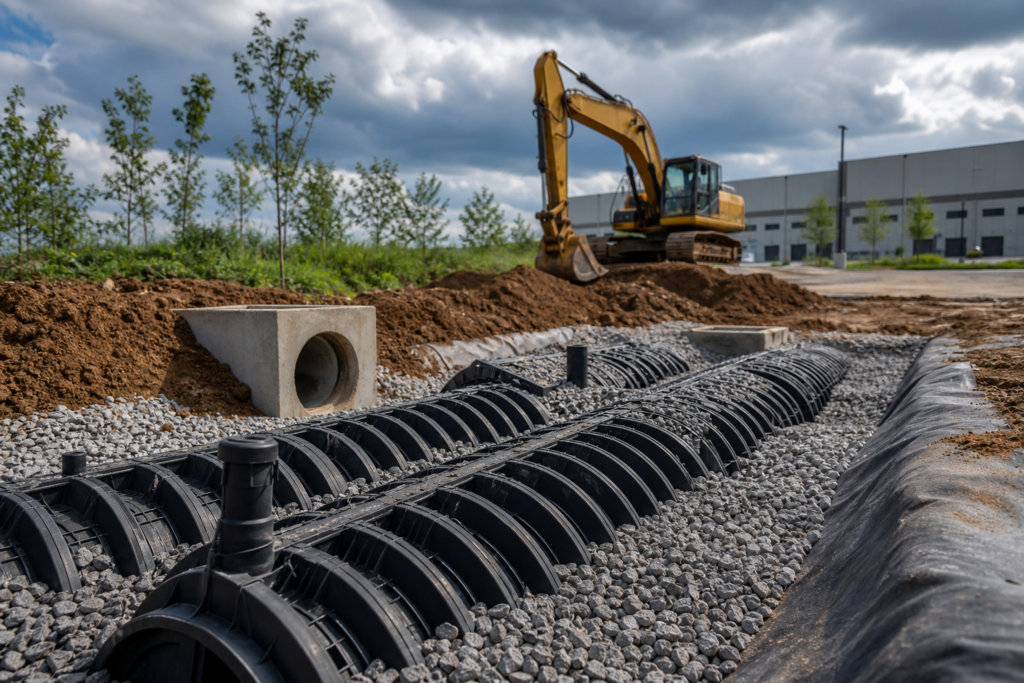
This storm water systems guide compares the common approaches you will see on Georgia commercial sites, subdivisions, and roadways so you can narrow options by the decision criteria project owners and engineers actually use. The options covered are conveyance-only layouts, detention basins, retention ponds and infiltration systems, and water-quality BMPs such as vegetated swales and bioretention. Read on to learn the technical tradeoffs, the regulatory checkpoints that matter in Georgia, and when a contractor who also provides virtual engineering deliverables can reduce risk and speed approvals.
Decision criteria you must use on every site
Use the same checklist of factors for every site before comparing system types. These criteria determine whether an approach will be permitted, buildable, maintainable, and cost effective.
- Available footprint, including slopes that can accept a pond or conveyance corridor.
- Soil infiltration rate and groundwater depth, which decide whether infiltration is feasible and how much pretreatment is required.
- Receiving water sensitivity and discharge point, for example streams or wetlands that trigger additional treatment.
- Water-quality requirement from the permitting authority or MS4; some projects need numeric treatment targets.
- Regulatory pathway, including municipal MS4 rules and GDOT standards for roadway projects; these drive both design and documentation needs. For background on MS4s see the EPA guidance on stormwater discharges from municipal sources and on planning for stormwater programs.
- Maintenance tolerance for the owner, and who will perform routine tasks such as mowing, sediment removal, or filter media replacement.
- Construction cost risk and schedule, including available working season and construction staging near traffic.
- Inspection and closeout documentation, such as as-built GIS submittals, grade calculations, and verification measurements required by permitting authorities.
The EPA recommends long-term stormwater planning to align design, scheduling, and permit compliance for regulated systems, and DOT design manuals outline the minor system components that must move runoff quickly and without backups. See EPA on planning and the Iowa DOT drainage introduction for design fundamentals.
Conveyance-only systems and detention basins: When each fits
Conveyance-only systems are the simplest option. They include curbs, gutters, inlets, pipes, and open channels designed to move runoff from paved areas to a permitted discharge point. Minor systems must convey design storm runoff without backing up at intakes, which is a core DOT requirement for roadway projects. The Iowa DOT design manual outlines these minor system elements and their role in preventing surface flooding.
When conveyance-only is the right choice
- Small sites or sites that discharge to an existing permitted storm sewer with available capacity.
- Projects with limited maintenance budgets and little room for a pond.
- Roadway repairs where GDOT or the local agency accepts conveyance to their MS4 system and downstream capacity exists.
Warning: conveyance-only rarely meets water-quality requirements on its own when discharge goes to sensitive waters or when the local MS4 requires treatment. For construction-era BMPs and sediment control guidance see the FHWA Stormwater Practitioners Guide.
When detention basins make sense
Detention basins temporarily store runoff and release it at a controlled rate. They reduce peak discharge to downstream channels and are frequently required when local hydrology would otherwise increase flood risk. Choose detention when there is enough footprint and the receiving water needs peak attenuation but infiltration is not feasible.
- Good for sites with moderate space and where infiltration is blocked by clay, high groundwater, or contamination.
- Lower maintenance than some treatment systems if designed for sediment forebays and easy access for dredging.
- Often required when MS4 or municipal ordinances demand peak flow control.
Retention ponds and infiltration systems: Soils and pollution risks that decide the choice

Retention ponds maintain a permanent pool and provide settling and biological treatment. Infiltration systems are designed to return stormwater to the subsurface quickly. Both can provide excellent stormwater control but they have different geotechnical and pollution constraints.
When to prefer retention ponds
- Where the permanent pool does not conflict with site use and the owner accepts routine vegetation and mosquito control tasks.
- Sites with low to moderate infiltration but where additional volume and water-quality benefit are desired.
- When downstream discharge limits require both attenuation and treatment.
When infiltration systems are appropriate
Infiltration succeeds when native soils allow percolation to groundwater without mobilizing contaminants. A geotechnical infiltration test and contaminant screening are essential before specifying infiltration. NOAA best practice guidance and EPA modelling tools such as SWMM inform design decisions related to water-quality volume and groundwater interactions.
- Prefer infiltration when soils are sandy, groundwater is deep, and the site has low contamination risk.
- Avoid infiltration where petroleum, high concentrations of heavy metals, or shallow bedrock exist.
- Expect higher maintenance attention to prevent clogging and to replace or rehabilitate underdrains or media over time.
Water-quality BMPs and hybrid approaches: Bioretention, swales, and combination designs
Water-quality BMPs reduce pollutants using physical and biological processes. Vegetated swales and bioretention cells provide treatment with a smaller footprint than ponds but require careful design and maintenance. Media filters and modular devices deliver high pollutant removal in compact areas at higher capital cost.
Hybrid designs often yield the best fit. For example, a bioretention basin can pretreat runoff before it enters a detention basin, or an infiltration trench can handle roof and small-event runoff while a detention pond controls peak flows. The FHWA guide and NOAA BMP guidance catalog construction-era practices and long-term operation steps to make these hybrids effective.
- Bioretention fits tight footprints and provides good pollutant removal where plant maintenance is acceptable.
- Vegetated swales work along road corridors and parking lot edges when slopes allow conveyance and residence time.
- Media filters and vaults suit constrained urban infill sites but need access for maintenance and periodic media replacement.
Regulatory and permitting factors for Georgia projects: MS4 and GDOT checkpoints
Regulatory triggers change the game. Municipal separate storm sewer systems or MS4s are commonly the permitting pathway for urban stormwater discharges. The EPA provides an overview of MS4s and how they channel runoff from public conveyances into receiving waters. Long-term stormwater planning helps communities meet MS4 permit conditions by aligning treatment, inspection schedules, and investment strategies, which is especially relevant for developments expecting municipal connections.
Roadway work under GDOT standards will add design and documentation expectations for minor systems and inlets. GDOT projects also often require as-built and grade verification deliverables with tight tolerances. For design basics see the Iowa DOT drainage introduction and for MS4 context see the EPA pages on stormwater discharges from municipal sources and on stormwater planning.
How a hybrid contractor that offers construction plus virtual engineering reduces risk

When you select a contractor that combines field work with virtual deliverables you shorten the feedback loop between design, permitting, and construction. A single partner who provides construction stakeout plans, roadway grade calculations, 3-point level verification, and GDOT as-built GIS submittals minimizes RFIs and reduces closeout rework. DCBC LLC advertises this integrated model and lists storm water systems, erosion control, stakeout plans, GDOT as-built GIS submittals, and grade calculations among its services on the company site. See DCBC LLC for the portfolio of construction and virtual services.
Using modeling tools such as EPA’s SWMM during the preconstruction phase supports sizing, predicts interaction with groundwater, and clarifies treatment volumes before grading. That reduces change orders and permits a clearer bid.
Pre-bid checklist and quick decision matrix to narrow options onsite
Use this short checklist during an initial site visit to reduce the options you will ask bidders to price.
- Footprint available: small, medium, or large.
- Soils: high infiltration (sandy), moderate, low (clay or bedrock near surface). Perform percolation tests if unsure.
- Groundwater: deep or shallow.
- Receiving waters: sensitive (streams, wetlands) or non-sensitive.
- Regulatory trigger: will the site discharge to a municipal MS4 or require GDOT approval?
- Maintenance tolerance: owner accepts high, moderate, or low ongoing upkeep.
Quick matrix outcome rules of thumb
- Small footprint and sensitive receiving water: consider compact media filters or modular vaults with pretreatment.
- Medium footprint with low infiltration: detention basin plus pretreatment such as forebays or bioretention.
- Large footprint and high infiltration: infiltration basin or distributed infiltration systems, pending contamination screening.
- Roadway projects connecting to MS4 with limited next-stage capacity: detention basin sized to local discharge limits and as-built GIS deliverables for compliance.
When you have narrowed options to two or three feasible schemes, request modeled outputs, a preliminary cost range, and sample as-built deliverables before inviting final bids.
Common objections, risks, and lifecycle maintenance to plan for
Address these frequent concerns during procurement to avoid surprises.
- “Infiltration always saves money.” Not always. Site preparation, pretreatment and long-term maintenance for clogging can increase lifecycle cost.
- “Detention ponds require huge footprints.” They do require space, but hybrids and staged basins can reduce footprint while providing comparable peak flow control.
- “BMPs need little maintenance.” All BMPs need routine attention such as sediment removal, vegetation management, and media replacement for filters.
Municipal and GDOT inspections commonly request as-built elevations, pipe invert records, and GIS-located features for closeout. Including these deliverables in the contract scope reduces punch-list work at the end of the job.
Next steps: what to ask bidders and when to request a quote
Prioritize these questions when you request a site assessment or a quote from bidders. They will surface differences in approach, risk allocation, and documentation capability.
- Do you have a recent infiltration test and geotechnical report for the site, or will you include testing in the bid?
- Which options do you model with SWMM or equivalent, and can you provide sample model outputs?
- What pretreatment is proposed for infiltration or bioretention areas, and what are the maintenance intervals?
- Can you deliver GDOT-compliant as-built GIS submittals and grade verification documentation as part of the contract closeout?
- Who will be responsible for long-term maintenance and what will you include in an operations and maintenance manual?
If you want a turnkey partner in Georgia that combines field construction with virtual engineering services such as stakeout plans, grade calculations, and GDOT as-built GIS submittals, request a site assessment and quote from DCBC LLC. You can also review contract terms including refund returns as part of your procurement documents.
Frequently asked questions
What is the difference between detention and retention for commercial projects in Georgia?
Detention basins temporarily store runoff and release it at a controlled rate to reduce peak flows. Retention ponds hold a permanent pool and provide greater settling and biological treatment. The choice depends on footprint, desired treatment, and maintenance capacity.
When do MS4 permits or GDOT standards force a particular stormwater solution?
MS4 permits and local MS4 ordinances can require water-quality treatment and peak attenuation before discharge to municipal systems. GDOT projects add roadway-specific minor system expectations and documentation standards. See EPA pages on MS4s and on stormwater planning for an overview of how these regulatory pathways affect design.
How do site soils and infiltration testing change the recommended system?
High infiltration soils make infiltration basins or trenches attractive. Low infiltration or shallow groundwater usually rules out infiltration and points to detention or retention with pretreatment. Always confirm with a site-specific infiltration test and geotechnical review.
What documentation should I require from bidders before awarding a stormwater contract?
Require modeled hydrographs or SWMM outputs, a proposed maintenance plan, a sample operations and maintenance manual, sample as-built deliverables in GIS and field-verified grades, and a schedule for infiltration and geotechnical testing if not already provided.
Can a contractor deliver GDOT-compliant as-built GIS and reduce permit delays?
Yes. A contractor that provides GDOT as-built GIS submittals and construction stakeout plans can reduce RFIs and shorten permitting cycles by delivering inspection-ready documentation. DCBC LLC lists GDOT as-built GIS and stakeout services among its offerings on the company website.
Ready to get started? Request a site assessment and quote from DCBC LLC to compare turnkey and hybrid stormwater solutions for your Georgia project.
References and further reading