
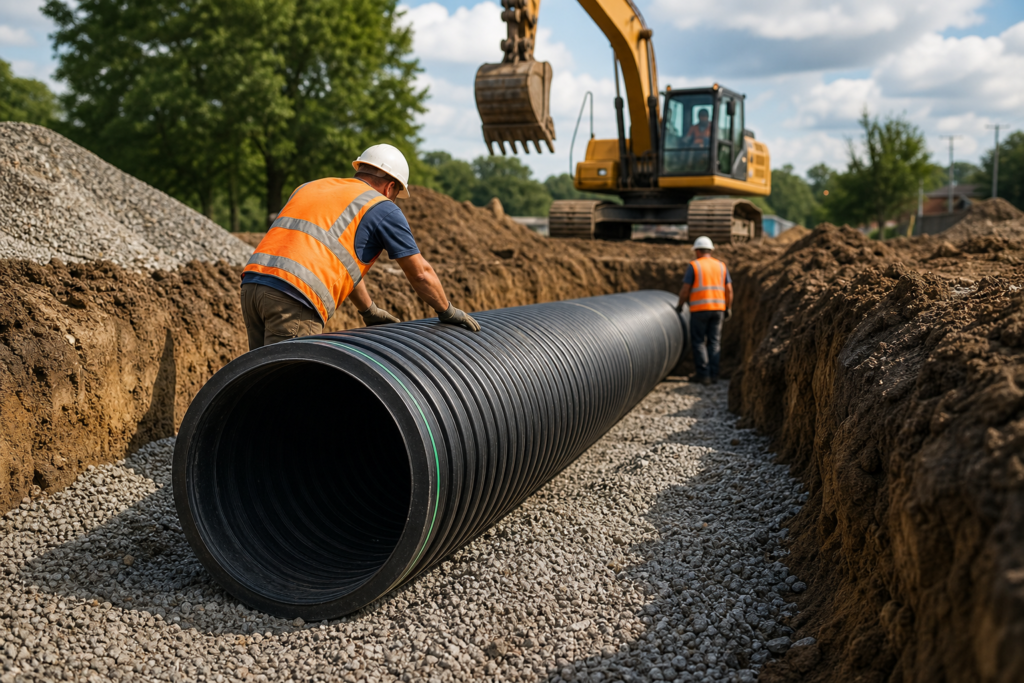
HDPE pipe installation for stormwater lines follows a predictable, contractor-ready sequence: choose the installation method that fits the site, prepare the trench and bedding, execute fusion or jointing with documented quality assurance, control backfill and thermal movement, and then pressure test and deliver GDOT-ready records. This article presents an ordered workflow with inspection stop points you can use in the field or include in procurement specifications.
At-a-glance contractor checklist
- Confirm design SDR, diameter, material grade, and embedment specification.
- Select the installation method: open-cut, HDD, pipe bursting, or sliplining and document the justification (method comparison).
- Complete permits, utility locates, erosion control, and a dewatering plan.
- Prepare trench geometry and bedding per designer requirements; verify bedding material and compaction targets.
- Perform fusion or electrofusion with calibrated equipment and keep fusion logs and traceability.
- Execute staged backfill with compaction testing, account for thermal movement, and install anchors where needed.
- Run pressure or low-pressure air/water tests and record results before final backfill.
- Handoff deliverables: fusion logs, pressure test reports, compaction records, grade verification, stakeout plans, and GDOT as-built GIS files when required.
Step 1: select the right installation method
Method selection is a jobsite decision. Open-cut excavation is the least complex and usually the least expensive when the right-of-way is available and traffic disruption is acceptable. Horizontal directional drilling, microtunneling, or HDD minimizes surface restoration and is preferred beneath paved roads, rail lines, or sensitive landscaping. Pipe bursting and sliplining are rehabilitation options that avoid full excavation. Choose the method based on site constraints, total cost (including restoration), utility conflicts, and environmental impact rather than on the pipe material alone (Primepoly).
Decision criteria
- Surface access and traffic: use HDD or sliplining to avoid long lane closures and expensive paving restorations.
- Subsurface obstructions and utilities: if utilities are dense or unknown, HDD or detailed potholing may reduce risk.
- Restoration costs: include paving, curb, landscape, and schedule impacts when comparing options.
- Permitting and schedule: HDD often requires geotechnical review and specific permits; weigh that in the bid comparison.
Step 2: site preparation, trenching, and bedding
Trenching and bedding are the foundation of a long-lived HDPE installation. HDPE can perform for many decades when installation follows specification, but a rushed trench or poor bedding will cause early failures (IFAN). Before placing pipe, confirm trench width, depth, side slopes, shoring requirements, dewatering strategy, and erosion controls with the project engineer.
Bedding and subgrade expectations
- Remove unstable organic material and soft pockets; replace with specified granular material where required.
- Provide a uniform bedding layer, commonly well-graded sand or granular material, of the thickness shown on plans and compact to the specified density.
- Inspect and record bedding prior to pipe placement; many owners require this as a hold point.
- Document corrective actions for unexpected conditions and capture photos and notes for the as-built record.
Step 3: jointing and fusion procedures with QA stop points

Common HDPE joint methods are butt fusion and electrofusion. Both require calibrated equipment, trained operators, and a clean environment. Poor fusion is a leading cause of premature failures when operators skip cleaning, use incorrect heating parameters, or allow uncontrolled cooling. Treat jointing as a controlled process with logs and acceptance criteria (USFusion) and (IFAN).
Execution checklist for fusion
- Verify pipe ends are clean, round, and free of gouges; face the pipe with the correct tool.
- Confirm fusion machine calibration, heater plate temperature, and timing per SDR and manufacturer guidance.
- Record operator name, machine ID, joint number, fusion parameters, ambient conditions, and cool times in a fusion log.
- Perform visual and any required non-destructive checks and retain records that connect joint IDs to the log.
- If a joint fails acceptance, cut out the joint and re-fuse under documented corrective action.
Step 4: backfill, compaction, anchoring, and thermal movement control
Backfill sequence and compaction directly affect pipe performance. Place controlled lifts and meet compaction percentages in the contract, and avoid running heavy equipment over the pipe until specified cover is achieved. HDPE expands and contracts with temperature, so layout must allow thermal movement. Long runs or abrupt alignment changes may require anchors, thrust blocks, or restrained joints. Improper backfill or ignoring thermal effects are common causes of field problems (USFusion).
Practical backfill steps
- Place initial surround to the springline carefully to prevent lateral movement.
- Backfill in uniform lifts, compact to specified relative compaction values, and perform compaction testing at intervals.
- Install anchors, thrust blocks, or use restrained joints at fittings, bends, and grade breaks where unbalanced forces occur.
- Document compaction tests and deviations before paving or surface restoration.
Step 5: pressure testing, inspection, and hold points for handoff
Testing validates the pipe before final backfill and service. Accepted tests include hydrostatic pressure tests and low-pressure air tests as specified. Conduct a controlled test, monitor pressure or leakage for the required hold time, and produce a written report; do not bury the line until the project engineer accepts the results (PipesAndFittings) and (IFAN).
Minimum testing workflow
- Isolate the test section, install test caps, and fill with water for hydrostatic tests.
- Bring pressure to the contract test value and hold for the specified period while monitoring for drops or visible leaks.
- Record readings, note repairs, and repeat the test after corrective work.
- Only after acceptance should final backfill and surface restoration proceed.
Documentation, GDOT compliance, and as-built deliverables

Public owners often require traceable closeout records: fusion logs, fusion equipment IDs, pressure test reports, compaction records, grade verification, stakeout plans, and GDOT-ready as-built GIS submittals. A contractor that provides both field execution and virtual deliverables can simplify handoff; DCBC LLC lists fusion traceability, stakeout plans, grade calculations, and GDOT-ready GIS as-built submittals among its capabilities, which reduces coordination at closeout (DCBC LLC) and (projects).
When writing specifications or soliciting bids, require the fusion log format, compaction test frequency, and pressure test acceptance criteria so bidders can plan equipment, staffing, and QA documentation correctly.
Common mistakes that cause HDPE pipe failures and how to avoid them
Failures usually stem from a few avoidable errors. Below are common issues and practical mitigations.
- Poor bedding and soft subgrade: remove unsuitable material and replace with compacted granular bedding, and document the work.
- Dirty or uncontrolled fusion: use calibrated equipment, trained operators, and complete fusion logs; inspect random joints.
- Improper storage and handling: store coils and lengths on pallets, protect from dirt and UV, and avoid kinking during placement.
- Ignoring thermal movement: design expansion loops or anchors where long runs cross temperature extremes or fixed structures.
- Skipping hold points: do not finalize backfill before bedding inspection, fusion QA, and accepted pressure tests.
Treat HDPE installation as a system-level scope: materials, jointing, bedding, and testing belong to the same quality control plan (USFusion) and (IFAN).
Procurement questions and decision criteria for contracting
When evaluating bids, request and score the following: evidence of trained fusion operators and fusion logs, a trenching and dewatering plan, compaction test frequency, method justification for HDD or bursting, a pressure-testing procedure with acceptance criteria, and a list of deliverables including fusion logs and as-built GIS files. If GDOT submittals are required, preference for a Georgia DOT certified contractor can reduce review friction; DCBC LLC highlights GDOT certification and hybrid field/virtual delivery among its capabilities (DCBC LLC).
Frequently asked questions
When should you use HDD instead of open-cut for HDPE stormwater lines?
Use HDD when surface restoration cost or active traffic makes open-cut impractical, when crossing beneath paved roads or rail, or when minimizing disturbance to landscaping is important. HDD requires geotechnical evaluation and permits and is usually more expensive than open-cut, so justify it based on total project cost and risk (installation methods).
What fusion records and tests should a contractor supply with HDPE installations?
Require a fusion log for each joint that records operator ID, machine ID, heating time, pressure, ambient conditions, joint number, and cool time. Include machine calibration records, any non-destructive checks, and retain documentation in the closeout package (contractor guidance).
How long should pressure tests hold and what are common acceptance criteria?
Hold times and pressures are set in contract documents. Typical practice is to pressurize a test section to a static value and hold for a defined period while monitoring for decay and visible leaks. Always follow the project specification and record all readings for the record (testing procedure).
Do HDPE stormwater pipes require thrust blocks or anchors and where?
Yes. Use thrust blocks, anchors, or restrained joints at fittings, bends, grade breaks, and transitions where unbalanced forces could produce movement. The designer will typically identify locations, but the contractor should plan for restraint and verify requirements during layout.
What GDOT as-built deliverables should I require at project closeout?
Require fusion logs, pressure test reports, compaction records, grade verification, stakeout plans, and GDOT-ready as-built GIS submittals when a public agency or GDOT review is expected. A contractor that provides virtual deliverables can prepare and submit files in the formats needed for municipal or state review (see project examples).
Next steps and how to get a site-specific quote
Ready to request a site-specific quote, fusion QA plan, or GDOT-ready as-built submittal for your HDPE stormwater project? Visit the DCBC LLC projects page or the main site DCBC LLC and submit your project details so the team can propose method selection, QA steps, and deliverables?