
How to navigate roadway construction phases
The phrase roadway construction phases describes the ordered steps every public or private road project follows from concept to final acceptance. This article gives a six-phase roadmap you can use to track progress, confirm deliverables, identify inspection and stop points, and see where a Georgia DOT certified contractor such as DCBC LLC can provide field work and GDOT-compliant virtual services.
Overview and what to expect
Most state and municipal delivery manuals break roadway delivery into discrete phases so agencies and contractors can manage risk, schedule, and compliance. Public DOT pages commonly list planning, final design and permitting, procurement, construction staging, paving, and closeout as the major phases; see the North Carolina overview and Virginia summary for typical public-agency sequencing and responsibilities (How a Road Gets Built | NCDOT, How projects get built | VDOT).
Quick checklist of common deliverables and permits to watch for:
- Funded project authorization or approved scope and funding source
- Environmental permits and NPDES discharge controls, and a SWPPP
- Right-of-way acquisitions and temporary construction easements
- Final plans, technical specifications, and the engineer’s estimate
- Traffic control plan, staging plans, and utility coordination agreements
- Compaction, density, and materials test reports for earthwork and asphalt
- As-built documentation, including GDOT as-built GIS submittals where required
Phase 1: Planning, scoping, and funding
What happens: project identification, corridor or traffic studies, public outreach, and programming for funding. Agencies and owners determine the need, select feasible alternatives, and choose a delivery method such as design-bid-build or design-build. Early feasibility work identifies environmental constraints, right-of-way needs, and utility impacts that will affect cost and schedule.
Typical deliverables: corridor studies, traffic forecasts, preliminary cost estimates, and a funding resolution. These documents are the basis for advancing to final design.
Who owns it: the project sponsor or agency leads planning with support from traffic and environmental consultants. For public projects, the planning phase is often separate from design to allow stakeholder input and funding alignment (NCDOT how a road gets built, MOVEBR project lifecycle).
Stop points and risk triggers:
- Do not start final design until funding is committed and a preferred alternative is selected.
- Pause and escalate if studies reveal major environmental or right-of-way constraints requiring additional approvals.
Phase 2: Final design, environmental permits, right-of-way, and procurement

What happens: designers prepare biddable plans, specifications, and a final engineer’s estimate. The project secures environmental permits and any required mitigation plans. Right-of-way and temporary construction easements are obtained, and utility coordination is completed so relocations do not block construction.
Typical deliverables: final plans set, bid-ready specifications, certified environmental permits, and documentation of right-of-way acquisitions. When the package is ready, the owner advertises the work and selects a contractor through the chosen procurement method.
Who owns it: the project engineer manages design and permitting, the owner secures right-of-way, and utility owners manage relocations. Local delivery manuals treat right-of-way and permit certifications as prerequisites to construction so work does not stall (LA Bureau of Engineering phases, NCDOT project phases).
Stop points and inspection holds:
- Do not advertise or award a contract until required permits and right-of-way clearances are in place.
- Hold construction start if critical utility agreements or environmental conditions remain unresolved.
How DCBC LLC can help: DCBC provides construction stakeout plans, house location plans, and preconstruction takeoffs that reduce RFIs during bidding and mobilization. Their hybrid consulting capability can prepare GDOT-friendly documentation to smooth advertisement or procurement if owners need support (DCBC LLC).
Phase 3: Site preparation — clearing, grubbing, erosion control, and earthwork
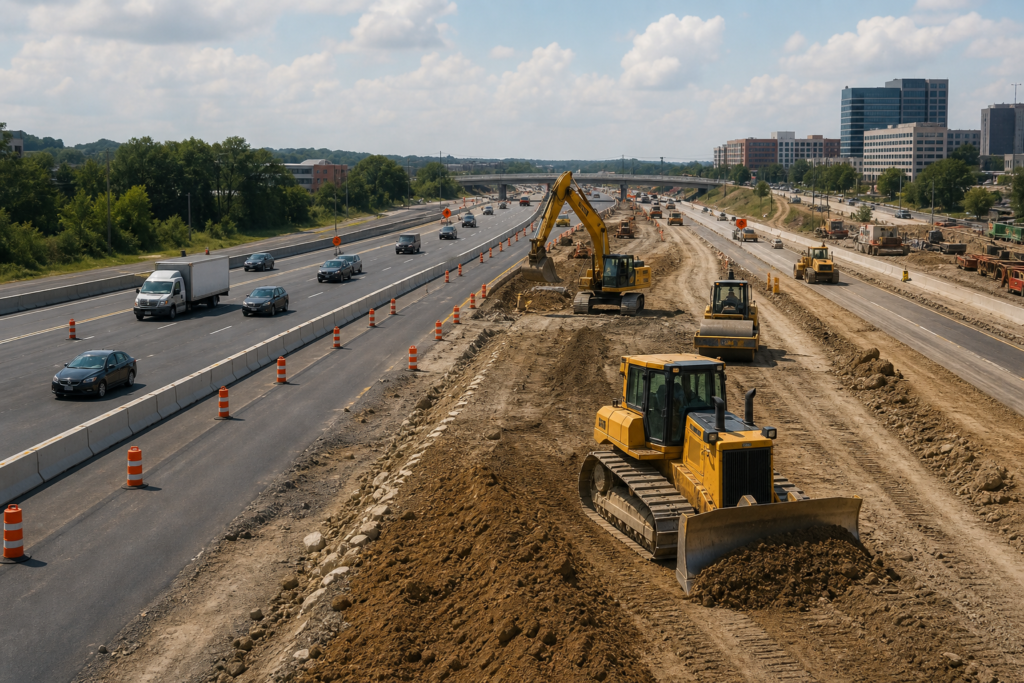
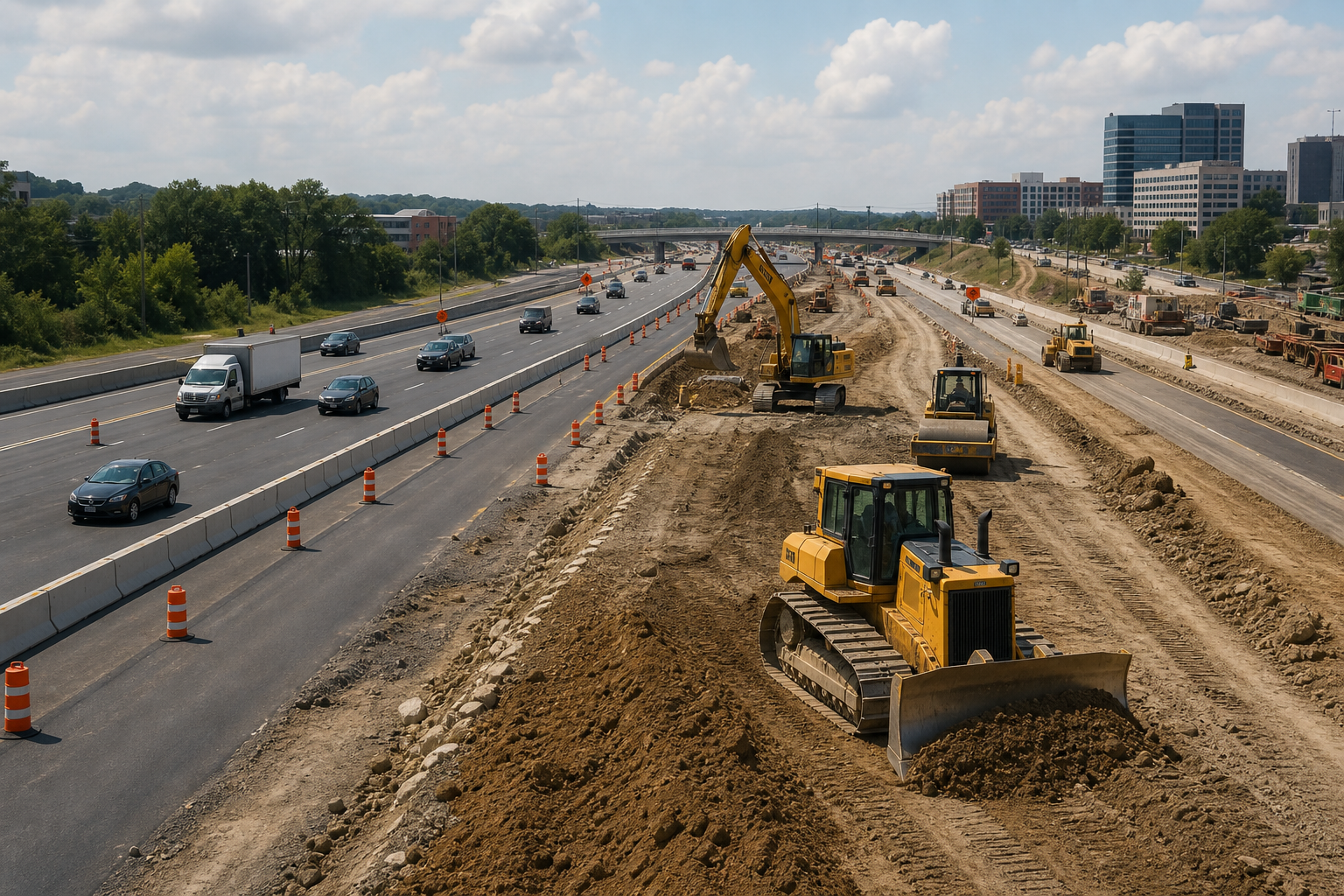
What happens: once access is granted, crews clear vegetation and structures, grub roots and organic material, and install temporary erosion and sediment controls. Massive cut and fill operations establish rough grades, haul routes, staging areas, and temporary traffic accommodations. Temporary pavement or detours may be placed to maintain mobility during construction.
Typical deliverables and checks: clearing limits, erosion control installation verified by inspection, earthwork quantity reports, haul-route permits, and initial compaction testing plans for mass-graded areas.
Who owns it: the awarded contractor performs clearing and grading under the engineer’s observation. Inspection agencies verify erosion control measures and ensure compliance with environmental permits. Public program descriptions list clearing and grubbing as the first construction activities after mobilization (MOVEBR clearing and grubbing).
Critical stop points and safety limits:
- Stop work if erosion control devices are not installed or are failing during storms. Permits commonly require immediate corrective action.
- Pause grading if undocumented utilities or cultural resources are discovered, and require an owner or engineer decision before proceeding.
- Require compaction plans and verification before accepting mass-graded areas for underground work.
Phase 4: Utilities, drainage, and subgrade preparation
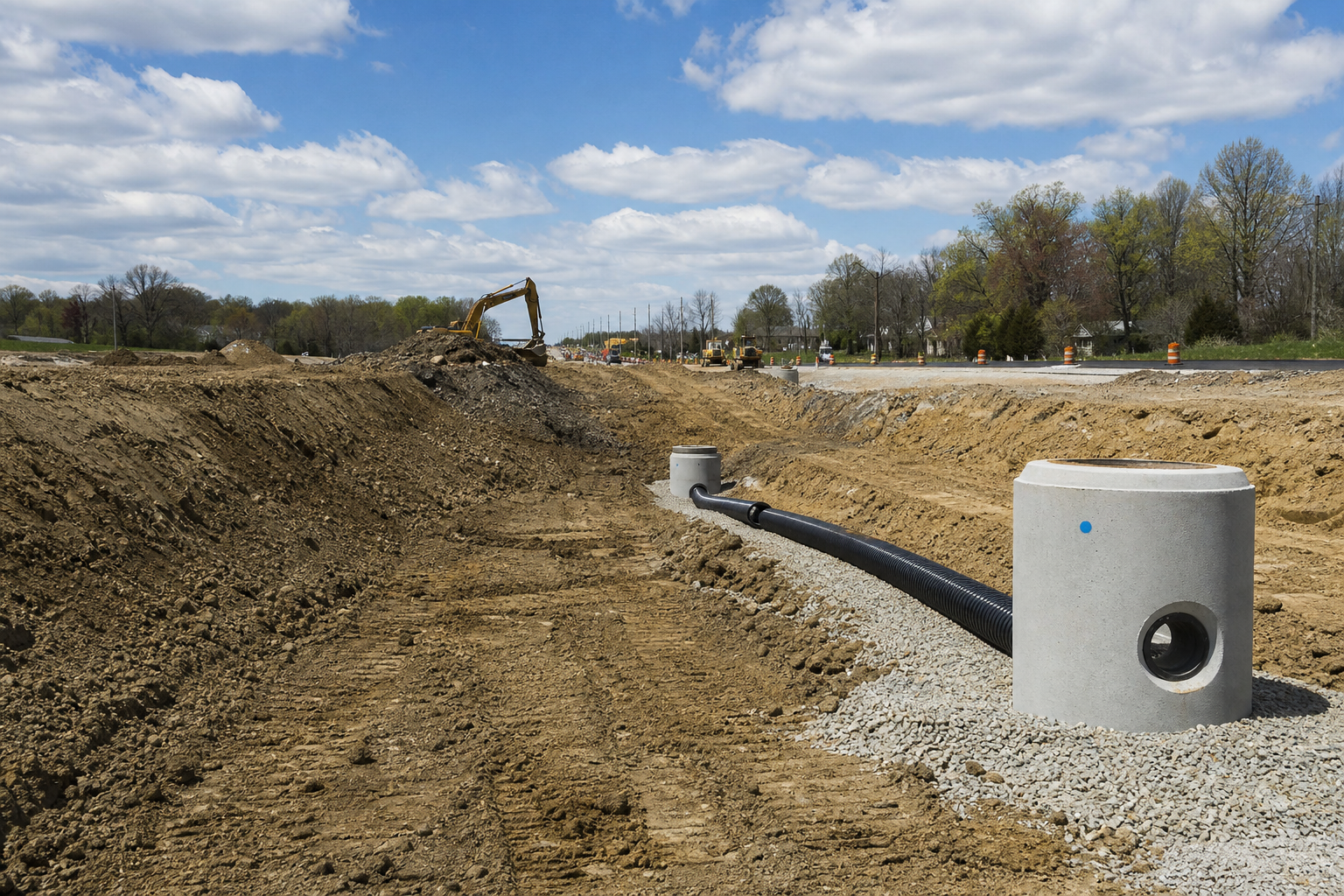
What happens: installation of underground utilities and stormwater systems takes place. Typical components include pipe types such as RCP or HDPE, drop inlets, catch basins, manholes, flumes, and energy dissipation structures. After utilities are placed, subgrade stabilization, proof-rolling, and compaction testing prepare the site for pavement sections.
Typical deliverables and tests: installed manholes and inlets inspected and tested, CCTV or video records for sanitary systems where required, compaction and density reports for each lift, and proof-roll results for subgrade acceptance.
Who owns it: the contractor installs and tests systems, the engineer inspects, and utility owners verify their assets. Manuals and technical reports highlight underground installation and subgrade acceptance as essential holds before paving (LA project delivery, Typical construction phasing | CTR/UTexas).
Inspection and regulatory stop points:
- Do not place base or paving until compaction and density tests meet plan requirements.
- Hold paving if stormwater conveyances are not installed, tested, and approved by the permitting authority.
- Escalate unresolved utility conflicts to the owner and document the RFI and response before proceeding.
Where DCBC LLC helps: DCBC lists HDPE and RCP installation, drop inlets, catch basins, and stormwater systems among its services. Their hybrid model can deliver field installation and provide GDOT as-built GIS submittals or grade calculations to document compliance (DCBC LLC).
Phase 5: Paving, milling, surface treatments, and pavement quality control
What happens: pavement work includes any milling of existing surfaces, placing asphalt base lifts, and final surface lifts to specification. Joint treatment, compaction, and density testing are enforced. For active corridors, temporary paving or staged lifts keep traffic moving while final lifts are scheduled.
Typical controls and acceptance: mix design verification, temperature monitoring during placement, lift thickness checks, density tests, and smoothness measurements as required by the specifications. Payment is often conditional on meeting these acceptance criteria.
Who owns it: the paving contractor executes work under materials testing and engineering oversight. Technical studies show how phasing and temporary pavement protect traffic and work quality during sequential construction steps (CTR/UTexas technical report).
Quality controls and stop points:
- Stop paving if temperature, mix composition, or compaction tests fall outside acceptance criteria.
- Require a testing plan and field QC to document lift thickness, density, and smoothness before payment or acceptance.
- Stage final paving so striping and permanent signage can be placed on a completed surface.
DCBC services relevant to this phase include asphalt paving and milling, parking lot resurfacing, and sealcoating for asset preservation and life extension (DCBC LLC).
Phase 6: Traffic control, striping, signage, final inspection, and closeout
What happens: the contractor installs permanent striping, thermoplastic or paint markings, traffic signs, wheel stops, and any ADA signage and markings. Final safety checks are performed and punch list items are completed. Certified as-built submittals and final testing reports are submitted so the owner can accept the work and release final payments.
Typical closeout deliverables: final materials and test reports, certified as-built plans, GDOT as-built GIS submittals where required, warranty and maintenance instructions, and a signed final acceptance letter.
Who owns it: the contractor prepares the as-built records and completes the punch list, while the engineer or owner performs final inspection and acceptance. DOT guidance and local project lifecycles emphasize closeout deliverables and certifications as the final phase before turnover (NCDOT how a road gets built, MOVEBR lifecycle).
Closeout checklist to confirm:
- All punch list items closed and safety devices installed
- Final materials and laboratory test reports submitted and approved
- GDOT as-built GIS submittal or equivalent as-built plans provided where required
- Warranty, maintenance schedules, and contact points delivered to the owner
Where to find examples and project references: review DCBC’s project examples to see how field execution and documentation are combined for turnkey delivery and closeout submittals (projects).
Frequently asked questions
Who is responsible for obtaining permits and right-of-way during roadway construction phases?
The project owner or sponsoring agency typically leads permitting and right-of-way acquisition, supported by the design consultant and a permitting specialist. Contractors must verify permit conditions before mobilizing. Unresolved permits are valid reasons to pause work until the agency issues formal clearance (LA project delivery manual).
When should owners or engineers pause work for inspections or stop work to resolve a compliance issue?
Pause work when erosion controls fail during runoff events, when compaction or density tests do not meet specified thresholds, when undocumented utilities are encountered, or when safety incidents occur. These inspection-hold points are standard protections for public safety and long-term performance (MOVEBR process).
What GDOT deliverables and formats should I expect at closeout, including as-built GIS submittals?
For GDOT projects expect certified as-built plans and, where required, GDOT as-built GIS submittals that document constructed grades, pipe and structure locations, and pavement sections. Consultants and contractors providing as-built services should be familiar with GDOT formatting and submission protocols. Hybrid firms like DCBC include GDOT as-built GIS submittals among their virtual services (DCBC LLC).
How do virtual services such as construction stakeout plans and grade calculations reduce risk during construction?
Virtual deliverables reduce field rework and RFIs by verifying stakeout positions, house locations, and roadway grades before crews mobilize. Accurate takeoffs and grade calculations improve bidding accuracy and limit change orders. Services such as construction stakeout plans, 3-point level verification, and precise grade calculations help field crews build to plan and avoid delays (DCBC LLC).
How is traffic maintenance staged during phased construction to protect public safety and minimize closures?
Agencies and contractors use construction phasing to shift traffic, install temporary pavement, or build one side at a time so lanes remain open. Temporary paving, lane shifts, and clear signing are common tactics to balance safety, mobility, and constructability. Technical phasing strategies and temporary paving sequences are documented in phasing studies and guidance documents (CTR/UTexas phasing study).
If you need a contractor who can perform field civil site work and provide GDOT-ready virtual deliverables, contact DCBC LLC to request a quote and discuss how combined construction and consulting support can shorten schedules and reduce risk.