
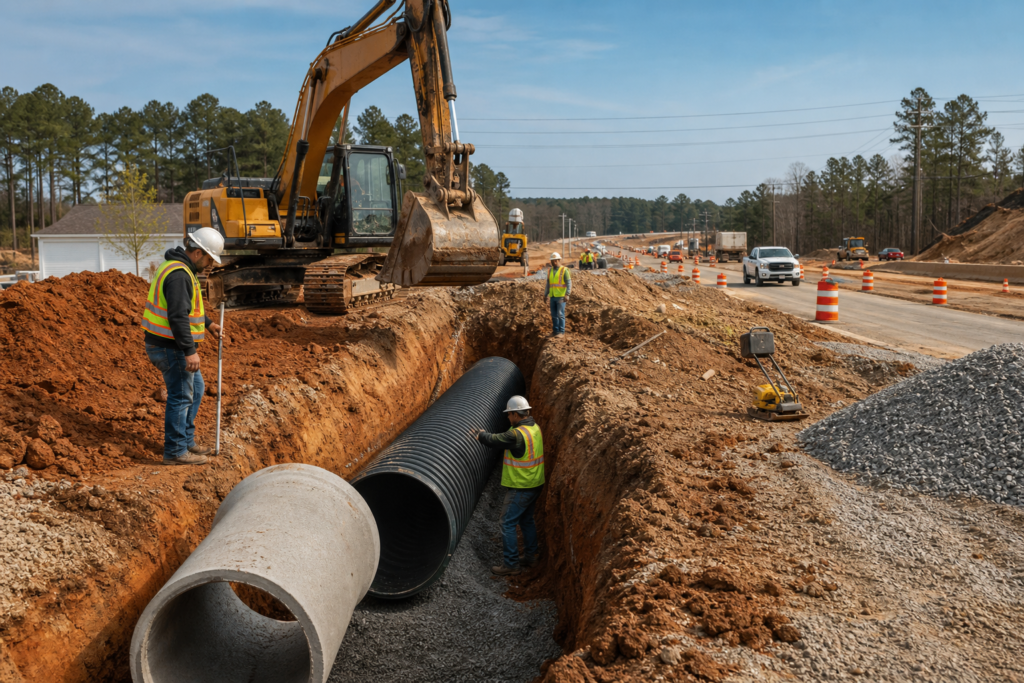
There is no universal winner between HDPE and reinforced concrete pipe (RCP) for a Bethlehem, Georgia project. The better choice depends on design loads, burial and trench conditions, drainage function, connection details, project specifications, construction access, and required approvals.
Pipe selection should therefore be treated as part of the complete civil site work plan rather than as an isolated product decision. This comparison helps developers, contractors, engineering teams, municipalities, and property stakeholders identify which option deserves closer review before finalizing plans or requesting a quote.
HDPE and RCP compared by project criteria
This table is a preliminary screening tool, not a design approval. Use it to frame questions for the project engineer, owner, municipality, general contractor, or site work contractor.
| Criterion | HDPE may deserve evaluation when | RCP may deserve evaluation when |
|---|---|---|
| Structural loading | The design and specifications allow HDPE for expected buried and surface conditions. | The project presents demanding structural or traffic-related conditions requiring detailed evaluation of concrete pipe. |
| Burial and trench conditions | Trench, bedding, backfill, and compaction requirements can be controlled for the selected system. | The team needs to assess a rigid pipe option alongside specified trench and support conditions. |
| Handling and access | Site congestion, staging, equipment access, or sequencing make handling especially important. | The site can support the equipment, staging, and placement sequence required for the specified RCP sections. |
| Structures and connections | Connections to inlets, catch basins, manholes, or other structures can be detailed and approved. | Connection details, structure interfaces, or specifications favor RCP components. |
| Roadway exposure | The crossing design, cover, support, and specifications permit HDPE at that location. | The roadway or traffic-bearing area requires closer review of rigid pipe, structures, cover, and sequencing. |
| Closeout documentation | The team can verify alignment, grade, structures, and quantities in the required format. | The same documentation can be coordinated with RCP installation and structure records. |
1. Structural loading, burial depth, and trench conditions

Start with what the pipe must support and how it will be installed. Traffic loading, burial depth, trench geometry, bedding, backfill, compaction, and soil information can all affect whether a proposed pipe system is suitable.
RCP is not automatically correct for every heavily used area, and HDPE is not automatically unsuitable beneath a roadway. The selected material must be evaluated with actual cover, surface use, support conditions, pipe size, alignment, and project requirements in view.
Ask for the design basis behind the selection. If the plans specify one material, determine whether an alternative is permitted and what calculations, submittals, or approvals would be required before changing it.
2. Installation access, handling, and sequencing
Installation conditions can be as important as the pipe material. A commercial development, residential subdivision, or roadway project may have limited staging space, active traffic, existing utilities, changing grades, or several trades working in the same area.
HDPE may be worth considering when the project team needs to examine handling and access constraints. RCP may also be appropriate where the site can support its planned delivery, equipment, placement, jointing, and inspection sequence.
The practical question is not simply which pipe is easier to move. It is whether the entire sequence works: excavation, trench preparation, placement, connections, backfill, inspection, restoration, and coordination with following trades.
3. Drainage function and system layout
Pipe material is only one part of a stormwater system. The layout may include inlets, catch basins, manholes, slope drains, roadway crossings, discharge points, and other structures. Alignment and grade must work across the complete system.
Hydraulic design should be distinguished from material selection. Choosing HDPE or RCP does not establish the required pipe size, slope, capacity, structure spacing, outlet arrangement, or erosion-control approach.
DCBC LLC lists stormwater systems work that includes HDPE pipe installation, RCP installation, drop inlets, catch basins, manholes, slope drains, and roadway crossings. That broader scope matters because the pipe decision needs to be coordinated with surrounding structures and earthwork.
4. Roadway crossings and traffic-bearing areas
A pipe beneath a roadway, parking area, or drive aisle deserves separate review. Confirm the proposed alignment, grade, cover, support conditions, surface loading, structure locations, traffic-control needs, and restoration sequence.
For a roadway crossing, compare the material allowed by the plans with the conditions that will exist when the crossing is installed. A technically suitable pipe can still create coordination problems if access, sequencing, existing utilities, or traffic movement have not been addressed.
Roadway construction also connects drainage to grading and pavement work. The crossing must be coordinated with finished grades, subgrade preparation, paving limits, and any turn lanes or other improvements in the scope.
5. Connections, inspection, and closeout documentation
Confirm how the selected pipe will connect to drop inlets, catch basins, manholes, culverts, slope drains, or other components. The design team should also clarify how transitions and connections will be inspected and recorded.
Field verification may include alignment, elevations, grades, structure locations, installed quantities, and changes from the plans.
DCBC LLC provides construction stakeout, roadway grade calculation, three-point level verification, estimation and takeoff, and GDOT as-built GIS submittal services. These services do not determine the correct pipe automatically, but they can support coordinated layout, quantity control, field verification, and as-built documentation.
When HDPE may fit the project
HDPE may deserve consideration when the team is weighing handling, staging, access, and sequencing alongside drainage design. It may also be a candidate where plans and specifications permit it and installation conditions support the required bedding, backfill, compaction, connections, and inspection.
This can be relevant on sites where several work areas must be coordinated or pipe installation must fit around active construction. However, site congestion alone is not enough to approve a material change. The proposed system still needs to satisfy design and approval requirements.
Before choosing HDPE, ask whether pipe size, burial conditions, roadway exposure, structure connections, and closeout requirements have been reviewed together.
When RCP may fit the project
RCP may deserve consideration where the project presents demanding structural, roadway, burial, or connection conditions. It can also be the specified option for a public, commercial, or transportation application, in which case the contractor should price and sequence the work around the approved design.
That does not make RCP the universal answer. Delivery, staging, equipment access, trench preparation, structure interfaces, and installation sequencing still need to be planned for the actual site.
Ask how the proposed sections, joints, structures, and installation sequence fit with grades, traffic areas, existing utilities, and restoration limits.
Could a project use both HDPE and RCP?
A drainage system may be evaluated as a mixed system when different segments have different loading, access, structure, or construction requirements.
A mixed approach is not simply a matter of joining two pipe types. The team must review transitions, compatible connections, grades, bedding and backfill, structure interfaces, inspection access, specifications, and approvals as one system.
If a mixed system is proposed, document where material changes occur and why. This makes estimating, procurement, installation, inspection, and as-built records easier to coordinate.
How pipe selection affects the rest of civil site work
The pipe decision can affect earthwork and grading, stormwater installation, erosion control, roadway construction, paving, structure placement, and project sequencing. It may also change quantities included in an estimate or takeoff.
Layout should be addressed before excavation begins. Construction stakeout can help coordinate alignments, structure locations, grades, and related work. For Bethlehem projects, review the role of construction stakeout plans in site coordination alongside the drainage plans.
Erosion control is part of the same conversation. Excavation, stockpiles, disturbed soil, outlets, and changing drainage paths should be coordinated with the project’s erosion-control measures and construction sequence.
Information to gather before choosing HDPE or RCP
- Site plans, utility plans, drainage plans, profiles, and relevant details.
- Pipe alignments, grades, sizes, lengths, slopes, and discharge points.
- Locations and details for inlets, catch basins, manholes, slope drains, roadway crossings, and other structures.
- Burial conditions, surface uses, traffic areas, cover information, and available soil or geotechnical information.
- Known trench, groundwater, utility, access, staging, and excavation constraints.
- Specifications identifying permitted materials, installation requirements, inspection, testing, and submittals.
- Phasing, traffic-control needs, restoration limits, and interfaces with paving or other trades.
- Required layout, quantity verification, as-built, GIS, or closeout documentation.
Questions to resolve before requesting a quote
Ask whether HDPE, RCP, or both are permitted by the current plans and specifications. Confirm whether an alternate material would require formal review, revised details, additional calculations, or approval from another project party.
Ask how the proposed material affects excavation, bedding, placement, connections, backfill, inspection, traffic control, restoration, and sequencing. Request that the quote identify assumptions, exclusions, structures, pipe quantities, access constraints, and documentation responsibilities.
Provide the contractor with the latest drawings and revisions rather than relying on a verbal description. Missing profiles, structure details, phasing information, or specifications can make comparison less reliable.
Frequently asked questions about HDPE and RCP selection
What is the basic difference between HDPE and RCP for stormwater work?
HDPE and RCP are different pipe materials with different handling, structural, connection, and installation considerations. The useful comparison is how each fits the project’s loads, burial conditions, drainage layout, structures, access, specifications, and closeout requirements.
Which pipe should be considered for a roadway crossing?
Consider the pipe allowed by the plans, then review cover, traffic exposure, bedding, backfill, alignment, grade, structure connections, sequencing, and restoration. A roadway crossing should not be assigned to HDPE or RCP from location alone.
Can HDPE and RCP be used in the same drainage system?
A mixed system may be considered when segments have different requirements, but it needs deliberate review. Transitions, compatible connections, grades, structures, installation details, inspection, specifications, and as-built records should be coordinated before construction.
What information does a contractor need to prepare a project-specific quote?
A contractor should receive current plans, profiles, alignments, pipe sizes and lengths, structure details, site and access information, burial and traffic conditions, specifications, phasing, restoration limits, and documentation requirements.
Make the pipe decision part of the complete site plan
HDPE versus RCP selection in Bethlehem should be based on structural demands, burial and trench conditions, installation access, drainage layout, roadway exposure, connections, inspection needs, specifications, and documentation. HDPE may fit some access and handling conditions, while RCP may fit other structural or roadway requirements. A mixed system may also be considered when the design supports it.
Assemble the plans, profiles, structure details, site constraints, and specifications, then coordinate the material with grading, stormwater, roadway, erosion-control, layout, and closeout work. DCBC LLC is a Georgia DOT-certified civil site work and roadway construction contractor that provides HDPE and RCP installation, stormwater systems work, construction consulting, stakeout and grade-related services, and project-specific quote preparation. Request a project-specific quote from DCBC LLC for your Bethlehem-area civil site work needs.