
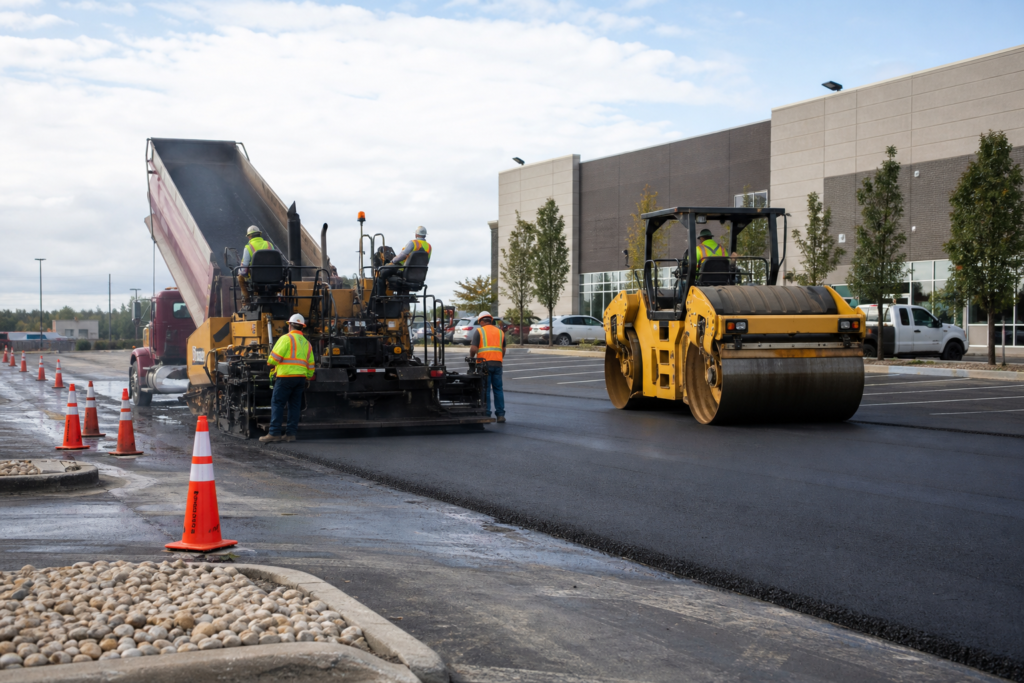
Commercial asphalt paving costs are driven by the complete project scope and site conditions, not asphalt alone. The right budget depends on whether the work involves surface maintenance, resurfacing, milling and overlay, or full-depth reconstruction, as well as traffic, subgrade, drainage, access, and documentation requirements.
There is no reliable Bethlehem-specific price per square foot supported by the available evidence. Instead, use the factors below to define the work clearly, compare equivalent proposals, and request an estimate that accounts for both pavement and the civil site work around it.
Choose the Right Paving Scope Before Comparing Prices
The first cost decision is determining what the pavement actually needs. A clean, lightly worn surface may need preventive maintenance, while widespread cracking, rutting, settlement, or base failure may require more extensive rehabilitation.
| Scope | What it addresses | Cost considerations |
|---|---|---|
| Sealcoating | Surface protection and appearance on suitable asphalt | Preparation, crack treatment, repairs, traffic control, and drying |
| Patching | Localized potholes, failed areas, or isolated defects | Repair size, depth, cause, disposal, and compaction |
| Resurfacing | A new asphalt layer over structurally suitable pavement | Preparation, level corrections, transitions, thickness, and edges |
| Milling and overlay | Controlled removal followed by new pavement | Milling depth, haul or reuse plan, grade adjustments, and cleanup |
| Full-depth reconstruction | Removal and rebuilding where pavement or supporting materials failed | Demolition, excavation, unsuitable soils, base, drainage, testing, and replacement |
Sealcoating is not a substitute for structural repair when asphalt or the base has failed. Inspect oil contamination, active cracks, potholes, ponding, and areas that may require milling or full-depth repair before applying a coating. These sealcoating application tips can help clarify whether maintenance is appropriate.
When an existing lot needs rehabilitation, the asphalt milling process affects removal costs and the amount of new asphalt required. An estimate should state milling depth, limits, disposal or reuse assumptions, and the surface condition required before overlay.
The Main Commercial Asphalt Paving Cost Factors

| Factor | How it affects the estimate |
|---|---|
| Traffic loading | Delivery trucks, buses, heavy equipment, turning movements, and roadway traffic may require a different pavement design. |
| Pavement section | Asphalt thickness, mix properties, aggregate base, and other section components determine quantities and installation effort. |
| Subgrade and base | Weak, wet, or unsuitable material may require undercutting, stabilization, additional aggregate, or improved drainage. |
| Existing pavement | Cracks, rutting, settlement, contamination, concrete edges, and failed areas affect the rehabilitation method. |
| Drainage and grading | Low areas, ponding, inlets, pipes, manholes, slopes, and elevation corrections add excavation, structures, layout, and restoration. |
| Access and traffic control | Phasing, lane closures, occupied businesses, delivery windows, and restricted staging can reduce production efficiency. |
| Demolition and disposal | Removal, hauling, recycling, dumping, or approved reuse changes the cost beyond placement. |
| Project size and layout | Large contiguous areas may be efficient, while small, fragmented, or phased areas can carry higher setup costs. |
| Finishing and closeout | Striping, accessible markings and signs, wheel stops, testing, inspections, as-builts, and agency documentation may be separate items. |
Traffic Loading and Pavement Design
A commercial lot used by employee vehicles has different demands from one serving distribution trucks, buses, construction equipment, or frequent deliveries. Turning and braking areas can experience concentrated stress even when the overall lot appears lightly used.
Georgia Department of Transportation research identifies traffic, asphalt mix properties, and subgrade strength as factors affecting pavement performance. Evaluate expected vehicle loading and supporting soil before selecting a pavement section rather than applying one universal thickness. Read the Georgia DOT research on pavement performance factors.
Give the estimator a realistic description of current and future use, including delivery frequency, vehicle types, loading dock movements, fire-lane use, bus or trailer traffic, and connections to public roads. Final design may also depend on plans, specifications, testing, and agency requirements.
Subgrade, Base Preparation, Grading, and Drainage
Asphalt depends on the conditions beneath it. Soft or wet subgrade, unsuitable soil, inadequate base, and unresolved drainage can require excavation, replacement, stabilization, aggregate placement, or additional compaction before paving.
Drainage work may include grading corrections, stormwater systems, pipes, drop inlets, catch basins, manholes, outlet connections, or protection around existing structures. Erosion-control measures may also be needed when grading and paving disturb soil or alter runoff paths.
Elevation-sensitive projects may need construction stakeout plans, finish-grade control, or pavement elevation verification. Accurate layout matters where pavement meets curbs, ramps, drains, building entrances, driveways, and roadway connections.
Existing Pavement, Milling, Demolition, and Disposal
Existing pavement condition is one of the most important commercial asphalt paving cost factors. Review cracking patterns, rutting, settlement, potholes, oil contamination, pavement thickness where known, concrete interfaces, drainage performance, and the underlying base.
Milling and overlay can be appropriate when the structure is suitable for rehabilitation and the surface needs controlled removal or grade correction. Full removal may be more appropriate where failure extends below the asphalt. The estimate should identify milling depth and area, full-depth repair allowances, haul distances, disposal fees, and whether reclaimed asphalt will be reused.
Site Logistics, Project Size, and Access
Two lots with the same area can have different costs if one is open and vacant while the other remains active. Occupied commercial properties may require phased paving, temporary access routes, pedestrian protection, coordinated deliveries, and work outside normal operating hours.
Ask how the proposal handles mobilization, staging, haul-truck access, equipment movement, weather interruptions, traffic control, and cleanup. Narrow sites, fragmented work areas, and multiple small sections can reduce production and increase setup time.
Striping, Testing, Compliance, and Documentation
New asphalt is not always the end of the project. Commercial work may also require parking lot striping, crosswalks, accessible markings and signs, wheel stops, traffic signs, pavement symbols, or restoration of markings removed during milling.
Testing and acceptance requirements can include base verification, compaction or density testing, surface checks, inspections, photographs, daily reports, and corrective work. A pavement and asphalt checklist can help identify testing, striping, and final acceptance items.
For work involving Georgia DOT or another public agency, ask which permits, traffic-control plans, inspection records, and as-built deliverables apply. DCBC LLC identifies itself as a Georgia DOT-certified contractor, but certification alone does not define every project requirement.
How to Compare Commercial Paving Quotes Fairly
Give every contractor the same drawings, measurements, pavement condition information, traffic assumptions, and access requirements. Then compare scope line by line instead of selecting the lowest headline number.
- Confirm area, pavement section, mix requirements, and planned thickness.
- Ask whether subgrade correction, aggregate base, compaction, and unsuitable-soil removal are included.
- Separate milling, full-depth repairs, demolition, hauling, disposal, and reclaimed-material assumptions.
- Identify drainage, grading, utilities, erosion control, curbs, ramps, and concrete interfaces.
- Confirm mobilization, staging, phasing, traffic control, temporary access, and cleanup.
- Check whether striping, accessible markings, signs, wheel stops, and symbols are included.
- Review allowances, exclusions, unit prices, change-order conditions, schedule assumptions, and closeout documents.
A higher total may include necessary base work, drainage, testing, or restoration that another proposal omits. A lower quote is meaningful only when quantities, specifications, exclusions, and acceptance requirements are comparable.
Information to Provide for a More Accurate Estimate
Provide the site address, drawings or survey, approximate paved area, pavement age if known, photographs of defects, drainage concerns, vehicle types, delivery patterns, access restrictions, desired markings, deadline, and public-agency involvement.
Also identify utility conflicts, low points, settlement, failed pavement, adjacent concrete, curbs, ramps, islands, loading areas, and areas that must remain open. If requesting milling or resurfacing, state whether the goal is grade correction, surface renewal, or structural rehabilitation.
DCBC LLC describes its estimating and takeoff services as covering earthwork, trucking, concrete, asphalt, striping, storm, sewer, water, underground ponds, landscape, hardscape, pavers, walls, culverts, and erosion control. Separating those categories can reveal scope that a pavement-only request may miss.
Frequently Asked Questions
Why can two commercial asphalt paving quotes differ so much?
Quotes may use different assumptions about thickness, base repairs, milling, drainage, traffic control, access, striping, testing, disposal, or schedule. Compare quantities and exclusions before comparing totals.
Is asphalt milling always necessary before resurfacing?
No. Milling depends on pavement condition, existing elevations, surface defects, transitions, and the intended overlay. A site may need repairs, direct resurfacing, controlled-depth milling, or reconstruction.
Can a price per square foot be trusted?
It can be a preliminary reference when area, pavement section, preparation, access, and finish requirements are defined. It should not replace a project-specific scope and quantity-based estimate.
How do drainage and grading affect a paving budget?
They determine whether water reaches intended inlets and outlets without ponding or undermining pavement. Corrections may require excavation, fill, pipe, structures, layout, erosion control, and restoration in addition to asphalt.
Conclusion: Budget the Complete Scope, Not Just the Asphalt
The most useful commercial paving estimate begins with the right treatment, then accounts for traffic loading, pavement design, subgrade, base preparation, existing pavement, drainage, grading, access, demolition, striping, testing, and closeout.
Give each contractor the same project information and require clear quantities, assumptions, exclusions, and deliverables. Comparable scopes produce more meaningful quote comparisons and make missing civil work easier to identify.
For a tailored, quote-based estimate, DCBC LLC provides commercial asphalt paving and milling, grading, stormwater, erosion control, striping, takeoff, and related civil site work across Georgia.