
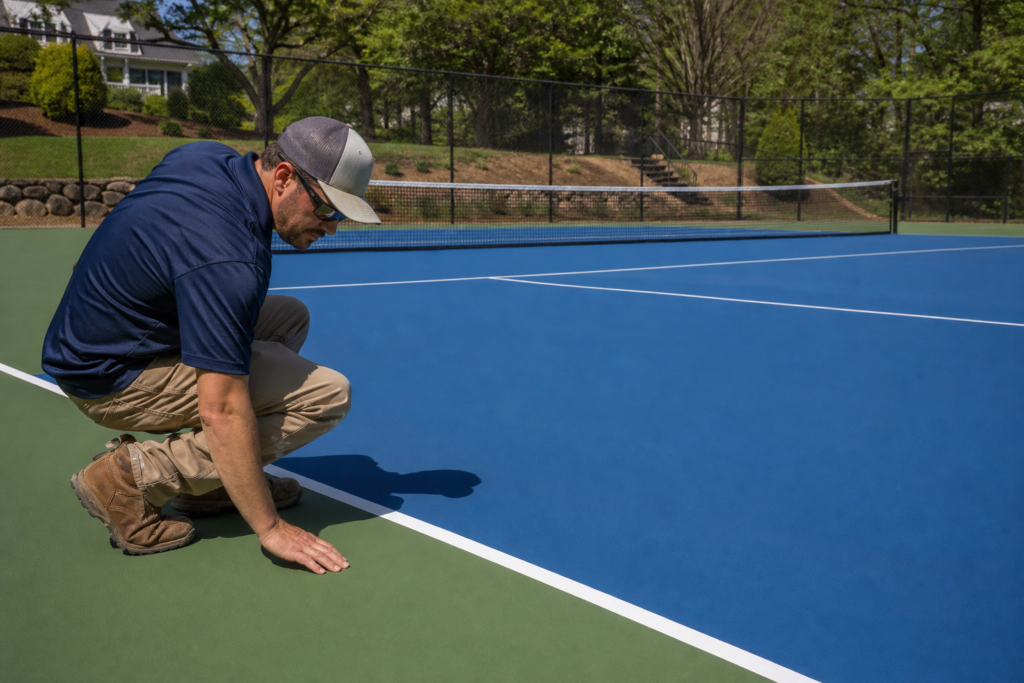
Tennis court sealcoating in Bethlehem may suit routine surface maintenance, but it is not automatically right for every court. Cracks, loose material, drainage issues, worn markings, or failed pavement may require localized repairs or broader resurfacing.
The best approach is to inspect the court first, define the work clearly, and request a proposal that separates preparation, repairs, coating or resurfacing, line painting, access, and closeout. Bethlehem-specific pricing requires a site assessment because court condition, dimensions, access, and surrounding site work affect the scope.
Key Takeaways
- Sealcoating is a possible maintenance treatment, not a substitute for evaluating surface failures.
- Document cracks, loose coating, ponding, worn lines, fencing, access restrictions, and surrounding pavement.
- Confirm whether cleaning, drying, repairs, coating or resurfacing, curing, line painting, and inspection are included.
- Compare complete scopes, exclusions, and alternates rather than headline prices alone.
- Consider broader civil coordination if grading, drainage, erosion control, asphalt, or access conditions affect the court.
Quick summary

Sealcoating, repair, or complete resurfacing?
“Tennis court sealcoating” can describe a maintenance-focused coating, while “tennis court resurfacing” often describes a broader system involving preparation, crack repair, surface treatment, color coating, and line painting. The terms can overlap, so the written scope matters more than the label.
| Scope | When it may fit | What to clarify |
|---|---|---|
| Maintenance sealcoating | The existing surface is generally sound and needs a protective or appearance-focused treatment. | Preparation, compatible coating system, coats, curing, and markings. |
| Localized repair and coating | The court has cracks, failed areas, loose material, stains, or isolated defects. | Repair limits, crack treatment, removal of failed material, and blending. |
| Complete resurfacing | Wear or widespread defects cannot be addressed by coating alone. | Full system, surface correction, color areas, lines, drainage interfaces, and acceptance criteria. |
Start by assessing the pavement and defining the work clearly. Although a tennis court is a specialized playing surface, the same principle applies: determine whether the surface suits the proposed treatment before comparing prices.
A Georgia public tennis-court resurfacing specification describes cleaning and removing loose paint or asphalt, allowing the surface to dry fully, and then completing repairs. That document is not a Bethlehem requirement or universal scope, but it shows why preparation and drying should be defined rather than assumed.
Inspect the court before requesting a quote

A short inspection record helps contractors price the same problem. Take clear photographs, note defect locations, and include a sketch or aerial view if the site has multiple courts or difficult access.
- Surface condition: Note wear, peeling, loose material, stains, exposed aggregate, and uneven or unstable areas.
- Cracks and failed areas: Record locations and approximate lengths, including separated paint, asphalt, or previous coating.
- Water behavior: Look for ponding, blocked drainage paths, low points, or runoff crossing the court. Coating will not automatically correct grading or drainage problems.
- Lines: Photograph faded, incomplete, or incorrectly positioned markings and state whether repainting is needed.
- Edges and surroundings: Check fencing, gates, curbs, sidewalks, vegetation, adjacent pavement, and lighting bases.
- Access and use: Note gate widths, equipment access, operating hours, public use, school schedules, and closure limits.
- Project size: Provide the court count, approximate dimensions, and surface type if known.
If the court has substantial cracking, widespread loose material, or drainage concerns, ask whether coating alone is appropriate. A strong proposal should identify the observed condition, recommended treatment, and assumptions that could change the final scope.
What the work may include
The exact sequence depends on the existing surface and selected system, but a quote should make the major stages visible.
- Preparation: Cleaning and removal of unsuitable material. Ask whether pressure washing, scraping, sanding, or blowing is included.
- Drying and review: Confirm how weather or unexpected moisture affects the schedule.
- Repairs: Ask whether cracks and failed sections are included, provisional, or separate.
- Coating or resurfacing: The proposal should clearly name the treatment and covered areas. Do not assume a generic asphalt sealcoat and a complete sports-surface system are interchangeable.
- Curing and protection: Confirm access restrictions and who determines when the court can reopen.
- Line painting: Clarify whether layout, painting, color areas, and touch-ups are included.
Before scheduling, review these sealcoating application tips covering preparation, weather, curing, traffic control, and striping coordination. Use general guidance for planning, then confirm the actual requirements for the selected system.
Coordinate drainage, access, markings, and curing
A court project can be affected by drainage inlets, curbs, adjacent pavement, fencing, gates, and public access. If runoff reaches the court or water collects at its edges, ask whether a separate civil review is needed before finalizing the coating scope.
Access planning should cover equipment movement, pedestrian separation, court closures, deliveries, and protection of nearby surfaces. Schools, parks, communities, and public facilities should provide operating calendars early so access controls can be planned without promising an unverified completion date.
Line painting generally follows coating or resurfacing after the surface reaches the condition required for paint adhesion. The cure period and marking system depend on the products, weather, surface, and project requirements, so the proposal should state who schedules and performs the markings.
Where work is near drainage structures, clarify how debris, wash water, and temporary protection will be managed. Georgia DOT’s contractor reference includes information on erosion control, earthwork, pavements, testing, and inspection, but a private tennis court is not automatically governed by GDOT requirements. Confirm which authorities and specifications apply.
Prepare a quote-ready project brief
- Bethlehem project address and site contact.
- Number of courts, dimensions, and known surface type.
- Photographs of the court, edges, cracks, loose areas, lines, drainage, and access route.
- Desired result, such as maintenance coating, repair, color refresh, resurfacing, or line repainting.
- Access limits, gate dimensions, operating hours, events, and closure restrictions.
- Ponding, runoff, adjacent pavement, fencing, lighting, vegetation, and other surrounding conditions.
- Whether the work is standalone or part of paving, grading, drainage, landscape, or facility improvements.
Ask each bidder to separate preparation, repairs, coating or resurfacing, line painting, access controls, protection, cleanup, and closeout. Request written inclusions, exclusions, allowances, and alternates. If a site visit is needed to confirm the treatment, schedule one rather than accepting a generic price.
When broader civil coordination is needed
Some court problems originate in the surrounding site. Grading may direct water toward the court, drainage structures may be blocked, adjacent asphalt may fail at the entrance, or erosion may affect slopes and access routes.
Include related conditions in the request for proposal. The scope may involve asphalt paving or milling, earthwork and grading, stormwater systems, erosion control, access improvements, or paint striping and signage.
DCBC LLC lists tennis court sealcoating among its sealcoating services and also lists asphalt paving and milling, earthwork and grading, stormwater systems, erosion control, and paint striping and signage. Its pricing is quote-based and tailored to project scope, so a Bethlehem court with related site conditions should be presented as a complete project.
Questions to ask before selecting a contractor
- Do you recommend maintenance sealcoating, localized repair, or complete resurfacing?
- What preparation is included?
- Which cracks or failed areas are included, and which are alternates?
- What treatment system is proposed, and is it compatible with the existing surface?
- Are line layout, painting, touch-ups, and final inspection included?
- How will access, fencing, drainage features, and public use be managed?
- What weather, drying, and curing assumptions affect the schedule?
- Who handles related grading, drainage, paving, erosion control, or repairs outside the court?
- What cleanup and closeout documentation will be provided?
Frequently asked questions
Is tennis court sealcoating the same as resurfacing?
No. Sealcoating may mean a maintenance coating, while resurfacing can include preparation, crack repair, color treatment, and line painting. Ask for the complete system and stages in writing.
Can a cracked court be sealcoated?
Possibly, but defects should be evaluated first. Cracks or loose material may require repair or removal, while widespread failure may justify broader resurfacing.
Does sealcoating include line painting?
Not necessarily. Confirm the layout, marking system, timing, and touch-ups in the proposal.
Why is a site assessment needed for pricing?
Preparation, repairs, access, court size, drainage, markings, surrounding conditions, and the selected treatment can all change the scope.
Conclusion: Choose the scope that matches the court’s condition
The right Bethlehem tennis court project starts with condition assessment, not a coating label. If the surface is generally sound, sealcoating may be suitable. Cracks, loose material, drainage problems, or widespread wear may require repairs or complete resurfacing.
Document the court and surroundings, coordinate access and markings, and compare proposals that clearly state preparation, repairs, treatment, curing, exclusions, and closeout. For a site-specific quote covering tennis court sealcoating and related civil conditions, contact DCBC LLC through its website.