
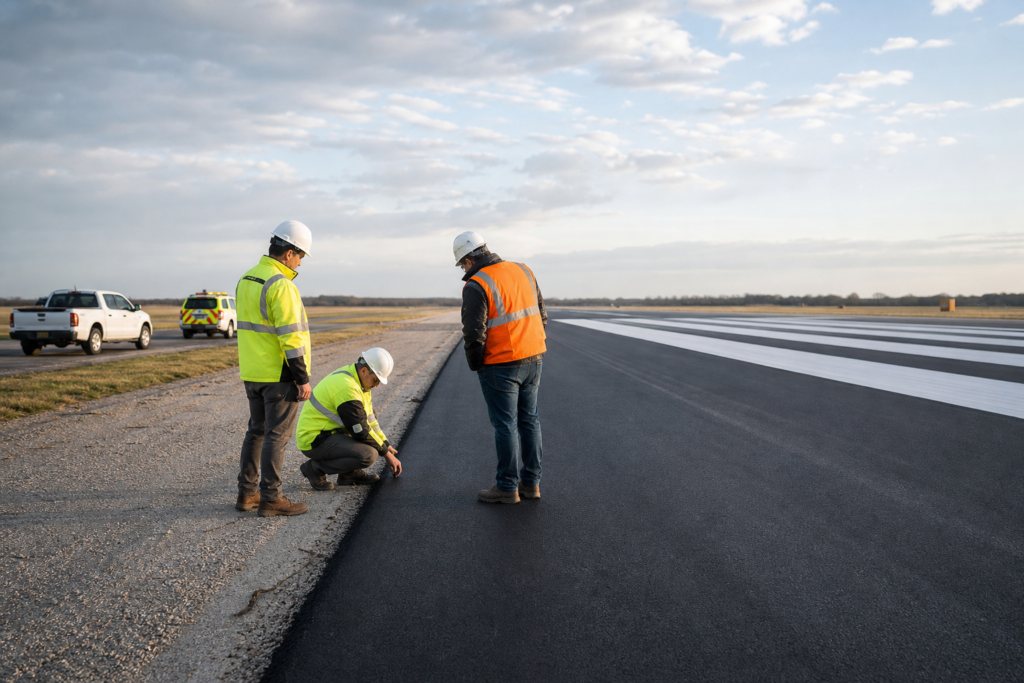
Airport runway sealcoating in Bethlehem should begin with approval and project definition, not a product choice. A runway is not automatically suitable for the same treatment used on a commercial parking lot. Requirements depend on the airport, pavement, operations, funding, specifications, and responsible authorities.
Use the process below to identify the approval path, confirm whether sealcoating is permitted, coordinate repairs and markings, and prepare a quote-ready scope. Bethlehem identifies the project area in this discussion. It does not identify a specific airport or establish which agency must approve the work.
Step 1: Define the Runway Project Before Discussing Sealcoating
Record the exact airport, runway or pavement area, project owner, and maintenance objective. Confirm whether the work concerns a runway, taxiway, apron, shoulder, access route, or another paved surface. These distinctions can affect the review process and the people who must authorize the work.
Gather information about pavement type, visible defects, existing markings, aircraft and vehicle use, access restrictions, and proposed work limits. If the project is near Bethlehem but the airport has not been clearly identified, resolve that issue first.
Stop point: Ask the airport operator or project owner to identify the facility, runway, governing documents, and responsible technical contact.
Step 2: Identify Every Authority That Must Review the Work

Build an approval map before requesting construction prices. Depending on the project, relevant parties may include the airport owner or operator, an aviation engineer, the project owner, the FAA when applicable, GDOT, and local agencies. The correct list must be confirmed for the specific airport and funding arrangement.
Ask who controls pavement treatment, airside access, work windows, markings, inspections, and reopening. A contractor can coordinate questions, but should not be treated as the party that grants aviation approval.
Stop point: Pause if no one can identify the approving party, operational coordinator, or professional responsible for accepting the technical approach.
Step 3: Gather the Governing Plans, Specifications, and Records
Request the documents that define the project before asking contractors to price an undefined treatment. Depending on what exists, the working file may include:
- Airport standards, owner requirements, contract specifications, or engineering direction.
- Pavement condition information, inspection records, repair history, and drainage concerns.
- Runway-use details, aircraft or vehicle restrictions, access rules, and proposed work limits.
- Existing marking plans, signage information, and protection or restoration requirements.
- Closure, phasing, airside safety, environmental, or erosion-control information.
- Expected inspection, testing, submittal, recordkeeping, and closeout requirements.
This is a document-gathering checklist, not a claim that every item is mandatory for every airport project. If a document does not exist, ask the responsible authority what should replace it.
Step 4: Confirm Whether Sealcoating Is Permitted for This Pavement
General asphalt sealcoating capability does not establish that a runway may receive the treatment. The airport operator and project engineer should review pavement condition, surface use, existing materials, operational needs, and the proposed product or system.
Ask for written direction on whether sealcoating is suitable, whether localized repairs or another treatment should occur first, and how the treatment must relate to markings and operations. If deeper correction is needed, milling or an overlay review may be more relevant than treating the surface alone.
Stop point: Do not select a product, place an order, or schedule application while suitability remains unresolved.
Step 5: Plan Surface Preparation, Repairs, and Drainage Coordination
Define the work needed to make the pavement ready. The scope may address cleaning, surface defects, crack or joint treatment, localized repairs, milling, edge conditions, drainage, grading, or interfaces with other civil work.
Separate confirmed work from allowances and unresolved conditions. A coordinated review of civil site work and project coordination can help identify where paving, drainage, grading, stormwater, and erosion-control activities affect the runway work.
Keep product-specific requirements in the approved project documents. This article does not establish application rates, curing periods, temperatures, friction targets, or weather limits.
Step 6: Coordinate Markings, Closures, and Airside Safety
Runway pavement work can affect markings, aircraft movement, vehicle routes, barricading, access control, inspection points, and reopening. Define how the work area will be separated, who controls access, which operations must change, and how the airport will communicate the work window.
Ask the airport operator or aviation professional to approve the phasing and safety approach. A contractor schedule alone is not an airside operations plan. Assign the final reopening decision to a named responsible party.
Stop point: Pause if closure, work-zone controls, aircraft and vehicle coordination, inspection access, or reopening authority has not been documented.
Step 7: Confirm Material and Application Acceptance Before Procurement
Before purchasing materials, ask the project engineer or approving authority what must be submitted and accepted. Questions include:
- Which products or systems are acceptable for the identified pavement and operating conditions?
- What manufacturer information, technical data, samples, or submittals are required?
- How should preparation and application sequencing be documented?
- What quality-control checks, inspections, or testing apply?
- Which weather, access, protection, and return-to-service limitations apply?
- Who can approve substitutions, corrective work, or sequence changes?
Do not fill gaps with generic parking lot practice. Project documents should control material, preparation, application, inspection, and acceptance decisions.
Step 8: Define Marking Restoration, Inspection, and Closeout
Confirm who will protect existing markings, remove or modify them when necessary, restore them, and verify their final condition. Clarify whether the striping contractor, paving contractor, airport team, or another party owns each activity.
Ask what closeout records are expected. Depending on the contract, these could include daily work records, material information, inspection notes, corrective-work documentation, photographs, survey or as-built information, and written acceptance.
Where layout or final locations must be documented, clarify the required control and deliverables early. Construction stakeout services may be relevant to a broader civil scope, but the airport or engineer must define accuracy, format, and acceptance requirements.
Step 9: Ask Contractors Questions That Match the Approval Path
Compare contractors against the approved requirements. Ask each bidder:
- What experience does the team have with airport or aviation-related work?
- How will the company follow owner specifications and coordinate with airport operations?
- Who will manage preparation, repairs, paving or milling, striping, signage, and subcontractors?
- How will drainage, grading, stormwater, and erosion-control interfaces be handled?
- What information is needed for a realistic schedule and quote?
- How will inspections, material records, daily reports, corrective work, and closeout documents be managed?
- What happens if pavement condition or authority direction changes after mobilization?
- Which requirements must be confirmed by the airport, engineer, FAA, GDOT, or another authority?
A Georgia DOT certification may be relevant to a contractor’s transportation and civil construction background, but it does not automatically establish qualification for every airport or aviation-specific project. Use project-specific qualifications and approval documents as the comparison standard. These site work contractor selection questions can support procurement review.
Step 10: Build a Quote-Ready Scope Without Overpromising Compliance
Send contractors a consistent package containing the identified airport and pavement area, drawings or specifications, condition information, existing markings, access limitations, proposed work limits, authority contacts, schedule constraints, and documentation needs.
Separate investigation, repairs, preparation, sealcoating, marking restoration, airside coordination, inspection support, and closeout documentation. Label alternatives clearly and explain which approval decision would trigger each one.
Quote-based pricing is most useful when the construction or consulting scope is defined. A preliminary review should distinguish confirmed work from assumptions, allowances, and items requiring direction.
Stop Points: When to Pause the Project
- The airport, runway, pavement area, or project owner is not clearly identified.
- The responsible approving authority or aviation engineering contact is unknown.
- Sealcoating suitability has not been confirmed.
- Material acceptance, preparation requirements, or application controls are unclear.
- Closure, airside access, work-zone safety, and inspection arrangements are incomplete.
- Marking restoration or reopening responsibility has not been assigned.
- The contractor cannot explain how specifications, records, changes, and closeout documents will be managed.
These pauses identify decisions that should be answered by the airport operator, project engineer, FAA, GDOT, or another responsible authority before work proceeds.
Where DCBC LLC May Fit the Project Scope
DCBC LLC identifies itself as a Georgia DOT-certified civil site work and roadway construction contractor. The company lists airport runway sealcoating and also provides asphalt paving and milling, paint striping and signage, earthwork and grading, stormwater systems, erosion control, construction stakeout plans, roadway grade calculations, GDOT as-built GIS submittals, estimation, and takeoff services.
That range may support a broader scope review or coordination effort for a Georgia project. It does not independently establish FAA approval, airport-specific qualification, acceptance of a particular coating, or compliance with an unconfirmed specification. Those matters remain subject to the airport owner, engineer, and applicable authorities.
Frequently Asked Questions
Is airport runway sealcoating the same as parking lot sealcoating?
No. Airport work must be evaluated against pavement condition, operational use, markings, access controls, engineering direction, and applicable approvals. General parking lot experience does not answer those project-specific questions.
Who should approve an airport runway sealcoating project in Georgia?
The responsible parties depend on the airport, project owner, funding, runway use, and governing documents. Begin with the airport operator and project owner, then confirm whether an aviation engineer, FAA, GDOT, local agency, or another authority must review or accept the work.
Should runway markings be included in the sealcoating scope?
They should at least be addressed before pricing. The scope should identify who protects, removes, restores, verifies, and accepts markings and related signage. The airport or engineer should define the layout, materials, inspection process, and reopening responsibility.
What should I send a contractor before requesting a runway sealcoating quote?
Send the identified airport and pavement area, available plans and specifications, condition information, existing marking details, proposed limits, access and closure constraints, authority contacts, schedule expectations, and documentation requirements. Mark unknown items clearly so the contractor can identify assumptions without presenting an unapproved approach as compliant.
Conclusion: Confirm the Standard Before You Confirm the Contractor
Airport runway sealcoating in Bethlehem should be treated as a standards-screening and coordination exercise before it becomes a material or scheduling decision. Identify the airport and approving parties, gather governing information, confirm treatment suitability, coordinate repairs and markings, define safety controls, and assign inspection and closeout responsibilities.
The key distinction is between a contractor’s ability to perform civil or sealcoating work and the project’s authority to approve that work for a particular runway. Resolve that distinction in writing before procurement or mobilization. DCBC LLC can review a proposed Georgia scope and provide a tailored quote for airport runway sealcoating or related civil work.