
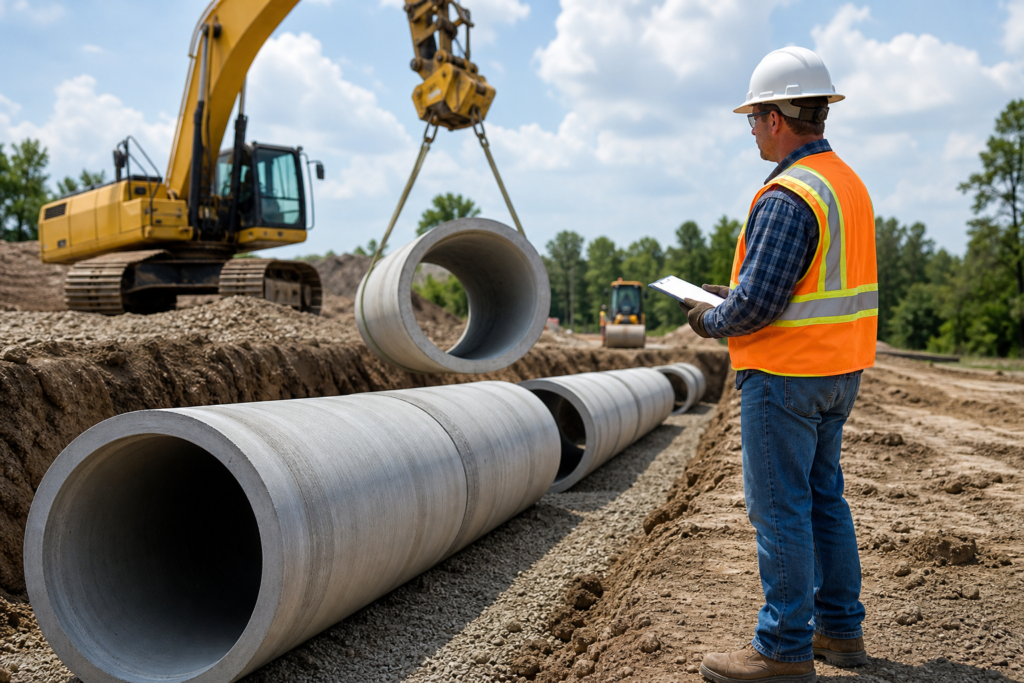
This checklist walks project teams from pre-bid review through final acceptance for reinforced concrete pipe (RCP) used in stormwater and drainage systems. Use it to set contract requirements, verify deliveries, control installation, identify inspection stop points, and assemble the acceptance package. Where the checklist references inspection or joint requirements, supporting guidance is available from recognized installation manuals and highway knowledge resources such as the KY RCP inspection manual and the Highway Knowledge Portal. Cite those references when you specify or document acceptance decisions.
1. Pre-bid and specification review
Before issuing a bid or purchase order confirm the contract and drawings specify the following items for RCP work. Clear, measurable specifications prevent disputes and speed inspections.
- Pipe class, wall thickness, and manufacturing certification requirements.
- Required joint type and joint materials, for example mortar, asphalt mastic, rubber gaskets, or butyl rubber sealants, as applicable to the project environment.
- Bedding class and compaction requirements for initial support and long term performance.
- Whether geotextile wrapping is required and where it must be applied.
- Slope specific measures such as tied joints when joints lie near outlets on steep grades.
- Inspection, testing, and documentation deliverables, including construction stakeout plans, grade verification, and any required GIS as-built submittals for DOT projects.
Reference manufacturer mill certificates and contractor submittals in the procurement documents. If the project is subject to GDOT or municipal standards require the contractor to identify which standards they will follow and to provide compliant submittals for approval before mobilizing.
2. Material selection and delivery inspection
At delivery confirm materials match the approved submittal. Reject or conditionally accept shipments that do not meet the contract documentation. Record acceptance decisions on delivery tickets and photograph defects.
Delivery micro-checks
- Verify manufacturer name, grade, and mill certificates match the purchase order.
- Inspect every pipe barrel for visible damage, spalls, or cracks on exterior surfaces.
- Confirm joint components and gaskets are present and match specified materials.
- Check labeling or markings for production date and lot traceability.
- Log any questionable items for engineer review and do not allow damaged pipe into trench unless the engineer accepts it in writing.
3. Joint selection and installation controls
Select the joint system that provides soil-tight performance for the site conditions and the intended hydraulic function. Common rigid pipe joint options include mortar, asphalt mastic, rubber gaskets, and butyl sealants. Document the chosen method in the field reports and verify installed joints match the approved submittal. For general guidance on joint types and wrapping practices consult the Highway Knowledge Portal overview of pipe installation techniques (Pipe Installation | Highway Knowledge Portal).
Slope specific joint rule
Where a joint is located within 12 feet of an outlet on slopes steeper than 3 to 1 require tied joints or equivalent restraints. Tied joints are commonly used to prevent joint separation and sliding on steeper grades. Incorporate tied joint requirements into the bid documents and daily reports so crews and inspectors enforce them in the field. The Highway Knowledge Portal summarizes this slope related joint requirement for rigid pipe installations (Pipe Installation | Highway Knowledge Portal).
4. Bedding, alignment, and backfill verification

Proper bedding and uniform barrel support are essential to prevent point loads and differential settlement that lead to failures. Confirm the bedding class called for in the contract is placed and that the trench bottom is prepared to the specified dimensions before setting pipe.
Field checks for grades and support
- Verify invert elevation with construction stakeout plans and by using three point leveling or grade calculation tools before the first pipe run is placed. If your project requires third party grade verification request it in the contract.
- Lay pipe on the bedding so the barrel touches at the specified support band. Avoid local rock contact and high spots under the pipe seating area.
- Backfill in specified lifts and perform compaction tests as required. Record compaction method and density tests in daily logs.
DCBC LLC provides construction stakeout plans, three point level verification, grade calculations, and estimation and takeoff services that streamline grade and support verification when specified in the contract. See available project examples for relevant work when preparing submittals.
5. Geotextile wrapping and joint sealing
Apply geotextile wrap when specified to prevent soil migration around the pipe and to maintain bedding integrity. Verify overlap and anchor methods meet the specification. For joint sealing, confirm installation of the specified gasket or mastic and observe manufacturer curing or installation requirements before placing adjacent pipe or backfill.
6. Inspection checkpoints during installation
Stop-work inspection points reduce rework and clarify responsibility. Mandatory inspection checkpoints include pre-installation layout, after bedding preparation, after each pipe length is set and jointed, and after complete backfill and compaction. The KY RCP inspection manual identifies inspection methods for detecting defects and lists failure modes that warrant engineer review (RCP%20Pipe%20Manual.pdf).
Cracking and defect decision criteria
Visible cracking that passes through the wall, observable on both interior and exterior surfaces, is cause for rejection unless the project engineer documents acceptance in writing. Smaller or hairline cracks may be questionable and require the engineer to evaluate whether they compromise structural or hydraulic function. Follow the KY RCP inspection manual for guidance when documenting crack size and disposition (RCP%20Pipe%20Manual.pdf).
7. Acceptance criteria and required documentation

Define the minimum documentation package required for final acceptance. Typical deliverables include:
- As-built stationing and invert elevations verified against the approved construction stakeout plans.
- Grade verification records and three point leveling logs if required in the contract.
- Photographic records of joint installation, geotextile wrap, and completed backfill layers.
- Manufacturer mill certificates and delivery acceptance records for every pipe used.
- Compaction test reports and any post-installation CCTV or hydraulic testing requested by the owner.
- GDOT compliant as-built GIS submittals where the project requires state format deliverables.
DCBC LLC lists virtual deliverables such as GDOT as-built GIS submittals and stakeout plans among their consulting services and can supply these items when included in the scope. Learn how these services integrate with construction schedules on the projects page.
8. Common failure modes and field remedies
Frequent installation defects and immediate remedies include:
- Improper bedding or localized voids: expose and regrade bedding, correct seat conditions, and reinstall pipe sections on uniform support.
- Poorly sealed or missing joints: remove backfill to open joint, install specified sealant or gasket, and document repair procedures before replacing backfill.
- Misaligned invert or incorrect grade: adjust bedding depth and re-establish grade using stakeout plans and grade calculations, replace any damaged pipe if necessary.
- Through-wall cracking: segregate affected pipe for engineer evaluation. Reject or repair only under engineer direction as per the inspection manual.
9. When to call an engineer or a GDOT experienced contractor
Escalate to the design engineer or hire a GDOT experienced contractor when a defect affects hydraulic performance or structural stability, or when contract requirements conflict with field conditions. Typical triggers to escalate include repeated joint separation, extensive through-wall cracking, slope instability affecting outlet performance, or ambiguity in bedding class interpretation.
When engaging a contractor ask for deliverables that match your inspection needs. Useful items to request are construction stakeout plans, three point level verification, grade calculation reports, GDOT as-built GIS submittals, and a documented test and inspection plan. DCBC LLC offers construction and virtual services that cover these deliverables. For examples of completed scopes and service offerings visit the projects section on the DCBC site.
10. Quick field checklist and next steps
Copy this one page checklist into daily reports or the project inspection form. Include contract references and photo fields for each checked item.
- Pre-bid: Confirm pipe class, joint type, bedding class, and required documentation are in the contract.
- Delivery: Mill certificates present, no visible through-wall cracks, required joint parts on site.
- Bedding: Trench prepared to spec, bedding placed, invert grade verified with stakeout or three point level tool.
- Jointing: Specified joint installed, gasket or sealant observed, slope tied joints where required.
- Wrapping: Geotextile installed where specified with correct overlap and anchorage.
- Backfill: Lift thickness and compaction method documented, density tests recorded if required.
- Defects: Any through-wall cracking or structural damage flagged and sent to engineer for disposition.
- Closeout: As-built elevations, photos, mill certificates, compaction reports, and GIS deliverables submitted for acceptance.
Procurement items to add to bid packages: specified joint type, tied joint requirement on steep slopes, required bedding class, geotextile wrap requirement, acceptance tests, and list of as-built deliverables including GDOT GIS formats when applicable. Link these items to clear payment milestones to avoid scope disputes.
Frequently asked questions
What joint type should I specify for RCP on steep slopes
Specify a soil-tight joint system appropriate for your material and environment. For joints within 12 feet of an outlet on slopes steeper than 3 to 1 require tied joints or equivalent restraint. State the joint material and installation procedure in the contract and verify in the field. The Highway Knowledge Portal summarizes joint options and slope specific guidance (Pipe Installation | Highway Knowledge Portal).
Who decides if visible pipe cracking is acceptable or must be rejected
The project engineer makes final acceptance decisions. Guidance in the KY RCP inspection manual identifies visible through-wall cracking on both interior and exterior surfaces as cause for rejection, while hairline cracks may be evaluated by the engineer for acceptability (RCP%20Pipe%20Manual.pdf).
What field documents and as-built deliverables should I require at closeout
Require as-built stationing and invert elevations, grade verification logs, photographic records of joints and wrapping, mill certificates, compaction test reports, and GDOT-compliant as-built GIS submittals when the project is state funded. These items establish traceability for acceptance.
Do I need geotextile wrap for all RCP installations
Not always. Specify geotextile wrap when soil migration, fine-grained backfill, or site-specific erosion control considerations justify it. Refer to the project specification and the Highway Knowledge Portal for installation considerations (Pipe Installation | Highway Knowledge Portal).
When should I hire a GDOT experienced contractor or call an engineer
Hire a GDOT experienced contractor or consult the project engineer when work will be on state right of way, when GDOT deliverables are required, or when encountering defects that affect hydraulic function or structural stability. If you need integrated construction and virtual deliverables such as stakeout plans and GDOT as-built GIS submittals consider contractors that list those services in their scope.
See DCBC LLC projects for examples of civil site work and consulting services that support RCP installation, including stakeout plans and as-built documentation.
Key takeaway: write measurable joint and bedding requirements into the contract, enforce delivery and installation micro-checks, stop work for through-wall cracking or major joint failures, and require as-built and verification deliverables to close the project cleanly. Use this checklist to make consistent, defensible acceptance decisions.
Ready to request deliverables or a quote from a contractor with GDOT experience and virtual engineering support? Contact DCBC LLC for construction and consulting services at their website.