
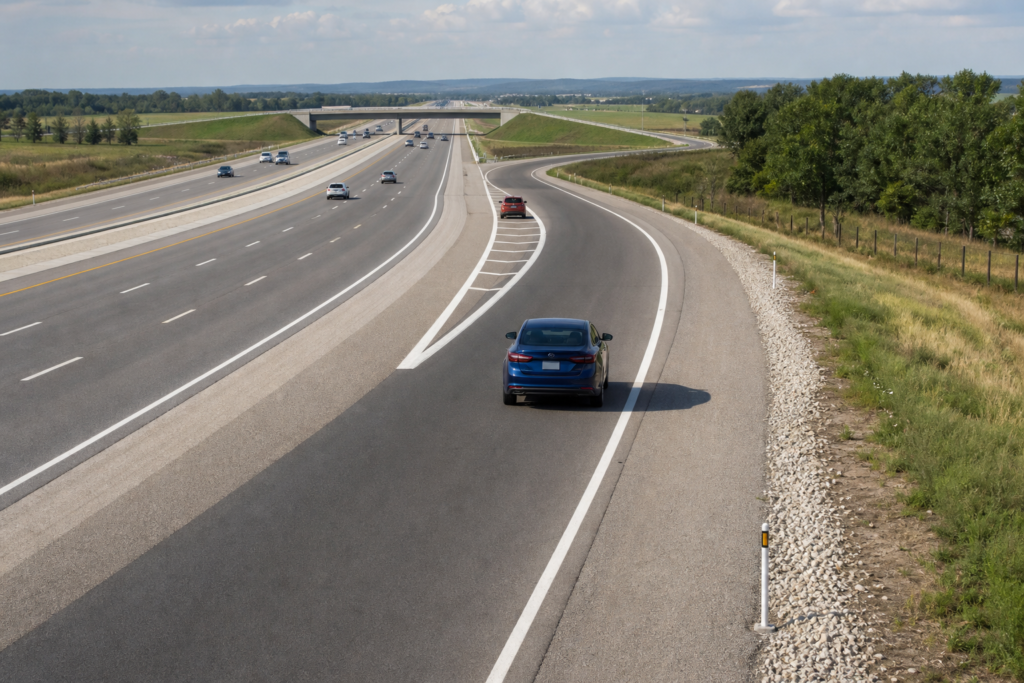

Which red flags matter in an acceleration lane design?
Acceleration lanes are a small but critical piece of roadway geometry. When they are undersized, unclearly detailed, or not verified in the field, they create operational friction, increase crash risk, and produce change orders during construction. This article lists the specific technical and procurement red flags owners and engineers should check before approving or awarding acceleration lane design and construction.
Why acceleration lane design matters for safety and operations
Dedicated acceleration lanes let vehicles entering a higher-speed road build speed and merge with through traffic with less disruption. Transportation research and FHWA reviews explain that auxiliary lanes shorter than optimum reduce operational performance and can raise safety concerns when drivers cannot reach mainline speed or are forced to merge in constrained space. Design must therefore account for ramp geometry, approach speeds, and traffic volumes when specifying length and taper. See FHWA practices evaluation for discussion of these operational effects and design inputs: FHWA Practices Evaluation. Transportation policy research also summarizes why acceleration and deceleration lanes matter to flow and safety: TTI overview.
Technical red flags to catch in plan review
When you review plans and bids, focus on the items below. Each is a frequent cause of rework or noncompliance when omitted or poorly documented.
Length and taper: what to verify
Red flags: a single fixed length stated without site justification, no taper geometry, or no allowance for a parallel-type entrance where needed. Federal guidance and state practice recognize both tapered and parallel acceleration layouts and provide length recommendations. For high-speed or freeway-style connections, FHWA notes that a parallel-type entrance with a long acceleration lane, often 1,200 feet or more plus a taper, is desirable because it gives entering drivers more time to merge. See FHWA interchange guidance: FHWA chapter 3. State design manuals such as TxDOT include minimum tables, grade adjustments, and figures showing tapered and parallel examples; compare a designer’s claimed length with those references: TxDOT speed change lanes.
Grade adjustments and speed assumptions
Red flags: length given without grade adjustment notes, missing documented design speeds, or no traffic volume basis. Acceleration length should be adjusted for longitudinal grade and the design speed of the controlling curve on the ramp and mainline. TxDOT provides adjustment tables and recommends designers document how grade affected the required lane length; see TxDOT cross-sectional guidance for minimum lengths on flat grades: TxDOT cross-sectional elements. FHWA research emphasizes that design must account for ramp and mainline speeds plus volumes when sizing auxiliary lanes: FHWA Practices Evaluation.
Sight distance and merge taper detail
Red flags: plans that omit sight-distance checks, show a downstream merge taper shorter than recommended, or fail to describe how sight lines were measured. FHWA design promptlists and interchange guidance specify minimum merge taper lengths and recommend sight-distance verification. For example, the FHWA promptlist notes desirable standards for taper lengths and cautions about shorter auxiliary lanes on grades: FHWA interchange promptlist. Missing taper details often signal inadequate operational review and expose the owner to liability or retrofit costs.
Constructability and field-verification red flags

Design-only deliverables are not enough. If the contractor or designer omits field-verification steps, expect grade disputes, incorrect paving depths, or drainage problems that lead to change orders.
Why stakeout plans, 3-point checks, and as-built GIS matter
Red flags: no construction stakeout plan, no 3-point level verification records, or no commitment to provide GDOT-compliant as-built GIS submittals. These deliverables are the bridge between design intent and field reality. A construction stakeout plan reduces interpretation error for crews, 3-point level verification documents confirm the finished profile before paving, and GDOT-style as-built GIS submittals are commonly required for acceptance on state projects. DCBC LLC lists these virtual and field verification capabilities among its services, including construction stakeout plans, roadway grade calculations, 3-point level verification, and GDOT as-built GIS submittals, which are useful proof points to request from bidders: DCBC LLC. You can also review recent contractor work to confirm the workflow and deliverables: projects.
Common bid and plan mistakes that predict rework
Below are real-world plan and bid issues that frequently cause change orders or construction delays. Spotting them early reduces cost and schedule risk.
- Auxiliary lane length stated as a flat number with no grade-adjustment calculation, leaving uphill ramps under-length.
- Taper geometry described only by a reference note, with no stationing or merge-limit dimensions on plan sheets.
- No documented design speed or assumed mainline speed, so reviewers cannot tell whether the length matches operating conditions.
- Missing sight-distance calculations and omitted obstructions such as guardrail, trees, or signs that reduce available sight distance.
- No construction stakeout plan, leaving crew layout to interpretation and increasing the chance of profile mistakes during paving.
- Incomplete quantity takeoffs that omit additional earthwork, pipe, or pavement transition items that later become change orders.
Pre-bid checklist: documents to require from bidders

Require a consistent package with each proposal. That package is the primary tool to compare technical competence and reduce surprises after award.
Sample checklist items
- Acceleration lane length calculations showing how the designer used grade adjustments and which table or method they followed. Cite TxDOT tables where applicable.
- Merge taper geometry with stationing, lane widths, and a plotted cross section showing the tie-in to existing pavement.
- Documented assumed approach speeds, mainline design speed, and ADT or peak volumes used for the design so reviewers can verify operational assumptions.
- Construction stakeout plan with control points and a staking tolerance statement, plus a schedule for stakeout deliverables to the owner.
- 3-point level verification protocol and an example report showing how grades will be confirmed before paving.
- Commitment to provide GDOT-compliant as-built GIS submittals and a description of the as-built deliverable format.
- Complete quantity takeoff and unit price list for earthwork, pavement, pipe, drainage structures, and traffic control.
- QA/QC plan describing who will check grade and geometry during construction and the procedures for addressing nonconformance.
As a reference for design checks and minimum lengths, include links in your RFP to authoritative guidance so bidders use consistent assumptions. Useful references include TxDOT and FHWA materials cited above.
Coordinating with GDOT and local permitting in Georgia
Red flags: assuming a contractor can build or amend state-controlled geometry without agency review. For state routes and GDOT-controlled facilities, early agency coordination is required. Owners should confirm submittal requirements and whether the proposed acceleration lane requires an encroachment permit, plan approval, or traffic control variance. Do not promise approval to bidders; instead, require the bidder to include a submittal schedule and identify who will be the point of contact for agency coordination. DCBC LLC provides GDOT as-built GIS submittal capabilities and virtual deliverables that can shorten review cycles when used correctly: DCBC LLC.
Decision criteria for selecting a contractor or approving plans
When scoring proposals, prioritize the items below to reduce delivery and compliance risk.
- GDOT certification or demonstrated experience delivering state projects and submitting GDOT-style deliverables.
- Evidence of an integrated virtual-to-field workflow: grade calculations, stakeout plans, 3-point verification, and as-built GIS commitments.
- Sample deliverables and project examples showing similar acceleration lane work; request a list of recent projects and references.
- Clear QA/QC and personnel qualifications for grade control and surveying.
- Responsive, itemized takeoffs and a transparent approach to change orders and schedule impacts.
Use the contractor’s project examples to confirm their workflow and deliverable formats. See contractor project portfolios such as the DCBC projects page for examples of combined construction and virtual services that owners can inspect before selection: projects.
Next steps and how to reduce approval risk
Immediate actions owners should take:
- Add the pre-bid checklist items above to your RFP or design approval package.
- Require lane-length calculations with grade adjustments and documented speed and volume assumptions for every proposal.
- Ask for sample stakeout plans and a 3-point verification protocol before award and make them contract attachments.
- Schedule an early coordination meeting with GDOT or the local permitting authority and include the agency timeline in the procurement evaluation.
Require these deliverables to reduce rework, accelerate closeout, and make the field installation match the design intent. To review how an integrated delivery works in practice, see DCBC LLC project examples or request a quote to confirm availability and deliverables: projects.
Frequently asked questions
What minimum acceleration lane length should I expect for my project and who decides that length?
There is no universal minimum. Length depends on ramp geometry, mainline and ramp speeds, grades, and traffic volumes. Guidance such as TxDOT’s speed change lane tables and FHWA interchange recommendations provide starting points and minimums to check against a site-specific calculation: TxDOT, FHWA.
Should bidders provide grade-adjusted length calculations for acceleration lanes?
Yes. Require grade-adjusted calculations and the method or table used. TxDOT includes grade adjustments in its guidance and reviewers should verify the math against the controlling curve and grade.
Can a contractor construct an acceleration lane on a state route without GDOT plan approval?
No. Do not assume state-controlled geometry can be changed without agency review. Owners must coordinate with GDOT and follow its submittal and permitting requirements. Require the bidder to identify needed approvals and include a submittal schedule.
Which deliverables prove a bidder can verify constructable grades and staking for an acceleration lane?
Key deliverables are a construction stakeout plan, 3-point level verification protocol and example report, roadway grade calculations, and a commitment to deliver GDOT-compliant as-built GIS. These items show the bidder can translate design grades into constructable field control.
What is the operational difference between tapered and parallel acceleration lanes and when should each be used?
A tapered lane narrows gradually into the mainline and is commonly used where space or traffic patterns limit a long auxiliary lane. A parallel acceleration lane runs alongside the mainline longer before a merge taper and gives drivers more distance to reach mainline speed. FHWA guidance notes that parallel entrances of about 1,200 feet plus a taper are desirable for facilities where operational performance is a priority: FHWA.
If you want help converting these checks into RFP language or verifying a bidder’s deliverables, DCBC LLC provides both virtual deliverables and construction services, from grade calculations and stakeout plans to GDOT as-built GIS submittals and pavement construction. Learn more or request a quote at the DCBC LLC website: DCBC LLC.