


7-point civil site work checklist compared: in-house vs contractor vs hybrid
This civil site work checklist is written for project managers, developers, engineers, and public works staff who need a concise, inspection-ready list for predesign, grading, utilities, paving, erosion control, and closeout. Each of the seven numbered items below gives a focused checklist, GDOT or municipal compliance flags, and three decision paths: in-house, contractor, and hybrid virtual support. When you want project coordination tools, see DCBC LLC project management for intake and reporting.
1. Predesign, permits and approvals
What to check before breaking ground
Collect the project scope and deliverables, all permit applications, environmental screenings, utility locate requests, right-of-way owner contacts, and a schedule that shows permit lead times and hold points. Authoritative QA guidance recommends identifying required site and utility permits during predesign and documenting required deliverables up front, including those for municipal and DOT reviews as part of the design package.
GDOT and municipal permit flags
Flag projects that touch state right-of-way, include turn lanes or traffic control on a state route, alter stormwater outfalls, or require GDOT encroachment permits. The U.S. National Park Service civil QA checklist highlights predesign deliverables and required permit identification as a foundational step, which is directly applicable to DOT and municipal workflows Civil (Site) & Environmental Engineering QA Review Checklist.
Decision guidance
- In-house: Use when the project is small, municipal-only, and your team has experience with local permit processes.
- Contractor: Best when the scope touches GDOT right-of-way, when the permit package includes traffic control or stormwater detention requirements, or when you want the contractor to carry permit risk.
- Hybrid: Use a permitting consultant or contractor for paperwork while your team keeps owner approvals, or use virtual consulting to speed permit-ready submittals.
2. Surveying and geotechnical investigation
What to check
Require control survey datum, a topographic and boundary survey, utility as-builts, and a geotechnical report with borings and groundwater observations. Include tolerances required for grade control, spot elevations at key points, and documented benchmarks for final verification. The NPS QA checklist emphasizes topographic survey requirements in predesign packages Civil (Site) & Environmental Engineering QA Review Checklist.
Decision guidance
- In-house: Use when you have certified survey and geotech teams on staff and tolerances are standard for small commercial lots.
- Contractor: Choose when accurate volumetric earthwork, roadway tolerances, or DOT-grade documentation is required and field control must tie to construction execution.
- Hybrid: Purchase virtual stakeout plans, 3-point level verification, or grade calculation services to pair with in-house crews; DCBC LLC provides construction stakeout plans and grade calculation deliverables to support this model DCBC LLC.
3. Earthwork, grading and erosion control planning
What to check
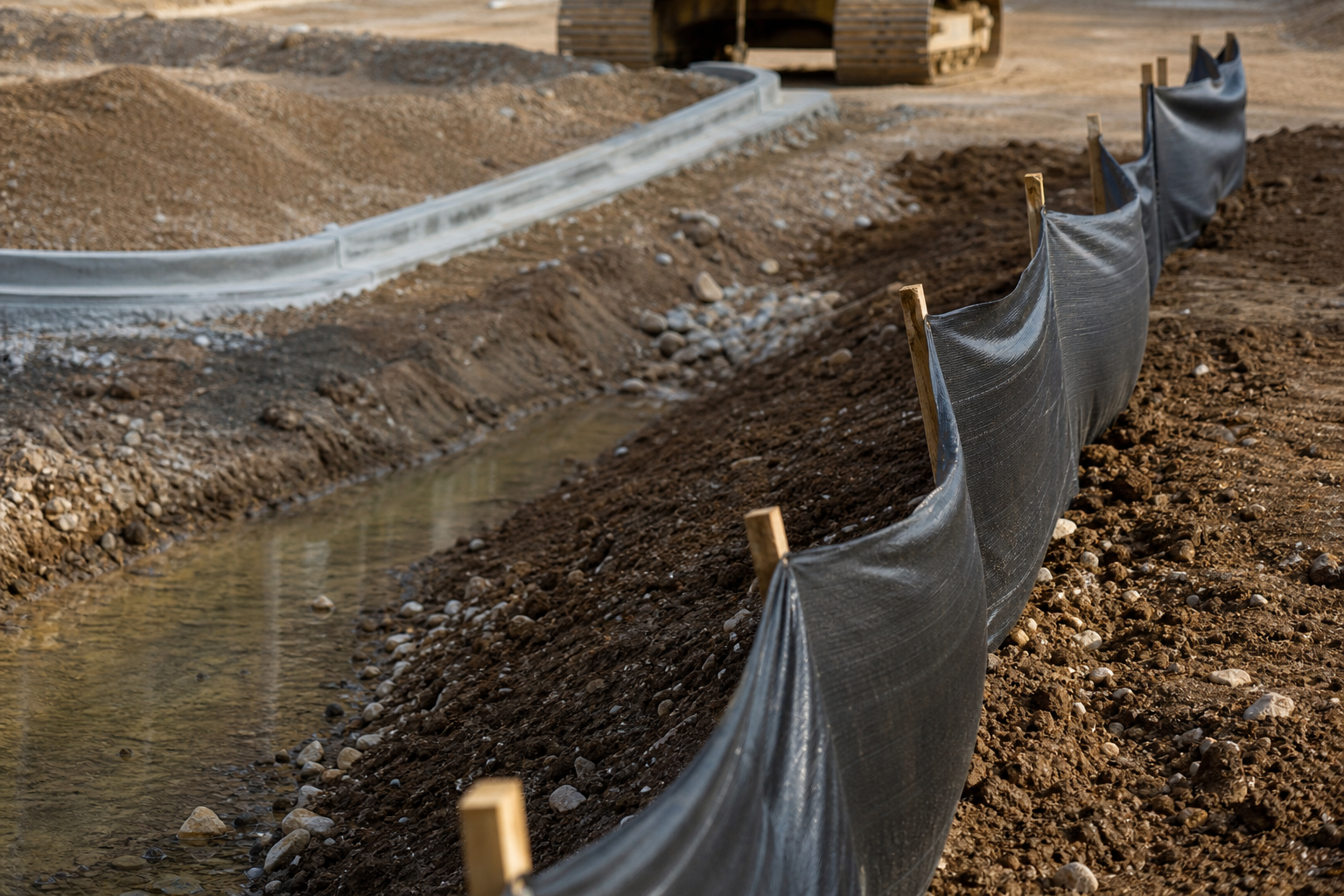
Confirm mass balance cut and fill plans, final tolerances and grade control points, compaction testing frequency, erosion and sediment control measures, dewatering methods, and sequencing to protect adjacent properties. Municipal inspection checklists commonly detail compaction test frequency, final slope limits, and temporary BMPs for review Civil Engineering Construction Inspection Checklist.
Quick erosion control checklist
- Silt fence and inlet protection installed before grading
- Staging and sediment traps in place for runoff control
- Temporary seeding or matting on exposed slopes within allowable timeframes
- Inspection logs for BMP maintenance after storms
Decision guidance
- In-house: Acceptable for small grading tasks where compaction testing and erosion controls are routine and your staff documents tests.
- Contractor: Prefer a contractor for large volume cuts or fills, complex dewatering, or where certified compaction testing and acceptance documentation are required by the municipality or GDOT.
- Hybrid: Use an earthwork contractor for heavy equipment and compaction, and virtual consulting for sequencing and permit-limit verification. DCBC LLC can deliver turnkey earthwork or provide grading plans and compaction verification services DCBC LLC.
4. Underground utilities and stormwater systems
What to check
Document pipe types and sizes, invert elevations, connection details, trenching and bedding specifications, backfill compaction, inlets, catch basins, manholes, and a hydrologic narrative with stormwater calculations. Municipal civil checklists outline inspection hold points for trenching, pipe placement, and final drainage acceptance Civil Engineering Construction Inspection Checklist.
GDOT as-built and testing notes
Record hold points for CCTV inspection, deflection testing for flexible pipes, and TV or pressure testing for sanitary lines. If the project will require GDOT as-built GIS submittals, ensure the as-built process captures horizontal and vertical accuracy to meet state requirements, and plan for GIS-ready deliverables.
Decision guidance
- In-house: Use for straightforward private utility runs with experienced crews and reliable testing equipment.
- Contractor: Choose for public utilities, highways, complex drainage networks, or where trench safety and confined space entry are present.
- Hybrid: Combine contractor installation with virtual as-built GIS submittal services to reduce rework. DCBC LLC performs HDPE and RCP installation and offers GDOT as-built GIS submittals to support closeout documentation DCBC LLC.
5. Pavement, asphalt milling and surface treatments
What to check
Verify structural section and mix design, milling limits and transition details, compaction and density acceptance, ride quality where required, surface tolerances, paint striping layout and ADA stall locations, and sealcoating schedules. Municipal checklists list paving hold points for base verification and final surface acceptance Civil Engineering Construction Inspection Checklist.
Decision guidance
- In-house: Suitable for small patching and restriping when you have certified rollers and quality control staff.
- Contractor: Essential for full-depth paving, GDOT-spec mixes, or projects where smoothness, density, and warranty documentation are required.
- Hybrid: Use a paving contractor for placement and a virtual or consulting provider for layout, stripe plans, and ADA compliance verification. DCBC LLC lists asphalt paving, milling, and paint striping among their core services DCBC LLC.
6. Final restoration, landscaping and as-built documentation

What to check
Confirm final grade verification, topsoil placement, seeding and mulching, pavement markings, wheel stops and signs, site cleanup, record drawings, and any GDOT or municipal as-built GIS submittals required for permit closeout. The NPS QA checklist and municipal inspection guidance both stress accurate record drawings and final site restoration in the closeout package Civil (Site) & Environmental Engineering QA Review Checklist Civil Engineering Construction Inspection Checklist.
Decision guidance
- In-house: Acceptable if your team will retain maintenance and can certify as-builts.
- Contractor: Let the contractor provide record drawings and warranty handoff when they performed the majority of work and accept responsibility for defects.
- Hybrid: Use contractor field closeout and retain a virtual provider to produce GDOT as-built GIS submittals and formal record drawings for future asset management. DCBC LLC offers GDOT as-built GIS submittals and project closeout documentation project management.
7. Safety, daily site controls and inspection readiness
What to check daily
Maintain a daily pre-start briefing log, public protection and traffic control measures, personal protective equipment checks, release-of-work-area documentation, permit postings, recorded hold points, daily QA/QC logs, and a punch list that addresses municipal or DOT inspector items. Industry guidance recommends a single, consolidated site checklist that covers safety, equipment readiness, and compliance to reduce OSHA and inspection exposure How to Create a Construction Site Checklist Construction site safety checklist for site managers.
Decision guidance
- In-house: Use when you have a competent site manager who can coordinate multiple trades and keep daily logs.
- Contractor: Contractor-managed safety is appropriate when the contractor controls the means and methods and will assume safety liability.
- Hybrid: Combine contractor field safety oversight with owner or third-party daily inspections to maintain transparency and documentation for inspections.
How to use this checklist and next steps
Use the seven items above as a project planning and inspection framework. For each item, create a simple three-column checklist row: the requirement, the hold point or test, and who is responsible. If you need help converting this checklist into permit-ready submittals, construction stakeout plans, GDOT as-built GIS deliverables, or turnkey site work, DCBC LLC provides hybrid services that combine field construction and virtual engineering. Visit DCBC LLC project management to start the intake process and share project documents project management.
Frequently asked questions
When should I hire a GDOT-certified contractor instead of managing site work in-house
Hire a GDOT-certified contractor when the scope touches state right-of-way, requires GDOT mix designs or encroachment permits, or when you need certified inspections and as-built GIS submittals for closeout. Certification reduces administrative risk and simplifies inspection-ready delivery. DCBC LLC advertises Georgia DOT certification and can manage GDOT compliance and documentation DCBC LLC.
What is included in a GDOT as-built GIS submittal and why does it matter
A GDOT as-built GIS submittal typically includes final horizontal and vertical alignments, as-built utilities and drainage features, structure coordinates, and attribute data formatted per GDOT requirements. Accurate as-builts are necessary for permit closeout and future maintenance, and they reduce rework for future projects.
How long do typical local and GDOT permits take in Georgia and how should I schedule them
Permit lead times vary by municipality and scope, but plan for several weeks for municipal permits and potentially longer for GDOT encroachment or traffic control approvals. Start permit identification in predesign and build permit lead times into your schedule so reviews do not delay construction.
Can I use the 7-point checklist as a daily site pre-start form
The 7-point checklist is a planning and inspection framework. Use a condensed daily pre-start checklist derived from item 7 to record daily briefings, hold points released, traffic control status, and key QC tests. Industry templates combine planning and daily safety checks for convenience How to Create a Construction Site Checklist.
What documentation should I require from a contractor at final closeout to ensure permit and inspection compliance
Require record drawings, compaction and density reports, material certifications, CCTV and pipe test reports, as-built GIS submittals if required, final erosion control sign-offs, warranty documents, and a signed acceptance checklist that references permit conditions. These items close permits and protect owners from latent defects.
Need hands-on help turning this checklist into permit-ready packages, stakeout plans, or construction execution? Contact DCBC LLC to request a quote and discuss turnkey or hybrid delivery at DCBC LLC.