
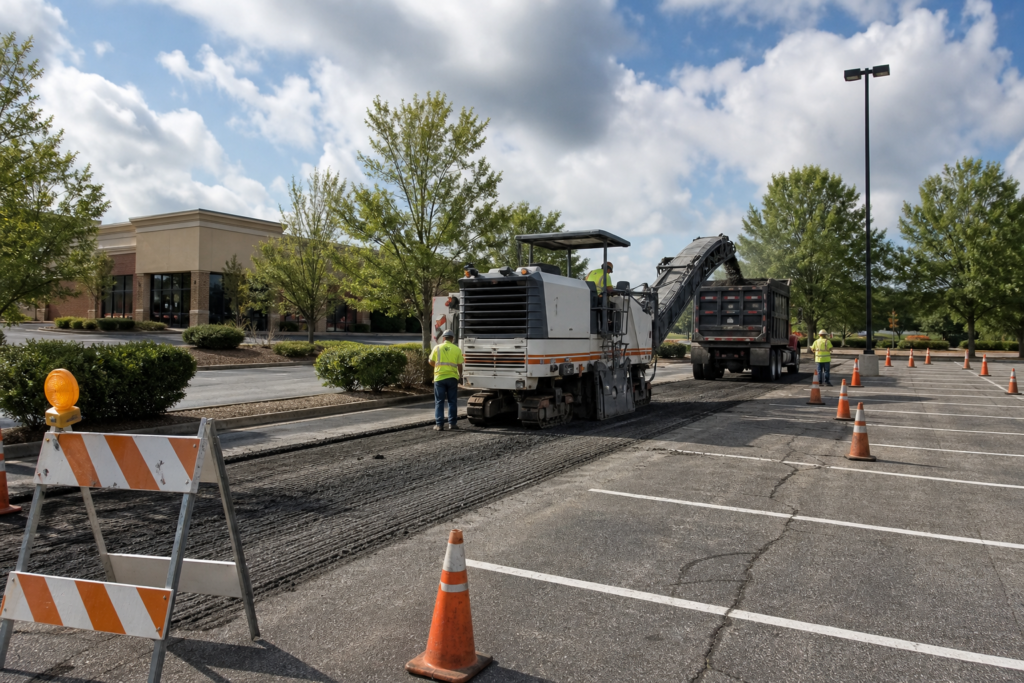
There is no reliable fixed parking lot resurfacing timeline for every property in Bethlehem, Georgia. The schedule depends on the lot’s size and layout, pavement condition, selected resurfacing method, repairs, drainage, access requirements, weather, curing, striping, and any related civil site work.
A practical schedule starts with a site assessment rather than a generic number of days. The goal is to define the work, identify dependencies, plan how people and vehicles will move through the property, and establish what must be complete before the lot reopens.
Key Takeaways
- A resurfacing-only project may have a simpler sequence than mill-and-fill work or a broader site-work package, but no method should be scheduled before pavement conditions are reviewed.
- Cracks, potholes, failed patches, standing water, grading problems, and deteriorated subgrade can add preparation, repair, drainage, or earthwork activities.
- Occupied commercial properties and public facilities may need phased closures, delivery coordination, emergency access, and a documented reopening plan.
- Striping, accessible parking, signs, wheel stops, traffic flow, and route connections should be coordinated before the final schedule is set.
- The most useful quote request includes the property location, approximate area, pavement history, visible damage, operating constraints, drainage concerns, and desired phasing.
What Controls a Parking Lot Resurfacing Schedule?
The first question is whether the pavement needs surface maintenance, resurfacing, milling and replacement, or more extensive correction. A clean-looking surface can still have drainage, grade, base, or access issues that affect the sequence. Before estimating a timeline, document the lot’s condition, high-use areas, entrances, loading zones, drive aisles, and sections where water collects.
Parking lot paving and resurfacing should also be considered alongside markings, signs, and site circulation. A scope that appears to involve asphalt alone may include parking stalls, crosswalks, accessible markings and signs, wheel stops, traffic-control changes, or repairs around structures and drainage features.
Before estimating the schedule, review the property’s pavement condition and access coordination. The same assessment can clarify whether sealcoating is appropriate maintenance or whether the pavement requires a more substantial resurfacing response. Sealcoating should not be treated as equivalent to asphalt resurfacing or mill-and-fill work.
How the Work Scope Changes the Timeline

The following comparison helps explain why two parking lots with similar apparent sizes may require different schedules. It is a planning framework, not a promise of a particular duration.
| Potential scope | What it generally involves | Schedule considerations |
|---|---|---|
| Resurfacing-only | Preparing an existing pavement surface and placing a new asphalt layer where conditions support that approach. | Still requires assessment, preparation, access planning, weather coordination, protection, and later striping or signage. |
| Mill-and-fill | Removing a defined depth of deteriorated asphalt before placing new material. | Adds milling, material removal, surface preparation, and coordination around transitions, structures, and existing grades. |
| Phased resurfacing | Completing sections in sequence so some parts of the property may remain available. | May support operations, but can add mobilization, traffic-control changes, temporary routes, and handoffs between phases. |
| Broader civil site work | Combining paving with grading, drainage, stormwater, erosion control, turn lanes, utilities, or other site improvements. | Schedule depends on the relationship between underground or earthwork activities, inspections, subgrade readiness, paving, and closeout. |
DCBC LLC lists asphalt paving and milling, parking lot paving and resurfacing, paint striping and signage, grading, stormwater systems, erosion control, and related civil site work. When several of these scopes are connected, the schedule should identify which activities must happen first and which can proceed concurrently.
Parking Lot Resurfacing Schedule Factors
Use the table below to identify the details that need to be resolved before a contractor can provide a meaningful project schedule.
| Schedule factor | How it can extend or change the work | Information that reduces uncertainty |
|---|---|---|
| Pavement condition | Widespread cracking, potholes, failed patches, raveling, or deteriorated areas may require additional preparation or repair. | Recent photographs, pavement history, repair records, and a site review showing where damage is concentrated. |
| Lot size and layout | Large areas, multiple entrances, narrow drive aisles, islands, loading zones, and irregular geometry can make sequencing more complex. | Approximate area, a site plan if available, entrances, drive aisles, loading areas, and restricted work zones. |
| Resurfacing method | An overlay, mill-and-fill, localized repair, or broader reconstruction has different preparation and coordination requirements. | The desired outcome, known pavement problems, prior overlays, and any engineering or owner specifications. |
| Drainage and grading | Standing water, inadequate slopes, damaged inlets, or runoff concerns may require drainage or grading work before paving. | Locations of ponding, drainage structures, known flooding or erosion, survey information, and existing plans. |
| Access and operations | Tenant traffic, customers, deliveries, school or public access, emergency routes, and operating hours affect closures and work windows. | Operating schedule, peak periods, delivery routes, minimum access needs, and preferred closure or phasing strategy. |
| Weather and surface conditions | Weather-sensitive work may need schedule adjustments when conditions do not support preparation, placement, marking, or protection. | Required completion constraints, seasonal operating concerns, and flexibility in the planned work window. |
| Curing and protection | The lot may need protection from traffic while newly placed materials, repairs, or markings reach the required condition. | Expected vehicle types, access restrictions, reopening responsibilities, and protection requirements. |
| Striping and signage | Parking stalls, crosswalks, accessible markings, traffic signs, and wheel stops typically follow surface work and require their own coordination. | Current layout, proposed changes, sign inventory, marking requirements, and whether materials or repairs are included. |
| Inspections and closeout | Owner, agency, or project documentation requirements can affect the final handoff and reopening sequence. | Applicable specifications, inspection responsibilities, photographs, as-built needs, and acceptance criteria. |
Planning Access for Occupied Parking Lots
A property that must remain operational needs an access plan before paving begins. Identify which entrances can close, where customers or tenants will park, how deliveries will move, and whether emergency access must remain available. The plan should also address temporary signs, pedestrian routes, barricades, and communication with occupants.
Partial access may sometimes be incorporated through phased work, but it should never be assumed. Phasing can preserve access to one area while another is closed, yet it may also add traffic-control changes, temporary transitions, repeated mobilization, and more coordination between finished and unfinished surfaces.
A Georgia public procurement example illustrates the planning principle without establishing a Bethlehem benchmark: Fayette County described a library lot that would be milled and resurfaced while two-thirds of the parking lot remained open during operating hours. The example shows that partial access can be included in a project plan when the site, scope, and operations support it. It does not establish how long another property will take or guarantee that a Bethlehem lot can remain open. Review the Fayette County project description for that specific procurement context.
Coordinate Striping, Accessibility, and Reopening
Resurfacing is not complete when asphalt placement ends. The reopening sequence may include surface protection, final inspection, parking lot striping, crosswalks, accessible markings, traffic signs, wheel stops, cleanup, and removal of temporary controls.
If resurfacing or restriping changes accessible spaces, access aisles, signs, grades, curb ramps, drainage, or the route to an entrance, review the applicable requirements before finalizing the schedule. Repainting an existing symbol does not by itself establish compliance. Project-specific requirements should be confirmed with the responsible authority or design professional.
Use this ADA-compliant parking planning guidance to coordinate accessible parking, routes, signs, grades, pavement condition, and striping with the resurfacing scope. This review is especially important for public facilities, commercial properties, and projects that alter the parking layout rather than simply restoring the existing surface.
What to Include in a Quote Request
A complete request helps a contractor distinguish a straightforward paving scope from a project that needs repairs, drainage coordination, or phased access. Include the following information:
- Property address and whether the site is in Bethlehem or another nearby Georgia location.
- Approximate parking area, number of sections, entrances, drive aisles, loading zones, and known restricted areas.
- Pavement history, including the last paving, resurfacing, milling, major repairs, or sealcoating work if known.
- Photographs or descriptions of cracks, potholes, failed patches, raveling, uneven areas, standing water, and deteriorated sections.
- Drainage, grading, erosion, inlet, catch basin, or runoff concerns that may need review before paving.
- Operating hours, tenant or customer demands, delivery schedules, emergency access needs, and preferred work windows.
- Whether partial access is required and how the property could be divided into phases.
- Existing and proposed parking stalls, crosswalks, accessible spaces, access aisles, signs, directional markings, and wheel stops.
- Related work to consider, such as grading, stormwater systems, erosion control, turn lanes, or traffic signage.
- Requested deliverables, including a site assessment, written scope, schedule assumptions, exclusions, phasing plan, closeout records, and quote.
When to Request a Site-Specific Schedule
Request a schedule after the work limits and major constraints are documented, not before. A contractor needs enough information to evaluate the pavement, select or compare the resurfacing method, identify repairs, understand access requirements, and determine whether drainage or grading affects the paving sequence.
Ask the proposal to state its assumptions. It should be clear whether preparation, repairs, milling, asphalt placement, striping, signs, wheel stops, traffic control, drainage work, testing, cleanup, and closeout are included or excluded. It should also identify what could change the schedule if concealed conditions or owner decisions alter the scope.
For a Georgia project requiring both field construction and technical coordination, DCBC LLC identifies capabilities that include parking lot paving and resurfacing, asphalt milling, grading, stormwater systems, erosion control, paint striping, signage, and wheel stop installation. Its construction and consulting model can be relevant when a project needs a coordinated civil scope, but the actual schedule still depends on the specific property and requested work.
Frequently Asked Questions
Can a parking lot remain partially open during resurfacing in Bethlehem?
Sometimes, but it depends on the lot layout, work method, safety controls, traffic demand, emergency access, and contractor’s sequencing plan. Partial access should be evaluated and documented rather than promised in advance.
Does parking lot resurfacing include striping and accessible parking updates?
It can, but inclusion varies by proposal. Ask specifically whether parking lot striping, accessible markings, signs, crosswalks, wheel stops, and layout changes are included. If accessible spaces or routes change, obtain a project-specific review of applicable requirements before work is scheduled.
How do drainage problems affect a parking lot resurfacing schedule?
Standing water or poor drainage may indicate that surface work alone will not address the underlying issue. Inlets, pipes, grading, erosion, or other stormwater work may need to be evaluated and coordinated before the final pavement scope and schedule are set.
Should a lot be repaired, milled, or resurfaced?
That decision depends on the condition and depth of deterioration, previous work, grades, drainage, traffic demands, and the intended service life of the improvement. A site assessment and clearly defined repair limits are more useful than selecting a method from photographs alone.
What information should I provide to receive a realistic resurfacing schedule?
Provide the property location, approximate area, site plan or photographs, pavement history, visible damage, drainage concerns, operating constraints, desired access plan, existing markings, accessibility needs, and any related civil work. Also state whether you want a resurfacing-only proposal or a broader coordinated scope.
Build the Schedule Around the Actual Site
The right answer to a parking lot resurfacing timeline question is not a generic number. It is a documented sequence that accounts for pavement condition, method, repairs, drainage, access, weather, protection, striping, accessibility, inspections, and reopening responsibilities.
Start by recording the lot’s current condition and operational constraints. Then ask for a site-specific scope that separates included work from assumptions and exclusions. This approach makes competing proposals easier to compare and gives the property team a clearer basis for planning closures, communications, deliveries, and reopening.
For a project in Georgia, DCBC LLC provides parking lot paving and resurfacing, asphalt milling, grading, stormwater systems, erosion control, striping, signage, and related civil site work. Request a project-specific assessment and quote rather than relying on an assumed completion timeframe.