
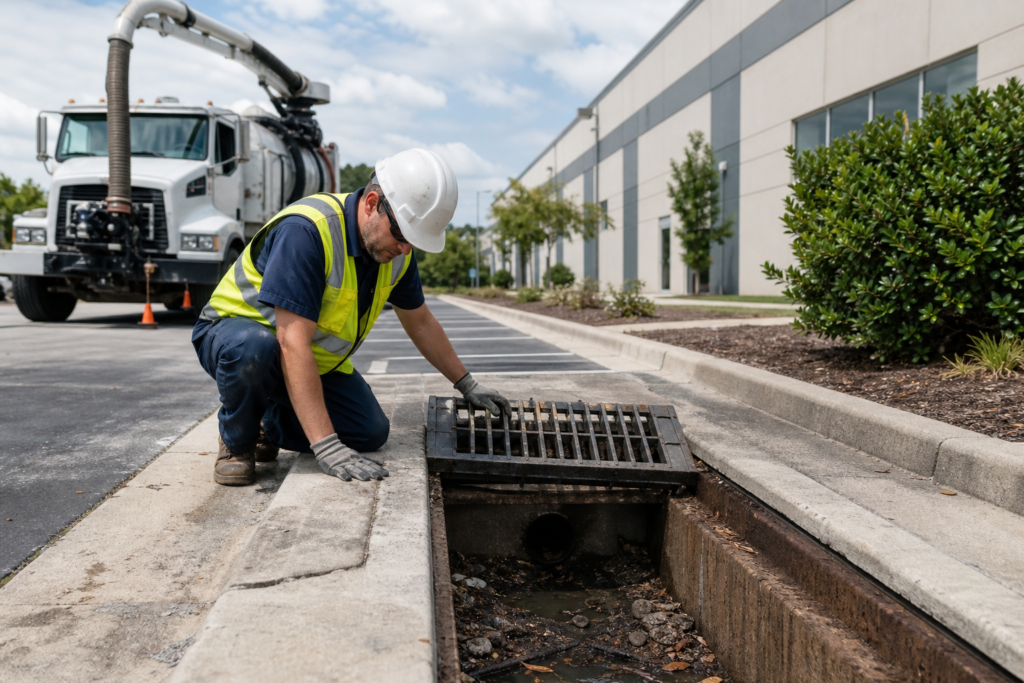
Drop inlet maintenance may involve simple debris or sediment removal, but cleaning alone is not always the right first step. If water continues to pond, the outlet does not flow properly, erosion is worsening, or the grate and structure are damaged, the inlet may need closer inspection or broader drainage evaluation.
For property owners, managers, developers, contractors, and public-works teams in Bethlehem, the key decision is whether the problem is limited to the inlet or connected to grading, upstream erosion, stormwater pipes, or another structure. DCBC LLC lists drop inlets, catch basins, stormwater systems, roadway crossings, and erosion-control measures among its civil site work capabilities, but the correct scope still depends on site conditions and responsibilities.
Key Takeaways
- Check the grate, frame, inlet walls, sediment, debris, outlet flow, surrounding grade, erosion, and access conditions before scheduling work.
- Routine cleaning may suit isolated debris or sediment. Recurring ponding or structural damage calls for closer evaluation.
- Do not block an overflow path or remove inlet protection without considering upstream erosion, flow concentration, traffic, and safe maintenance access.
- Confirm who owns the structure, what records or permits apply, and whether it serves private property, a roadway, or a public drainage system.
- Document conditions with photographs and a written scope so cleaning, repairs, disposal, traffic control, and follow-up responsibilities are clear.
What drop inlet maintenance should cover
A drop inlet is one part of a connected drainage system. Effective maintenance should look beyond the grate and consider the inlet box, connected pipe, outlet, nearby grades, upstream sediment sources, and the path water takes during ordinary and heavier rainfall.
The work discussion should address visible debris, sediment accumulation, vegetation, standing water, damaged grates or frames, inlet-wall condition, outlet performance, and safe access. It should also establish whether photographs, inspection notes, disposal records, or other closeout documentation are needed.
Georgia DOT’s Stormwater System Inspection and Maintenance Manual provides reference material for GDOT stormwater systems and related drainage or water-quality structures. It does not automatically determine requirements for every privately owned or locally managed inlet.
Cleaning, inspection, or repair planning: which do you need?

Use the condition of the inlet and the pattern of the problem to decide the next step. This comparison is a planning aid, not a substitute for a site-specific assessment.
| What you observe | Likely next step | Why it matters |
|---|---|---|
| Leaves, trash, or manageable sediment with no visible structural damage | Routine cleaning and condition documentation | Removing the obstruction may restore the opening, but outlet flow should still be considered. |
| Slow drainage, standing water, heavy sediment, or vegetation inside the structure | Closer inspection with cleaning as appropriate | The visible material may accompany a blocked connection, damaged component, or upstream source. |
| Broken grate, shifted frame, cracked structure, undermining, exposed pipe, or unsafe access | Repair planning and safety controls | Cleaning does not correct structural or access hazards. |
| Recurring ponding, erosion, washouts, or sediment returning soon after cleaning | Broader drainage evaluation | The cause may involve grading, concentrated flow, pipe capacity, upstream erosion, or another structure. |
Maintenance mistakes that can hide larger drainage problems
Removing debris without checking outlet flow
An open grate does not prove that the system is functioning. After visible material is removed, consider whether water can leave the structure as expected and whether the outlet, connected pipe, or downstream structure appears obstructed. Do not enter a confined structure or perform hazardous work without appropriate procedures and qualified personnel.
Ignoring upstream erosion and sediment sources
If sediment repeatedly reaches the inlet, cleaning treats the symptom rather than the source. Bare slopes, unprotected soil, construction activity, poor drainage paths, or eroded shoulders can continue sending material downstream. Georgia EPD identifies the Georgia Stormwater Management Manual and other best-management-practice resources as relevant references for Georgia stormwater management.
Where construction activity is involved, review inlet protection best practices before changing a device or its placement. Inlet protection is a secondary sediment control, not a replacement for upstream erosion and sediment controls, and it must not create an unsafe or damaging overflow condition.
Blocking a safe overflow path
A device that traps sediment can also restrict flow if it is poorly selected, overloaded, displaced, or installed in the wrong location. Consider the inlet configuration, contributing drainage area, flow concentration, available ponding space, traffic exposure, and maintenance access before selecting or replacing protection.
Treating recurring ponding as a cleaning issue
Repeated ponding after cleaning may indicate low spots, settlement, blocked or damaged pipes, inadequate outlet conditions, a changed drainage path, or flow arriving faster than the inlet can safely accept. Document the pattern and investigate the connected system rather than scheduling identical cleanings indefinitely.
Failing to document conditions
Photographs before and after work, notes on blockage, weather observations, and dates of recurring problems can help distinguish an isolated event from a persistent condition. Documentation also clarifies responsibility when several owners, contractors, or agencies share a drainage network.
A practical drop inlet inspection checklist
Before requesting drop inlet maintenance in Bethlehem, gather the following information. Do not open, enter, or clean a structure if doing so would expose anyone to traffic, confined-space, contaminated-water, unstable-ground, or other hazards.
- Ownership and location: Identify the property, inlet location, access route, and party authorizing work.
- Grate and frame: Look for missing, broken, displaced, corroded, or unsafe components.
- Visible blockage: Record trash, leaves, sediment, vegetation, construction material, or other obstructions.
- Interior condition: Where safe and permitted, note visible cracks, damaged walls, undermining, standing water, or unusual deposits. A visual check is not a structural certification.
- Outlet and downstream flow: Record slow drainage, backflow, unusual ponding, or signs that water cannot move through the system.
- Surrounding grade: Check for settlement, low areas, pavement directing water incorrectly, exposed soil, washouts, or water flowing around the inlet.
- Erosion and sediment sources: Note nearby slopes, construction areas, unprotected soil, eroded shoulders, and failing erosion controls.
- Access and safety: Identify traffic, narrow shoulders, unstable ground, gates, overhead hazards, and traffic-control needs.
- History: Gather prior cleaning dates, photographs, plans, complaints, flooding observations, and repair records.
When the inlet is only a symptom of a larger site problem
Repeated inlet problems can be connected to the broader civil site. Grading may direct too much water toward one location, a slope may be shedding sediment, a pipe or catch basin may be obstructed, or a roadway crossing may be affecting the flow path.
For properties requiring broader drainage evaluation, civil site work in Bethlehem connects inlet maintenance with grading, stormwater strategy, erosion controls, utility coordination, and site sequencing. This broader view is particularly relevant when cleaning provides only temporary improvement or several structures show related symptoms.
DCBC LLC lists stormwater systems and erosion-control measures alongside drop inlets, catch basins, flumes, spillways, manholes, slope drains, roadway crossings, HDPE pipe, reinforced concrete pipe, and ductile iron pipe. These components are not interchangeable, and repairs or redesigns should follow applicable plans, ownership requirements, and project-specific technical direction.
Questions to ask before scheduling work in Bethlehem
- Who owns and maintains the inlet and connected drainage system?
- Does it serve private property, a construction project, a roadway, or a public drainage system?
- Are there plans, easements, inspection records, permits, maintenance agreements, or closeout documents defining responsibilities?
- Is the concern isolated to debris, or are ponding, erosion, sediment recurrence, or outlet-flow problems also present?
- Who provides access, traffic control, equipment, disposal, repairs, photographs, and follow-up documentation?
- What work is excluded, such as pipe repairs, structural replacement, grading, erosion control, or engineering review?
Georgia EPD identifies stormwater permits and the Georgia Stormwater Management Manual as relevant regulatory and technical references, while the GDOT manual applies specifically to GDOT stormwater-system inspection and maintenance guidance. Requirements can depend on ownership, permit status, design, and project conditions.
How to evaluate a contractor or site-work partner
A useful proposal should state whether it includes inspection, debris or sediment removal, outlet-flow observations, structural concerns, erosion-control coordination, access and traffic controls, disposal, photographs, and follow-up recommendations. It should identify assumptions and exclusions instead of implying that cleaning will resolve every drainage concern.
Ask how the contractor will coordinate the inlet with surrounding grading, pipes, catch basins, manholes, roadway crossings, and erosion controls. DCBC LLC presents itself as a Georgia-based civil site work and roadway construction contractor with construction and consulting capabilities, including stormwater and related site-work services. Its listed consulting services include construction stakeout plans, three-point level verification, roadway grade calculations, GDOT as-built GIS submittals, and estimation and takeoff.
For a larger project, compare site work contractor selection questions that clarify limits of work, drainage interfaces, testing, inspection support, documentation, and closeout responsibilities.
Know the limits of general maintenance guidance
This article can help organize observations and questions, but it cannot determine the structural condition of a specific inlet, interpret a permit, confirm compliance, or approve a repair. Ownership, drainage design, site conditions, applicable plans, and the responsible authority determine the proper approach.
If the inlet is near traffic, shows structural damage, receives concentrated flow, or requires entry into a confined space, use qualified personnel and appropriate safety procedures. During active construction, coordinate maintenance with the project’s erosion and sediment controls rather than changing one device in isolation.
FAQ
How often should a drop inlet be inspected in Bethlehem?
There is no single schedule for every Bethlehem property. Frequency depends on ownership, site use, construction activity, sediment exposure, storms, drainage performance, and applicable requirements. Inspect sooner when ponding, erosion, blockage, or damage appears.
What is the difference between drop inlet cleaning and catch basin maintenance?
The structures and connected systems may differ by project. Cleaning generally means removing debris or sediment, while maintenance may also include condition checks, outlet review, access concerns, documentation, and repair recommendations. Confirm the structure type and scope from plans or a qualified assessment.
What should I do if a drop inlet keeps ponding after cleaning?
Record when ponding occurs, how long it lasts, whether nearby inlets are affected, and how water moves. Persistent ponding warrants inspection of the outlet, connected drainage, surrounding grades, settlement, and upstream flow rather than repeated cleaning alone.
Should erosion around a drop inlet be addressed during maintenance?
It should at least be documented and considered in the scope. Erosion can undermine the inlet, redirect water, carry sediment into the structure, or indicate that upstream controls and grading need attention.
What information should I provide when requesting a maintenance quote?
Provide the location, structure photos, access limitations, observed symptoms, recent cleaning or storm history, available plans, ownership information, and whether the inlet serves a roadway, private property, or construction site. Ask the contractor to separate cleaning, inspection, repair planning, disposal, traffic control, documentation, and broader drainage evaluation.
Conclusion: Check the system before choosing the scope
Routine debris or sediment removal may be appropriate when the inlet is accessible, structurally sound, and not showing wider drainage symptoms. Recurring ponding, returning sediment, erosion, damaged components, poor outlet flow, or unsafe access should move the decision toward closer inspection or broader drainage planning.
Before requesting work in Bethlehem, document the inlet and surrounding site, confirm ownership and applicable requirements, and ask for a scope that separates cleaning from repairs or civil site work. DCBC LLC provides civil site work, stormwater, erosion-control, roadway, and related construction and consulting services in Georgia. To discuss a site-specific scope or request a quote, contact DCBC LLC.